Blog
Jindal Aluminium Flat Bars: Sizing Schedule, Weight Chart & Busbar Fabrication Guide
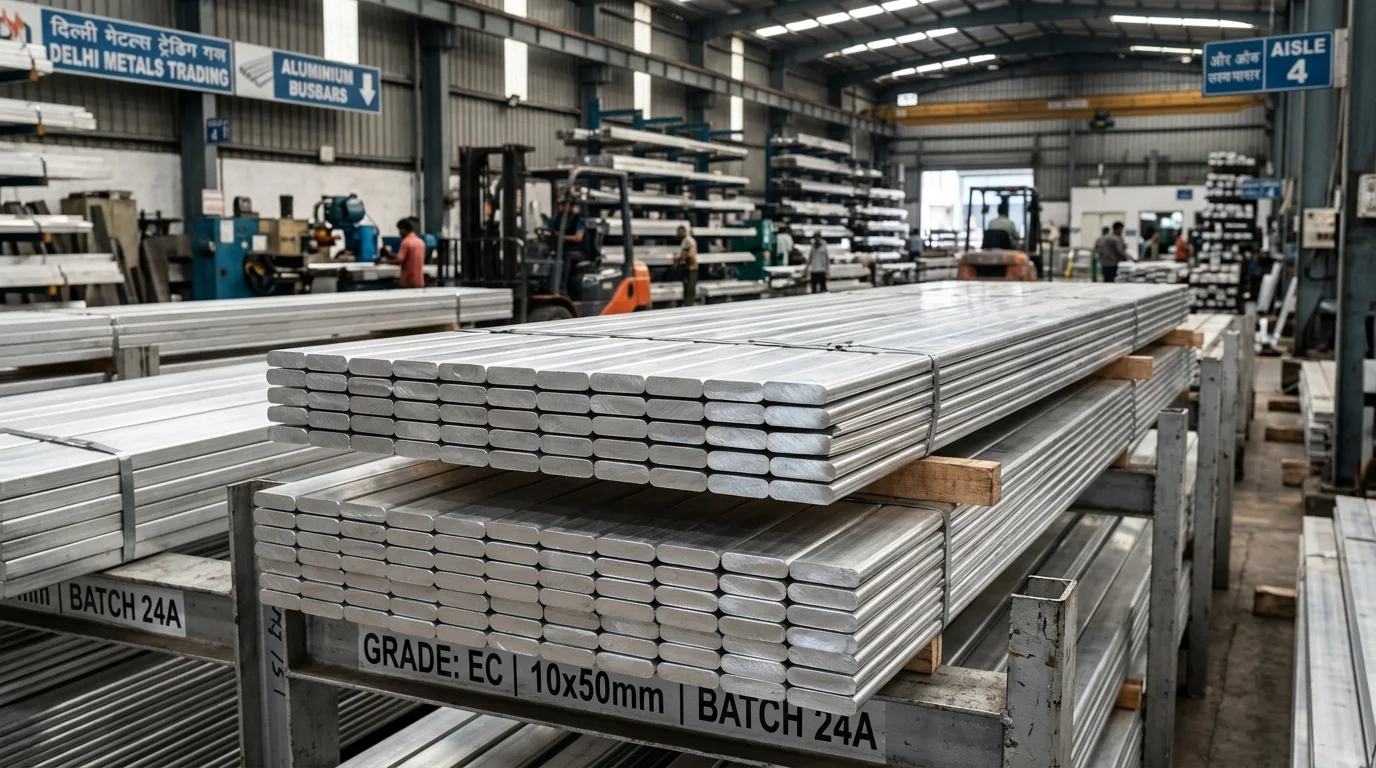
In electrical switchgear manufacturing, industrial machine building, architectural metalcraft, and automotive bracket fabrication, solid extruded aluminium flat bars represent one of the most versatile and widely procured raw material forms. Combining high electrical and thermal conductivity with uniform flat parallelism, high shear strength, and rust-free longevity, aluminium flat bars serve dual engineering roles: carrying heavy electrical currents as high-capacity busbars in substations, while simultaneously acting as high-rigidity structural mounting plates and fixture bases in mechanical machine shops.
However, procuring flat bars for precision projects demands a clear understanding of edge geometry (sharp edges vs. fully radiused edges per IS 5082 standards), bending physics (flatwise vs. edgewise bending radii to prevent edge cracking), theoretical weight calculation equations, and alloy selection across EC Grade 1350, 6101-T6, 6061-T6, and 6082-T6. Sourcing genuine extrusions manufactured by Jindal Aluminium Limited guarantees strict dimensional tolerances, zero porosity, and verified conductivity ratings.
Curated by the technical sales desk at Premier Aluminium Traders—authorized distributor and stockist of Jindal Aluminium Limited in Paharganj, New Delhi since 1978—this authoritative commercial and workshop guide delivers verified flat bar weight schedules, busbar bending parameters, electrical current sizing rules of thumb, and wholesale sourcing guidance for fabricators across North India.
1. Sharp Edge vs. Radiused Edge (Form B): The Electrical & Mechanical Difference
Extruded aluminium flat bars are manufactured with two distinct edge configurations, each tailored to specific engineering environments:
        SQUARE FLAT BAR (Sharp 90° Edge)          FULL RADIUSED FLAT BAR (Form B / IS 5082)
        +-----------------------------------+     .-----------------------------------.
        |                                   |    /                                     \
        |         Width (W)                 |   |              Width (W)                |
        |                                   |    \                                     /
        +-----------------------------------+     '-----------------------------------'
                 Thickness (T)                             Radius r = T/2 at Both Edges
1. Square Edge Flat Bars (Sharp 90° Corners)
- Geometry: Sharp right-angle corners ($90^\circ$) across all four edges.
- Primary Applications: CNC machine fixturing plates, structural machine brackets, architectural decorative trims, staircase balustrade spacers, and general welding assemblies where flat face-to-face squaring is essential.
2. Full Radiused Edge Flat Bars (Form B / IS 5082)
- Geometry: Features semicircular fully rounded edges ($r = T/2$) along both lateral sides.
- Primary Applications: Electrical busbars in LT/HT switchgear panels, power transformer tap-off connectors, motor control centers (MCC), and battery energy storage busbars.
- Why Radiused Edges Are Critical in Electrical Panels: In medium- and high-voltage electrical installations ($>415\text{ V}$), sharp corners create concentrated electric field gradients that trigger localized corona discharge, ozone generation, and dielectric insulation breakdown. Semicircular rounded edges distribute electrical potential uniformly, completely mitigating corona losses and preventing insulation jacket puncture.
2. Universal Weight Calculation Formula for Aluminium Flat Bars
Aluminium raw materials are traded commercially on an actual weight basis (₹/kg). Fabricators and cost estimators can compute theoretical weight per meter using this universal formula:
$$\text{Weight per Meter } (kg/m) = W \times T \times 0.00270$$
Where:
- $W$ = Width of the flat bar in millimeters ($mm$)
- $T$ = Thickness of the flat bar in millimeters ($mm$)
- $0.00270$ = Metallurgical density factor of high-purity aluminium ($g/cm^3$)
(For Form B full radiused busbar flats, the theoretical weight is fractionally lighter by ~0.8% due to the corner radii, but $W \times T \times 0.00270$ remains the universal commercial standard).
Worked Workshop Example: 100 mm x 10 mm Flat Bar
------------------------------------------------
- Width W = 100 mm
- Thickness T = 10 mm

Calculation:
Weight (kg/m) = 100 * 10 * 0.00270
Weight (kg/m) = 1000 * 0.00270
Weight (kg/m) = 2.700 kg/meter

For a standard 12-foot (3.657 meter) bar:
Total Bar Weight = 2.700 * 3.657 ≈ 9.87 kg
3. Jindal Aluminium Flat Bar Sizing & Weight Reference Schedule
Below is the verified engineering reference chart for standard extruded aluminium flat bars, correlating width, thickness, weight per meter, and standard engineering applications:
| Width $W$ (mm) | Thickness $T$ (mm) | Inch Equivalent | Theoretical Weight ($kg/m$) | Weight per 12-ft Bar ($kg$) | Primary Industrial Applications |
|---|---|---|---|---|---|
| $20.0\text{ mm}$ | $3.0\text{ mm}$ | $\approx 3/4" \times 1/8"$ | $0.162\text{ }kg/m$ | $0.59\text{ }kg$ | Light earth grounding strip, decorative trim |
| $25.0\text{ mm}$ | $3.0\text{ mm}$ | $1" \times 1/8"$ | $0.203\text{ }kg/m$ | $0.74\text{ }kg$ | Control cabinet earth bar, small brackets |
| $25.0\text{ mm}$ | $5.0\text{ mm}$ | $\approx 1" \times 3/16"$ | $0.338\text{ }kg/m$ | $1.24\text{ }kg$ | Low-current busbar (up to 150A), clamps |
| $25.4\text{ mm}$ | $6.35\text{ mm}$ | $1" \times 1/4"$ | $0.435\text{ }kg/m$ | $1.59\text{ }kg$ | Machine mounting plate, fixture stop blocks |
| $30.0\text{ mm}$ | $5.0\text{ mm}$ | $\approx 1-3/16" \times 3/16"$ | $0.405\text{ }kg/m$ | $1.48\text{ }kg$ | Industrial grounding grid, shelf supports |
| $38.1\text{ mm}$ | $6.35\text{ mm}$ | $1-1/2" \times 1/4"$ | $0.653\text{ }kg/m$ | $2.39\text{ }kg$ | 250A electrical panel busbar, tooling rail |
| $50.0\text{ mm}$ | $5.0\text{ mm}$ | $2" \times 5mm$ | $0.675\text{ }kg/m$ | $2.47\text{ }kg$ | 300A busbar, structural facade bracket |
| $50.8\text{ mm}$ | $6.35\text{ mm}$ | $2" \times 1/4"$ | $0.871\text{ }kg/m$ | $3.18\text{ }kg$ | 400A panel busbar, robotic base rail |
| $50.0\text{ mm}$ | $10.0\text{ mm}$ | $2" \times 10mm$ | $1.350\text{ }kg/m$ | $4.94\text{ }kg$ | 630A high-capacity busbar, mold base clamp |
| $50.8\text{ mm}$ | $12.7\text{ mm}$ | $2" \times 1/2"$ | $1.742\text{ }kg/m$ | $6.37\text{ }kg$ | Heavy CNC milling stock, hydraulic manifold base |
| $75.0\text{ mm}$ | $6.0\text{ mm}$ | $3" \times 6mm$ | $1.215\text{ }kg/m$ | $4.44\text{ }kg$ | 600A busbar distribution, structural cleats |
| $75.0\text{ mm}$ | $10.0\text{ mm}$ | $3" \times 10mm$ | $2.025\text{ }kg/m$ | $7.41\text{ }kg$ | 800A switchboard main busbar, press plates |
| $100.0\text{ mm}$ | $6.0\text{ mm}$ | $4" \times 6mm$ | $1.620\text{ }kg/m$ | $5.92\text{ }kg$ | 800A distribution busbar, facade floor bracket |
| $100.0\text{ mm}$ | $10.0\text{ mm}$ | $4" \times 10mm$ | $2.700\text{ }kg/m$ | $9.87\text{ }kg$ | 1250A main LT panel busbar, transformer link |
| $100.0\text{ mm}$ | $12.7\text{ mm}$ | $4" \times 1/2"$ | $3.484\text{ }kg/m$ | $12.74\text{ }kg$ | 1600A heavy feeder bar, high-load tooling |
| $125.0\text{ mm}$ | $10.0\text{ mm}$ | $5" \times 10mm$ | $3.375\text{ }kg/m$ | $12.34\text{ }kg$ | 1600A - 2000A industrial substation busbar |
| $150.0\text{ mm}$ | $10.0\text{ mm}$ | $6" \times 10mm$ | $4.050\text{ }kg/m$ | $14.81\text{ }kg$ | 2000A generator incomer bar, power plants |
| $150.0\text{ mm}$ | $12.7\text{ mm}$ | $6" \times 1/2"$ | $5.226\text{ }kg/m$ | $19.11\text{ }kg$ | 2500A heavy power station busbar trunking |
| $200.0\text{ mm}$ | $12.0\text{ mm}$ | $8" \times 12mm$ | $6.480\text{ }kg/m$ | $23.70\text{ }kg$ | 3200A jumbo busbar, industrial cathode bars |
| $200.0\text{ mm}$ | $25.0\text{ mm}$ | $8" \times 1"$ (Jumbo) | $13.500\text{ }kg/m$ | $49.37\text{ }kg$ | Jumbo electrical smelting bus, press bolsters |
4. Busbar Fabrication: Bending, Punching & Joint Prep Rules
When fabricating electrical busbars or structural brackets from aluminium flat bars in the workshop:
        FLATWISE BENDING (Easy Way)                 EDGEWISE BENDING (Hard Way)
        +-----------------------------------+        |   |
        |                                   |        |   |
        +-----------------------------------+        |   | Width W
                     ^ Bending Force                 |   |
        Minimum Radius: R = 1.0 to 1.5 x T           +---+ Thickness T
        Safe, crack-free on hydraulic benders        Minimum Radius: R = 2.0 to 3.0 x W
1. 90° Flatwise Bending (The Easy Way)
- Bending across the flat face of the bar.
- Rule of Thumb: Minimum inside bend radius must be at least $1.0 \times \text{thickness}$ for soft EC Grade (1350) and $1.5\text{ to }2.0 \times \text{thickness}$ for fully aged 6101-T6 or 6082-T6. Bending sharper than $1.0T$ risks tensile surface micro-cracking on the outer bend radius.
2. Edgewise Bending (The Hard Way)
- Bending along the narrow thickness edge of the bar.
- Extreme compression occurs on the inside edge while severe tension stretches the outer edge. Use an inside bend radius of at least $2.0\text{ to }3.0 \times \text{bar width}$. Always apply dedicated bending lubricants to prevent outer flange thinning.
3. Joint Overlap & Bolting Pressure
- Contact Area Rule: Overlap electrical busbar joints by at least $1.0 \times \text{bar width}$ to ensure contact area resistance is lower than the solid bar's bulk resistance.
- Surface Preparation: Always lightly abrade aluminium joint contact faces with a non-metallic Scotch-Brite pad to remove natural oxide, apply electrical joint compound (penetrox/contact grease), and torque high-tensile Grade 8.8 galvanized or stainless steel bolts using Belleville conical spring washers to maintain constant clamping pressure through thermal expansion cycles.
5. Alloy Selection: Electrical EC Grade vs. Structural 6082-T6
| Engineering Parameter | EC Grade 1350 (Pure Aluminium) | High-Strength Electrical 6101-T6 | Heavy Structural 6082-T6 |
|---|---|---|---|
| Primary Specialty | Maximum electrical conductivity | High short-circuit dynamic strength | Maximum mechanical load & tooling |
| Electrical Conductivity | $\ge 61.0%\text{ IACS}$ (Highest) | $\ge 55.0%\text{ IACS}$ | $40.0% - 44.0%\text{ IACS}$ |
| Yield Strength (0.2% Proof) | Soft ($40 - 70\text{ }MPa$) | $\ge 215\text{ }MPa$ (High) | $\ge 260\text{ }MPa$ (Maximum) |
| Tensile Strength (UTS) | $80 - 100\text{ }MPa$ | $\ge 240\text{ }MPa$ | $\ge 310\text{ }MPa$ |
| Short-Circuit Fault Withstand | Low (flats can distort under fault surge) | Exceptional (resists magnetic warping) | Exceptional |
| CNC Machinability & Threading | Gummy; poor for fine threads | Good | Pristine chip breaking & tight threads |
| Recommended Application | Flexible grounding, transformers | HT/LT switchboards, MCC panels | Fixtures, tooling plates, machinery |
6. Sourcing Jindal Aluminium Flat Bars at Premier Aluminium Traders
Premier Aluminium Traders is North India’s premier authorized dealer and stockist of Jindal Aluminium Limited flat bars and busbars:
- Comprehensive Inventory in Paharganj: Ready stock of flat bars from $20 \times 3\text{ mm}$ up to $200 \times 25\text{ mm}$ in both sharp square edge and Form B radiused edge specifications.
- Primary Billet Assurance: 100% extruded from certified primary alloy billets, ensuring maximum electrical conductivity, zero inclusions, and complete structural reliability.
- Factory Mill Test Certificates (MTC): Verified chemical purity, electrical conductivity (% IACS), and tensile yield strength reports accompanying dispatches.
- Value-Added Processing: Precision bundle cutting, CNC hole punching, and custom electro-tin plating ($8 - 12\text{ }\mu m$) for direct copper equipment connections.
Explore our full commercial product catalog:
- Jindal Aluminium Flat Bars
- Jindal Aluminium Rods & Bars
- Aluminium Busbars vs Copper Busbars Sizing Guide
- Jindal Extrusions Complete Catalog
7. Frequently Asked Questions (FAQs)
1. What is the current carrying capacity of aluminium busbars?
As a standard engineering rule of thumb for ambient temperatures in India ($40^\circ C$), calculate aluminium busbar ampacity at $0.8\text{ to }1.0\text{ Amps per }mm^2$ of cross-sectional area for natural air cooling. For example, a $100 \times 10\text{ mm}$ flat bar ($1000\text{ }mm^2$ area) safely carries approximately $800\text{ to }1000\text{ Amps}$ under standard enclosure ventilation.
2. Why is tin plating recommended for aluminium busbars?
Electro-tin plating ($8\text{ to }12\text{ }\mu m$) prevents atmospheric oxidation on aluminium contact surfaces and completely eliminates galvanic corrosion when connecting aluminium busbars directly to copper circuit breaker terminals.
3. What is the standard commercial bar length for Jindal flat bars?
Standard commercial extruded lengths are 12 feet (3.657 meters). For high-volume panel builders and busduct manufacturers, custom extruded lengths up to 16 or 20 feet can be supplied upon request.
4. Which alloy is best for CNC milling fixtures: 6061-T6 or 6082-T6?
Both 6061-T6 and 6082-T6 offer exceptional CNC machinability. Alloy 6082-T6 delivers slightly higher hardness (100 HB vs. 95 HB) and higher yield strength, making it especially resistant to thread stripping and deformation under high clamping bolt torques.
5. Where can I buy certified Jindal aluminium flat bars in Delhi NCR?
Genuine Jindal Aluminium flat bars and electrical busbars are available directly from Premier Aluminium Traders, located at 3/8, D.B. Gupta Road, Paharganj, New Delhi - 110055 (Phone: +91-9891097111 / 011-41657680), with same-day loading and fast delivery across Delhi NCR, Haryana, Uttar Pradesh, and Rajasthan.