Blog
Aluminium U-Channel & C-Channel Profiles: Glass Balustrade, Partition & Sizing Weight Chart Guide
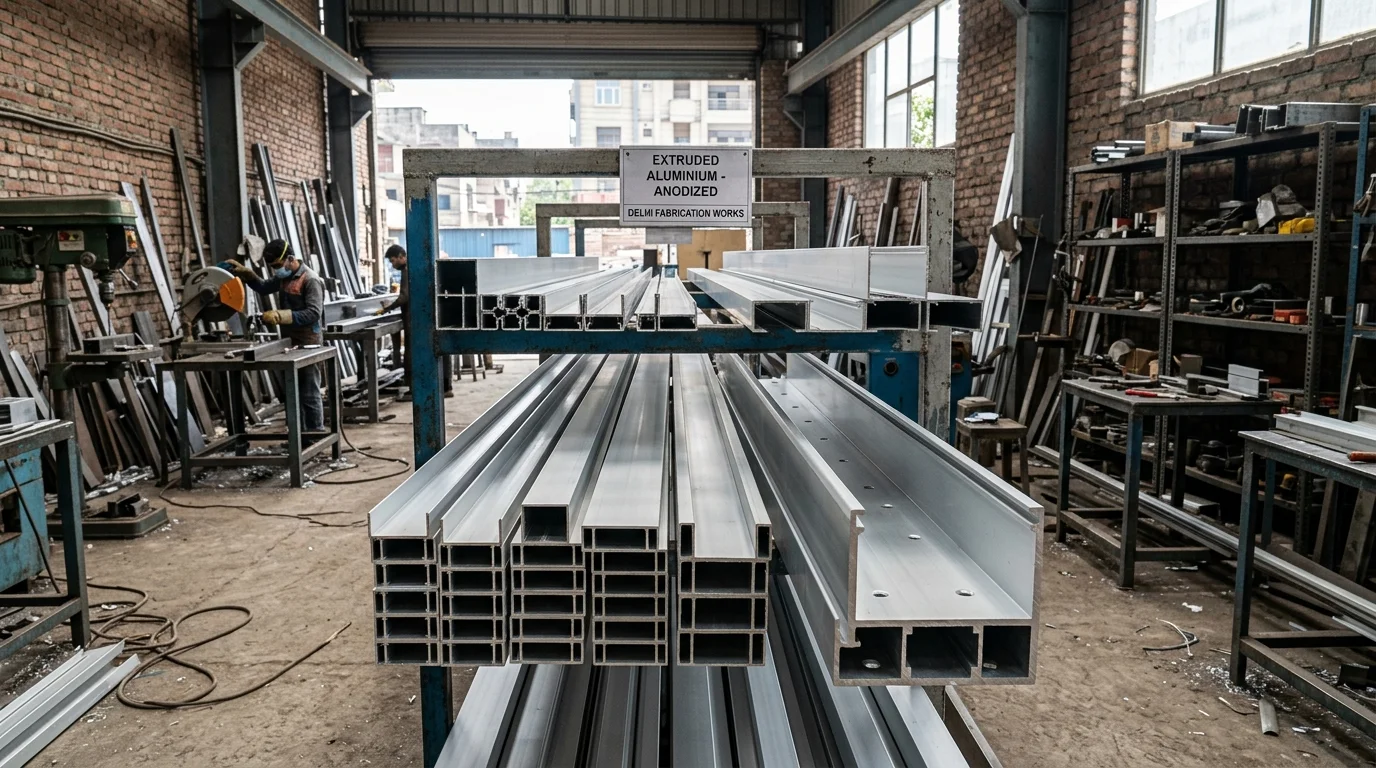
In architectural glass installations, commercial interior partitions, sliding door track assemblies, and industrial framing systems, extruded aluminium U-channels and C-channels are indispensable structural components. Sized to provide precision internal pocket clearance, continuous edge retention, and high torsional rigidity, these channel profiles protect delicate glass edges while creating seamless minimalist sightlines favored in contemporary architecture.
Whether designing heavy-duty base shoe channels anchored into reinforced concrete to support frameless 12mm or 15mm toughened glass balustrades, framing demountable acoustic glass walls in corporate offices, or routing cable trays in electrical switchgear enclosures, selecting the correct channel profile requires understanding channel geometry, web-to-flange thickness ratios, and theoretical weight per meter per IS 733 / IS 1285 standards.
Curated by the architectural glazing and metals desk at Premier Aluminium Traders—authorized distributor and stockist of Jindal Aluminium Limited in Paharganj, New Delhi since 1978—this practical guide examines U-channel vs. C-channel structural mechanics, weight calculation equations, standard size charts, glass balustrade installation guidelines, and wholesale procurement across North India.
1. U-Channel vs. C-Channel: Structural Differences & Applications
While often used interchangeably in colloquial trade discussions, U-channels and C-channels possess distinct structural configurations designed for specific engineering tasks:
        STANDARD U-CHANNEL (Architectural)          STRUCTURAL C-CHANNEL (With Lips)
          +-------+         +-------+                     +-----------+     +-----------+
          |       |         |       |                     |  Return   |     |  Return   |
          |       |         |       |                     |  Lip (c)  |     |  Lip (c)  |
          |       |         |       |                     +-------+   |     |   +-------+
    Leg H |       |         |       |               Leg H |       |   |     |   |
          |       |         |       |                     |       |   +-----+   |
          |       |         |       |                     |       |             |
          |       +---------+       |                     |       +-------------+
          +-------------------------+                     +---------------------+
                 Base Web (W)                                  Base Web (W)
1. Standard Architectural U-Channels
- Geometry: Features a flat base web ($W$) and two parallel perpendicular vertical legs ($H$) forming an open, clean channel with no inward lips.
- Primary Uses:
- Frameless Glass Balustrades: Heavy base shoes anchored to floor slabs to hold 12mm, 15mm, or 19mm toughened safety glass.
- Office Partitions: Top and bottom perimeter glazing channels for single- and double-glazed demountable glass partition systems.
- Edge Trims & Tile Trims: Protecting raw edges of plywood, compact laminate sheets, and stone vanity tops.
2. Structural C-Channels (Lipped Channels)
- Geometry: Features an open channel with short inward-facing return lips ($c$) along the top edges of the flanges.
- Primary Uses:
- Solar Purlins & Industrial Racks: The inward return lips accept spring-loaded channel nuts (Unistrut type), allowing hardware to be bolted securely anywhere along the channel length without drilling.
- Sliding Door Headers: Enclosed overhead tracks carrying wheeled nylon hanger rollers for commercial sliding doors.
- Conveyor Side Guides: High-rigidity guide rails for packaging lines and automation conveyors.
2. Universal Weight Calculation Formula for Aluminium Channels
In commercial B2B procurement across Delhi NCR, aluminium extrusions are priced based on actual physical weight. Estimators and fabricators calculate theoretical weight per meter using the volumetric equation:
$$\text{Weight per Meter } (kg/m) = \left[ W + 2 \times (H - t) \right] \times t \times 0.00270$$
Where:
- $W$ = Overall outside base width in millimeters ($mm$)
- $H$ = Overall outside flange / leg height in millimeters ($mm$)
- $t$ = Nominal wall thickness in millimeters ($mm$)
- $0.00270$ = Density of high-purity extruded aluminium ($g/cm^3$)
Worked Workshop Example: 50 x 25 x 3 mm U-Channel
-------------------------------------------------
- Base Width W = 50.8 mm
- Leg Height H = 25.4 mm
- Wall Thickness t = 3.0 mm

Calculation:
Weight (kg/m) = [50.8 + 2 * (25.4 - 3.0)] * 3.0 * 0.00270
Weight (kg/m) = [50.8 + 44.8] * 3.0 * 0.00270
Weight (kg/m) = 95.6 * 3.0 * 0.00270
Weight (kg/m) ≈ 0.774 kg/meter

For a standard 12-foot (3.657 meter) commercial bar:
Total Bar Weight = 0.774 * 3.657 ≈ 2.83 kg
3. Jindal Aluminium Channel Sizing & Weight Reference Chart
Below is the verified engineering reference chart for extruded aluminium architectural U-channels and heavy glass balustrade profiles:
Part A: Standard Architectural U-Channels
| Base Width $W$ (mm) | Leg Height $H$ (mm) | Thickness $t$ (mm) | Inch Size Equivalent | Theoretical Weight ($kg/m$) | Primary Workshop Applications |
|---|---|---|---|---|---|
| $12.7\text{ mm}$ | $12.7\text{ mm}$ | $1.50\text{ mm}$ | $1/2" \times 1/2"$ | $0.142\text{ }kg/m$ | 8mm glass trim, edge protection capping |
| $19.05\text{ mm}$ | $19.05\text{ mm}$ | $1.60\text{ mm}$ | $3/4" \times 3/4"$ | $0.233\text{ }kg/m$ | 10mm glass partition channel, signage frame |
| $25.4\text{ mm}$ | $25.4\text{ mm}$ | $1.60\text{ mm}$ | $1" \times 1"$ (Light) | $0.315\text{ }kg/m$ | Standard office divider perimeter channel |
| $25.4\text{ mm}$ | $25.4\text{ mm}$ | $3.00\text{ mm}$ | $1" \times 1"$ (Heavy) | $0.569\text{ }kg/m$ | Heavy commercial partition base track |
| $38.1\text{ mm}$ | $25.4\text{ mm}$ | $2.00\text{ mm}$ | $1-1/2" \times 1"$ | $0.458\text{ }kg/m$ | Gypsum partition floor track, sliding sash guide |
| $50.8\text{ mm}$ | $25.4\text{ mm}$ | $3.00\text{ mm}$ | $2" \times 1"$ | $0.774\text{ }kg/m$ | Cable ducting, conveyor guide rail |
| $50.8\text{ mm}$ | $50.8\text{ mm}$ | $3.18\text{ mm}$ | $2" \times 2"$ | $1.255\text{ }kg/m$ | Structural HVAC duct framing, equipment base |
| $75.0\text{ mm}$ | $38.0\text{ mm}$ | $4.00\text{ mm}$ | $3" \times 1-1/2"$ | $1.544\text{ }kg/m$ | Heavy architectural fascia, facade curtain trim |
| $100.0\text{ mm}$ | $50.0\text{ mm}$ | $5.00\text{ mm}$ | $4" \times 2"$ | $2.565\text{ }kg/m$ | Industrial vehicle sub-frames, floor joists |
Part B: Heavy Structural Glass Railing Base Channels
For frameless glass railings complying with IS 875 (Part 3) wind-load requirements, standard thin-wall channels are insufficient. Heavy-gauge base shoes feature stepped wall thicknesses (thick bottom web for anchoring and tapered side flanges for glass clamping):
| System Profile Designation | Outside Dimensions ($W \times H$) | Glass Compatibility | Web / Flange Thickness | Theoretical Weight ($kg/m$) | Recommended Anchoring Spec |
|---|---|---|---|---|---|
| Jindal Continuous Shoe 45 | $45\text{ mm} \times 75\text{ mm}$ | $12\text{ mm}$ Toughened | $6.0\text{ mm} / 5.0\text{ mm}$ | $2.95\text{ }kg/m$ | M10 Anchor bolts at $300\text{ mm}$ c/c |
| Jindal Heavy Balustrade 50 | $50\text{ mm} \times 100\text{ mm}$ | $12\text{ mm} - 15\text{ mm}$ Glass | $8.0\text{ mm} / 6.0\text{ mm}$ | $4.85\text{ }kg/m$ | M12 Anchor bolts at $250\text{ mm}$ c/c |
| Jindal Jumbo Base Shoe 60 | $60\text{ mm} \times 120\text{ mm}$ | $15\text{ mm} - 19\text{ mm}$ Laminated | $10.0\text{ mm} / 8.0\text{ mm}$ | $6.80\text{ }kg/m$ | M12 Chemical fasteners at $200\text{ mm}$ c/c |
4. Frameless Glass Balustrade Installation: 5 Practical Steps
When installing continuous aluminium base shoe channels for commercial or residential glass railings, proper fabrication protocols guarantee structural safety:
        RCC CONCRETE SLAB
               |
               v
  [ Heavy Aluminium Base Channel ] <--- Bolted via M10/M12 Stainless Anchors
               |
  +------------+------------+
  | Rigid EPDM Setting Blocks (Bottom)
  | Centered 12mm/15mm Toughened Glass Panel
  | Hard Plastic Pressure Wedges (Sides)
  | High-Modulus Structural Silicone Sealant
  +-------------------------+
- Drilling & Weep-Hole Drainage: Always drill $\varnothing 8\text{ mm}$ drainage weep-holes through the channel base every $1.0\text{ meter}$ on outdoor balconies. Trapped rainwater accelerates seal breakdown and clouds laminated glass interlayers.
- Substrate Leveling & Isolation: Place non-compressible neoprene shims beneath the channel to ensure continuous laser-level alignment over uneven RCC concrete slabs.
- Setting Blocks: Position high-durometer EPDM rubber setting blocks ($100\text{ mm}$ long $\times 5\text{ mm}$ thick) beneath the glass at quarter points to prevent direct glass-to-aluminium contact.
- Side Wedging: Tap engineered composite pressure wedges between the glass and channel wall at $300\text{ mm}$ intervals until the glass is locked plumb.
- Weather Sealing: Top off the channel perimeter with UV-resistant neutral-cure structural silicone or push-fit EPDM gasket capping.
5. Anodizing & Powder Coating Performance in Delhi NCR
Architectural channels installed outdoors are subjected to Delhi’s intense environmental extremes, including summer temperatures above 45°C, high particulate smog, and monsoon humidity. Selecting the appropriate finish prevents premature oxidation:
- Architectural Natural Anodizing (Class 1 / 25 Microns): The gold standard for modern glass railings. Electrolytically grown aluminium oxide ($Al_2O_3$) layer provides a smooth metallic sheen that never peels, blisters, or discolors under direct sun exposure. Available in Natural Silver, Champagne, Bronze, and Deep Black.
- Architectural Powder Coating (Qualicoat Approved): Electrostatically applied thermoset polyester powder baked at 200°C. Ideal when channels must match specific architectural palettes (Charcoal Grey RAL 7016, Jet Black RAL 9005, or White RAL 9010).
6. Sourcing Genuine Jindal Channels at Premier Aluminium Traders
Premier Aluminium Traders is North India’s leading distributor and stockist of Jindal Aluminium Limited channel profiles:
- Direct Factory Dealership: Sourcing directly from Jindal Aluminium Limited since 1978, guaranteeing genuine primary billet purity with zero recycled scrap contamination.
- Central Delhi Warehouses: Massive physical inventory of standard U-channels and heavy continuous glass railing shoes in stock in Paharganj for same-day loading.
- Factory Mill Test Certificates (MTC): Complete batch traceability verifying mechanical yield strength ($\ge 170\text{ }MPa$ for 6063-T6) and Webster hardness ($12 - 14\text{ }HW$).
- In-House Processing: Precision miter sawing, base hole slotting, and protective masking tape applied to all finished decorative surfaces.
Explore related architectural and industrial products:
- Jindal Aluminium Extrusions Catalog
- Office Partition Aluminium Sections
- Jindal Window Sections Guide
- Jindal Section Weight Chart
7. Frequently Asked Questions (FAQs)
1. What channel thickness is required for a 12mm glass balustrade?
For 12mm toughened frameless glass balustrades subject to standard residential crowd loading ($0.74\text{ }kN/m$), the aluminium base shoe should possess a minimum base web thickness of $6.0\text{ mm}$ to $8.0\text{ mm}$ and a flange wall thickness of at least $5.0\text{ mm}$. Thin commercial channels ($1.5\text{ mm} - 2.0\text{ mm}$) will spread open under wind load and must never be used for structural balustrades.
2. Can U-channels be welded to other aluminium profiles?
Yes. Jindal channels in alloy 6063-T6 and 6082-T6 are readily weldable using TIG (GTAW) or MIG (GMAW). Use ER4043 filler wire for clean appearance and crack control when assemblies will be powder-coated, or ER5356 filler wire when high dynamic joint strength or clear post-weld anodizing is required.
3. How do I prevent rainwater from damaging outdoor glass railing channels?
Ensure the channel is drilled with drainage weep holes ($\varnothing 8\text{ mm}$) facing the exterior balcony slab edge every $1.0\text{ meter}$, and seal the top glass perimeter with a weather-grade EPDM gasket or neutral-cure silicone sealant.
4. What is the standard commercial bar length for Jindal U-channels?
Standard commercial extruded lengths are 12 feet (3.657 meters) and 16 feet (4.876 meters). Custom lengths up to 24 feet (7.315 meters) can be manufactured for continuous high-rise facade installations.
5. Where can I buy certified Jindal aluminium channels in Delhi NCR?
Genuine Jindal Aluminium U-channels, C-channels, and glass base shoe profiles can be procured directly from Premier Aluminium Traders, located at 3/8, D.B. Gupta Road, Paharganj, New Delhi - 110055 (Phone: +91-9891097111 / 011-41657680). Immediate dispatch across Delhi, Gurgaon, Noida, Faridabad, Ghaziabad, and North India.