Blog
Jindal Aluminium Section Weight Chart: Complete Dimensions & Weight Per Meter Guide
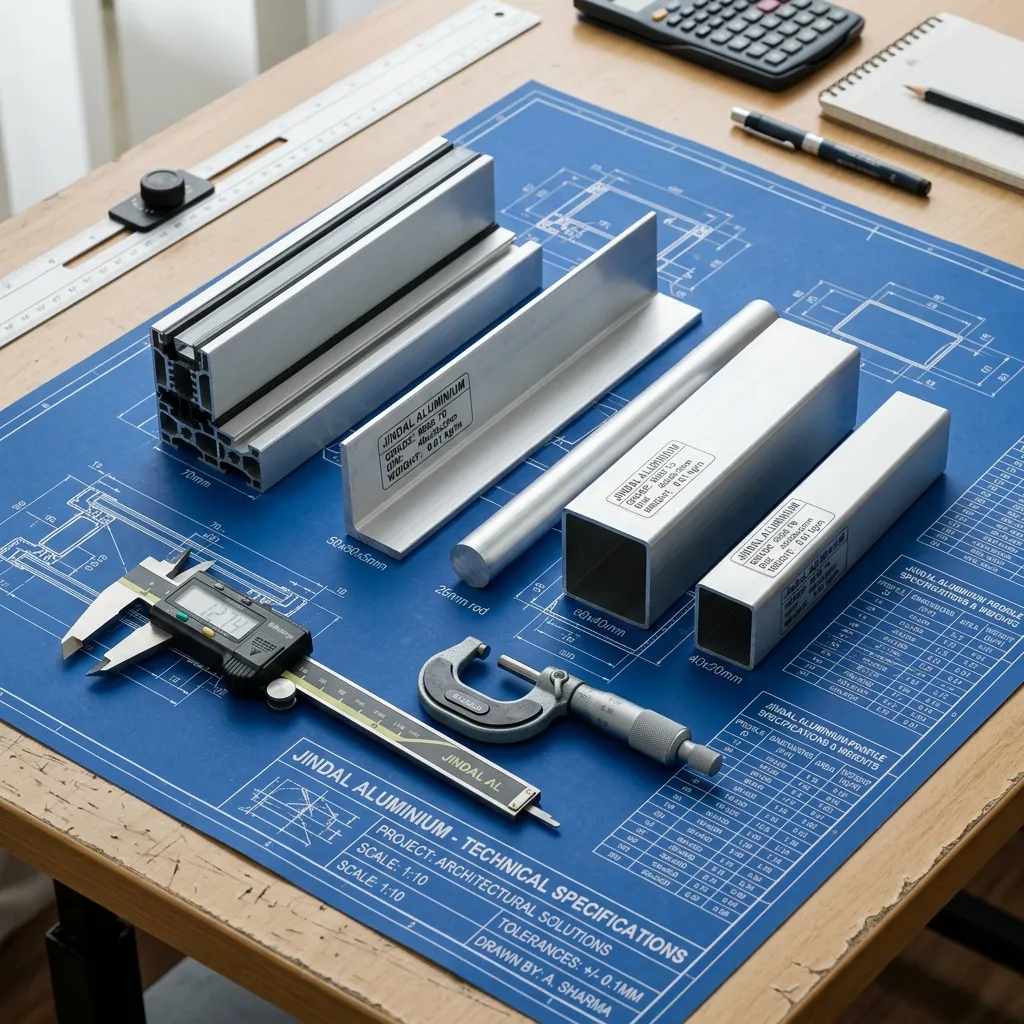
In architectural engineering, structural glazing, facade fabrication, and industrial manufacturing, precise material estimation is the foundational pillar of budget control, structural safety, and project success. Aluminium is traded, billed, and structurally engineered on the basis of unit weight (kilograms per meter or metric tonnes) rather than linear length alone. Sourcing authentic extruded profiles from Jindal Aluminium Limited (JAL)—India's premier and largest aluminium extruder—requires structural consultants, facade fabricators, procurement managers, and civil contractors to have immediate access to standardized, mathematically verified weight metrics.
This authoritative engineering manual and technical guide, curated by the metallurgical engineering team at Premier Aluminium Traders (Paharganj, New Delhi), delivers the universal mathematical formulas, verified section weight charts, alloy temper comparisons, Indian Standard (IS) tolerances, and commercial costing frameworks required to accurately engineer, specify, and procure Jindal Aluminium sections across India.
1. Key Takeaways & Executive Summary
Section weight calculation is the critical variable that directly governs raw material procurement costs, dead-load calculations for high-rise building facades, container payload logistics, and structural compliance. Standard commercial aluminium alloys (predominantly 6063, 6061, 6082, and 6101) exhibit a nominal metallurgical density of 2.70 g/cm³ (2700 kg/m³ or 0.0000027 kg/mm³). Standard commercial stock lengths supplied by Jindal Aluminium Limited range from 12 feet (3.657 meters) to 16 feet (4.876 meters), with custom architectural lengths up to 24 feet (7.315 meters) available for continuous curtain wall mullions.
2. The Universal Aluminium Weight Calculation Formula
Aluminium profile weights are fundamentally derived from the cross-sectional area of the profile multiplied by the alloy's volumetric density and the total length of the section. Understanding these formulas allows engineering teams to calculate theoretical section weights directly from CAD fabrication blueprints before physical dies are extruded.
The Fundamental Mathematical Relationship
Weight (kg) = Cross-Sectional Area (mm²) × Length (m) × Density (kg/mm³)
For standard commercial aluminium alloys with a density of 2.70 g/cm³:
Weight per Meter (kg/m) = Cross-Sectional Area (mm²) × 0.0027
Formula Breakdown by Cross-Sectional Profile Geometry
a) Solid Square & Rectangular Flat Bars
For solid architectural flat bars and electrical busbars:
Weight per Meter (kg/m) = Width (W in mm) × Thickness (T in mm) × 0.0027
Total Section Weight (kg) = Width (mm) × Thickness (mm) × Length (m) × 0.0027
Example Calculation: Calculate the weight of a Jindal 50 mm × 6 mm solid flat bar of 12-foot length (3.657 meters):
- Cross-Sectional Area = 50 × 6 = 300 mm²
- Weight per Meter = 300 × 0.0027 = 0.810 kg/m
- 12 ft Weight = 0.810 × 3.657 = 2.962 kg per bar
b) Solid Round Rods
For solid machining rods and structural pins:
Weight per Meter (kg/m) = π × (Radius in mm)² × 0.0027
Simplified Formula: Diameter (D in mm)² × 0.0021206
Total Rod Weight (kg) = D² (mm) × 0.0021206 × Length (m)
Example Calculation: Calculate the weight of a 25 mm diameter Jindal solid round rod of 12-foot length:
- Weight per Meter = 25² × 0.0021206 = 625 × 0.0021206 = 1.325 kg/m
- 12 ft Weight = 1.325 × 3.657 = 4.845 kg per rod
c) Hollow Square Tubes / Box Sections
For equal hollow box profiles used in interior partitions and framework:
Weight per Meter (kg/m) = [Outer Width² - Inner Width²] × 0.0027
Alternative Formula: 4 × Wall Thickness (T) × [Outer Width (W) - Wall Thickness (T)] × 0.0027
Example Calculation: Calculate the weight of a 50 mm × 50 mm square tube with a 2.0 mm wall thickness:
- Outer Width = 50 mm, Inner Width = 50 - (2 × 2) = 46 mm
- Area = (50² - 46²) = (2500 - 2116) = 384 mm²
- Weight per Meter = 384 × 0.0027 = 1.037 kg/m
- 12 ft Weight = 1.037 × 3.657 = 3.792 kg per pipe
d) Hollow Rectangular Tubes
For unequal rectangular hollow sections utilized in framing and structural transoms:
Weight per Meter (kg/m) = [(Outer W × Outer H) - (Inner W × Inner H)] × 0.0027
Alternative Formula: 2 × Wall Thickness (T) × [(Outer W + Outer H) - (2 × T)] × 0.0027
Example Calculation: Calculate the weight of a 100 mm × 50 mm hollow section with a 2.5 mm wall thickness:
- Outer Area = 100 × 50 = 5000 mm²
- Inner Width = 100 - 5 = 95 mm, Inner Height = 50 - 5 = 45 mm
- Inner Area = 95 × 45 = 4275 mm²
- Net Metal Area = 5000 - 4275 = 725 mm²
- Weight per Meter = 725 × 0.0027 = 1.9575 kg/m
- 12 ft Weight = 1.9575 × 3.657 = 7.158 kg per section
e) Hollow Round Pipes / Tubes
For circular architectural railings, conduits, and fluid transport lines:
Weight per Meter (kg/m) = (Outer Diameter - Wall Thickness) × Wall Thickness × 0.0215
Alternative Formula: π × (Outer Radius² - Inner Radius²) × 0.0027
Example Calculation: Calculate the weight of a 50.8 mm (2.0 inch) OD Jindal pipe with a 1.5 mm wall thickness:
- Weight per Meter = (50.8 - 1.5) × 1.5 × 0.0215 = 49.3 × 1.5 × 0.0215 = 1.590 kg/m
- 12 ft Weight = 1.590 × 3.657 = 5.815 kg per pipe
f) Equal & Unequal Angles (L-Sections) and Channels (U-Sections)
For structural L-angles and perimeter glazing channels:
Angle Weight (kg/m) = [Leg 1 (mm) + Leg 2 (mm) - Thickness (mm)] × Thickness (mm) × 0.0027
Channel Weight (kg/m) = [Base (mm) + 2 × Flange Height (mm) - 2 × Thickness (mm)] × Thickness (mm) × 0.0027
3. Comprehensive Jindal Aluminium Section Weight Charts
The following engineering weight tables list standardized nominal dimensions, metal wall thicknesses, linear weight per meter (kg/m), and standard 12-foot length weights (kg/12ft) for authentic Jindal Aluminium extrusions.
Table 1: Solid Round Rods (Alloy 6063 / 6061 / 6082)
Solid aluminium round bars are high-precision machined profiles engineered for CNC turning, precision fittings, mechanical rollers, and electrical bus links.
| Nominal Diameter (mm) | Nominal Diameter (Inches) | Cross-Sectional Area (mm²) | Theoretical Weight per Meter (kg/m) | Weight per 12ft Length (kg) |
|---|---|---|---|---|
| 6.00 mm | 0.236 in | 28.27 | 0.076 kg/m | 0.279 kg |
| 8.00 mm | 0.315 in | 50.27 | 0.136 kg/m | 0.496 kg |
| 10.00 mm | 0.394 in | 78.54 | 0.212 kg/m | 0.776 kg |
| 12.00 mm | 0.472 in | 113.10 | 0.305 kg/m | 1.117 kg |
| 16.00 mm | 0.630 in | 201.06 | 0.543 kg/m | 1.985 kg |
| 19.05 mm (3/4") | 0.750 in | 285.02 | 0.770 kg/m | 2.814 kg |
| 22.22 mm (7/8") | 0.875 in | 387.95 | 1.047 kg/m | 3.830 kg |
| 25.40 mm (1.0") | 1.000 in | 506.71 | 1.368 kg/m | 5.003 kg |
| 31.75 mm (1-1/4") | 1.250 in | 791.73 | 2.138 kg/m | 7.818 kg |
| 38.10 mm (1-1/2") | 1.500 in | 1140.09 | 3.078 kg/m | 11.257 kg |
| 44.45 mm (1-3/4") | 1.750 in | 1551.79 | 4.190 kg/m | 15.322 kg |
| 50.80 mm (2.0") | 2.000 in | 2026.83 | 5.472 kg/m | 20.013 kg |
| 63.50 mm (2-1/2") | 2.500 in | 3166.92 | 8.551 kg/m | 31.270 kg |
| 76.20 mm (3.0") | 3.000 in | 4560.37 | 12.313 kg/m | 45.028 kg |
| 88.90 mm (3-1/2") | 3.500 in | 6207.17 | 16.759 kg/m | 61.290 kg |
| 100.00 mm | 3.937 in | 7853.98 | 21.206 kg/m | 77.550 kg |
Table 2: Square & Rectangular Hollow Box Sections
Hollow tubes form the primary skeletal sub-structures for architectural cladding, signage back-frames, solar structures, cleanroom partitions, and industrial workbenches.
| Outer Dimensions (mm) | Outer Dimensions (Inches) | Wall Thickness (mm) | Weight per Meter (kg/m) | Weight per 12ft Length (kg) |
|---|---|---|---|---|
| 19.05 × 19.05 mm | 3/4" × 3/4" | 1.20 mm | 0.231 kg/m | 0.846 kg |
| 25.40 × 25.40 mm | 1" × 1" | 1.20 mm | 0.314 kg/m | 1.147 kg |
| 25.40 × 25.40 mm | 1" × 1" | 1.50 mm | 0.387 kg/m | 1.416 kg |
| 25.40 × 25.40 mm | 1" × 1" | 2.00 mm | 0.505 kg/m | 1.849 kg |
| 38.10 × 25.40 mm | 1-1/2" × 1" | 1.20 mm | 0.395 kg/m | 1.446 kg |
| 38.10 × 25.40 mm | 1-1/2" × 1" | 1.50 mm | 0.490 kg/m | 1.792 kg |
| 38.10 × 38.10 mm | 1-1/2" × 1-1/2" | 1.50 mm | 0.593 kg/m | 2.168 kg |
| 38.10 × 38.10 mm | 1-1/2" × 1-1/2" | 2.00 mm | 0.780 kg/m | 2.852 kg |
| 50.80 × 25.40 mm | 2" × 1" | 1.20 mm | 0.478 kg/m | 1.747 kg |
| 50.80 × 25.40 mm | 2" × 1" | 1.50 mm | 0.593 kg/m | 2.168 kg |
| 50.80 × 25.40 mm | 2" × 1" | 2.00 mm | 0.780 kg/m | 2.852 kg |
| 50.80 × 50.80 mm | 2" × 2" | 1.50 mm | 0.798 kg/m | 2.919 kg |
| 50.80 × 50.80 mm | 2" × 2" | 2.00 mm | 1.054 kg/m | 3.854 kg |
| 50.80 × 50.80 mm | 2" × 2" | 3.00 mm | 1.549 kg/m | 5.664 kg |
| 76.20 × 25.40 mm | 3" × 1" | 1.50 mm | 0.798 kg/m | 2.919 kg |
| 76.20 × 38.10 mm | 3" × 1-1/2" | 2.00 mm | 1.196 kg/m | 4.372 kg |
| 100.00 × 50.00 mm | 4" × 2" | 2.00 mm | 1.577 kg/m | 5.766 kg |
| 100.00 × 50.00 mm | 4" × 2" | 2.50 mm | 1.958 kg/m | 7.159 kg |
| 100.00 × 50.00 mm | 4" × 2" | 3.00 mm | 2.333 kg/m | 8.531 kg |
Table 3: Equal Angles & Unequal L-Sections
Aluminium angle sections are extensively specified for structural corner bracing, curtain wall bracket anchoring, perimeter cleat fixing, and framing trim.
| Dimensions A × B (mm) | Dimensions (Inches) | Flange Thickness (mm) | Weight per Meter (kg/m) | Weight per 12ft Length (kg) |
|---|---|---|---|---|
| 12.0 × 12.0 mm | 1/2" × 1/2" | 1.20 mm | 0.074 kg/m | 0.270 kg |
| 19.0 × 19.0 mm | 3/4" × 3/4" | 1.20 mm | 0.119 kg/m | 0.435 kg |
| 19.0 × 19.0 mm | 3/4" × 3/4" | 1.50 mm | 0.148 kg/m | 0.540 kg |
| 25.0 × 25.0 mm | 1" × 1" | 1.20 mm | 0.158 kg/m | 0.578 kg |
| 25.0 × 25.0 mm | 1" × 1" | 1.50 mm | 0.196 kg/m | 0.718 kg |
| 25.0 × 25.0 mm | 1" × 1" | 2.00 mm | 0.259 kg/m | 0.948 kg |
| 25.0 × 25.0 mm | 1" × 1" | 3.00 mm | 0.381 kg/m | 1.392 kg |
| 38.0 × 38.0 mm | 1-1/2" × 1-1/2" | 2.00 mm | 0.400 kg/m | 1.462 kg |
| 38.0 × 38.0 mm | 1-1/2" × 1-1/2" | 3.00 mm | 0.591 kg/m | 2.162 kg |
| 50.0 × 25.0 mm (Unequal) | 2" × 1" | 2.00 mm | 0.394 kg/m | 1.442 kg |
| 50.0 × 25.0 mm (Unequal) | 2" × 1" | 3.00 mm | 0.583 kg/m | 2.133 kg |
| 50.0 × 50.0 mm | 2" × 2" | 2.00 mm | 0.529 kg/m | 1.936 kg |
| 50.0 × 50.0 mm | 2" × 2" | 3.00 mm | 0.786 kg/m | 2.873 kg |
| 50.0 × 50.0 mm | 2" × 2" | 5.00 mm | 1.283 kg/m | 4.690 kg |
| 75.0 × 50.0 mm (Unequal) | 3" × 2" | 3.00 mm | 0.988 kg/m | 3.614 kg |
| 75.0 × 75.0 mm | 3" × 3" | 5.00 mm | 1.958 kg/m | 7.159 kg |
Table 4: Architectural Sliding Window & Door Profiles
Jindal Aluminium produces India's most comprehensive range of architectural door and window systems, categorized into the 18mm series (economical residential), 27mm series (standard commercial), and 35mm / Domal series (heavy-duty luxury fenestration).
| System Series | Profile Description | Functional Role | Nominal Weight (kg/m) | Weight per 12ft Length (kg) |
|---|---|---|---|---|
| 18 mm Series | 2-Track Bottom Frame | Outer base running track | 0.460 kg/m | 1.682 kg |
| 18 mm Series | 2-Track Top & Side Frame | Perimeter outer jamb/head | 0.410 kg/m | 1.499 kg |
| 18 mm Series | 3-Track Bottom Frame | 3-Panel base track with mesh | 0.720 kg/m | 2.633 kg |
| 18 mm Series | 3-Track Top & Side Frame | 3-Panel outer head/jamb | 0.650 kg/m | 2.377 kg |
| 18 mm Series | Shutter Handle Section | Vertical sliding sash profile | 0.285 kg/m | 1.042 kg |
| 18 mm Series | Shutter Interlock Section | Center acoustic/weather lock | 0.320 kg/m | 1.170 kg |
| 18 mm Series | Shutter Top & Bottom Rail | Horizontal sash rails | 0.265 kg/m | 0.969 kg |
| 27 mm Series | 2-Track Heavy Bottom | Heavy commercial base track | 0.785 kg/m | 2.871 kg |
| 27 mm Series | 2-Track Top & Side Outer | Heavy perimeter frame | 0.695 kg/m | 2.542 kg |
| 27 mm Series | 3-Track Heavy Bottom | 3-Track sliding base track | 1.180 kg/m | 4.315 kg |
| 27 mm Series | 3-Track Top & Side Outer | 3-Track perimeter frame | 1.050 kg/m | 3.840 kg |
| 27 mm Series | Heavy Shutter Handle | Stiffened vertical sash | 0.540 kg/m | 1.975 kg |
| 27 mm Series | Heavy Interlock Profile | Wind-load reinforced lock | 0.610 kg/m | 2.231 kg |
| 27 mm Series | Heavy Top & Bottom Rail | Horizontal sash frame | 0.490 kg/m | 1.792 kg |
| 35 mm / Domal | Domal Outer Frame (2-Track) | Thermal/acoustic outer box | 1.250 kg/m | 4.571 kg |
| 35 mm / Domal | Domal Outer Frame (3-Track) | Triple track luxury frame | 1.850 kg/m | 6.765 kg |
| 35 mm / Domal | Domal Heavy Sash Handle | High-rise luxury sash | 1.120 kg/m | 4.096 kg |
| 35 mm / Domal | Domal Center Interlock | Deep structural interlock | 1.280 kg/m | 4.681 kg |
| Casement Door | 45 mm Hinged Door Outer Frame | Flush entryway door frame | 0.980 kg/m | 3.584 kg |
| Casement Door | 45 mm Door Shutter Vertical | Heavy glass swing sash | 1.420 kg/m | 5.193 kg |
Table 5: Office Partition & Curtain Wall Sections
Engineered for corporate interior fit-outs and high-rise unitized/semi-unitized structural glazing facades.
| System Application | Profile Type | Section Size (mm) | Nominal Weight (kg/m) | Weight per 12ft Length (kg) |
|---|---|---|---|---|
| Office Partition | Outer Perimeter Channel | 50.0 × 25.4 mm (2" × 1") | 0.485 kg/m | 1.773 kg |
| Office Partition | Vertical Center Post (Single) | 63.5 × 38.1 mm (2.5" × 1.5") | 0.780 kg/m | 2.852 kg |
| Office Partition | Vertical Center Post (Double) | 100.0 × 44.5 mm (4" × 1.75") | 1.280 kg/m | 4.681 kg |
| Office Partition | Glazing Clip / Snap Bead | Standard 12mm Glass Bead | 0.145 kg/m | 0.530 kg |
| Office Partition | Flush Door Frame Section | 100.0 × 44.5 mm Single Rebate | 1.150 kg/m | 4.206 kg |
| Curtain Wall Facade | Structural Mullion (Vertical) | 57.0 × 100.0 mm System | 2.450 kg/m | 8.960 kg |
| Curtain Wall Facade | Structural Mullion (Vertical) | 65.0 × 125.0 mm Heavy Wind | 3.480 kg/m | 12.726 kg |
| Curtain Wall Facade | Structural Mullion (Vertical) | 65.0 × 150.0 mm High Rise | 4.650 kg/m | 17.005 kg |
| Curtain Wall Facade | Structural Transom (Horizontal) | 57.0 × 60.0 mm Intermediate | 1.680 kg/m | 6.144 kg |
| Curtain Wall Facade | Structural Transom (Horizontal) | 65.0 × 85.0 mm Heavy Glass | 2.350 kg/m | 8.594 kg |
| Curtain Wall Facade | Pressure Plate (External) | 50.0 mm Width Clamping Plate | 0.580 kg/m | 2.121 kg |
| Curtain Wall Facade | Face Cover Cap (Aesthetic) | 50.0 × 20.0 mm Snap-on Cap | 0.340 kg/m | 1.243 kg |
4. Alloy Grades, Tempers & Density Variations
While 2.70 g/cm³ is the industry-standard baseline density for aluminium weight calculations, metallurgical composition alters density by fractional percentages across the 6000-series alloy family. Choosing the correct alloy and temper ensures optimal mechanical yield strength, surface anodizing clarity, and corrosion resistance.
Primary Architectural & Industrial Extrusion Alloys
-
Alloy 6063 (HE9) - Architectural Grade:
- Primary alloying elements: Magnesium (0.45-0.9%) and Silicon (0.2-0.6%).
- Characteristics: Exceptional extrusion surface finish, superior anodizing response, high corrosion resistance, and good structural strength in T6 temper.
- Applications: Window frames, door sections, curtain walls, and architectural moldings.
- Density: 2.69 g/cm³ (0.00000269 kg/mm³).
-
Alloy 6061 (HE20) - Structural / Engineering Grade:
- Primary alloying elements: Magnesium (0.8-1.2%), Silicon (0.4-0.8%), and Copper (0.15-0.40%).
- Characteristics: High tensile and yield strength, excellent weldability, and high toughness. Machinability is significantly higher than 6063.
- Applications: Heavy industrial frames, railway carriages, truck beds, hydraulic manifolds, and marine structures.
- Density: 2.70 g/cm³ (0.00000270 kg/mm³).
-
Alloy 6082 (HE30) - High-Strength Structural Grade:
- Primary alloying elements: Manganese (0.4-1.0%), Magnesium (0.6-1.2%), Silicon (0.7-1.3%).
- Characteristics: The strongest alloy in the 6000 series. Replaces low-carbon steel in structural applications with 60% weight reduction.
- Applications: Bridges, cranes, roof trusses, transport frameworks, and defense components.
- Density: 2.71 g/cm³ (0.00000271 kg/mm³).
-
Alloy 6101 (E91E) - Electrical Busbar Grade:
- Primary alloying elements: Formulated for high electrical conductivity (minimum 55-57% IACS).
- Characteristics: Superior electrical and thermal conductivity combined with mechanical strength to resist short-circuit electrodynamic stresses.
- Applications: HT/LT switchgear busbars, transformer windings, and power distribution channels.
- Density: 2.70 g/cm³ (0.00000270 kg/mm³).
Mechanical Property Comparison Matrix
| Alloy & Temper | 0.2% Proof Stress / Yield (MPa) | Ultimate Tensile Strength (MPa) | Elongation A50mm (%) | Hardness (Webster / HV) | Electrical Conductivity (% IACS) |
|---|---|---|---|---|---|
| 6063-T5 | 130 MPa min | 175 MPa min | 8% min | 8-10 HW / 65 HV | 53% |
| 6063-T6 | 170 MPa min | 215 MPa min | 8% min | 12-14 HW / 80 HV | 50% |
| 6061-T6 | 240 MPa min | 290 MPa min | 8% min | 15-17 HW / 95 HV | 43% |
| 6082-T6 | 260 MPa min | 310 MPa min | 8% min | 16-18 HW / 100 HV | 40% |
| 6101-T6 | 180 MPa min | 215 MPa min | 10% min | 12-14 HW / 75 HV | 57% |
5. Standard Extrusion Tolerances & Quality Verification (IS Standards)
In bulk procurement and high-tolerance facade engineering, section weight is subject to national dimensional and manufacturing standards. Sourcing certified Jindal Aluminium ensures that profiles comply strictly with the Bureau of Indian Standards (BIS).
Relevant Indian Standard (IS) Specifications
- IS 733: Specification for Wrought Aluminium and Aluminium Alloy Bars, Rods, and Sections (for General Engineering Purposes).
- IS 1285: Specification for Wrought Aluminium and Aluminium Alloy Extruded Round Tube and Hollow Sections.
- IS 3965: Dimensions for Wrought Aluminium and Aluminium Alloys, Extruded Heavy Sections.
- IS 2673: Dimensions for Wrought Aluminium and Aluminium Alloys, Extruded Round Rods and Bars.
Standard Extrusion Tolerances on Weight and Dimensions
-
Weight Tolerance:
- Under standard IS specifications, commercial extruded profiles are permitted a weight tolerance of ±5% to ±10% from theoretical nominal catalog weight, depending on the circumscribing circle diameter (CCD) and wall thickness class.
- Genuine Jindal extrusions consistently operate within tight precision limits of ±3% to ±5%, eliminating the commercial risk of underweight profiles (which compromise structural integrity) or overweight profiles (which inflate project procurement budgets).
-
Straightness & Twist Tolerance:
- Maximum allowable deviation for straightness is 1.5 mm per meter length, with maximum total camber not exceeding 3 mm over a 3-meter span.
- Angular twist is limited to 1° per meter length for precision architectural systems.
How to Verify Genuine Jindal Aluminium Extrusions
To protect your projects against counterfeit and substandard local scrap-recycled extrusions, verify the following authentication markers:
- JAL Embossing & Inkjet Laser Mark: Authentic Jindal sections feature continuous laser inkjet marking or physical die embossing displaying the official "JAL" or "JINDAL" logo, alloy grade (e.g., 6063 T6), die number, and batch tracking code.
- Surface Finish Uniformity: Genuine Jindal primary-billet extrusions exhibit clean, uniform surface morphology free of longitudinal die lines, blistering, pitting, or orange-peel textures.
- Manufacturer Test Certificates (MTC): Every bulk dispatch from Premier Aluminium Traders is accompanied by genuine Jindal Mill Test Certificates verifying spectrographic chemical analysis and mechanical tensile testing per IS standards.
- Authorized Stockist Sourcing: Procuring through an authorized wholesale dealer like Premier Aluminium Traders guarantees direct supply chain traceability from Jindal's manufacturing facilities in Bangalore and Dwas.
6. Practical Tips to Calculate Material Costs from Weight
In the commercial B2B metal trade across India, aluminium extrusions are priced based on the following comprehensive cost formula. Knowing your exact theoretical or actual weight allows you to calculate final project billing with precision.
Total B2B Billing = [Total Weight (kg) × (Base Metal Rate/kg + Extrusion Premium/kg + Surface Treatment/kg)] + GST (18%)
Breakdown of Cost Components:
- Base Metal Rate (NALCO / MCX Linked):
- The primary raw material cost fluctuates with global LME and domestic NALCO primary aluminium ingot pricing benchmarks.
- Extrusion Conversion Premium:
- The manufacturing cost charged by the extrusion press based on section complexity, wall thickness, and die difficulty. Solid sections have lower extrusion conversion premiums than complex multi-cavity hollow curtain wall profiles.
- Surface Treatment Add-ons:
- Mill Finish: Raw extruded surface (No added finishing cost).
- Anodizing: Chemical electrolytic treatment (Natural Silver, Champagne, Bronze, Black). Priced per kg or per sq. meter based on micron rating (typically 15 to 25 microns for architectural outdoor exposure).
- Powder Coating: Electrostatic thermoset polymer application (RAL shades). Adds approximately ₹25 to ₹45 per kg depending on coating warranty (10-year, 15-year, or 25-year PVDF).
- Statutory Goods & Services Tax (GST):
- Aluminium profiles and extrusions fall under HSN Code 7604 with a statutory GST rate of 18%.
Practical Commercial Example:
- Section: Jindal 100 × 50 × 2.5 mm Box Section (7.158 kg per 12ft length)
- Quantity: 100 lengths (Total Weight = 715.8 kg)
- Base Rate + Extrusion Premium: ₹245.00 per kg
- Architectural Powder Coating (RAL 7016 Anthracite Grey): ₹35.00 per kg
- Total Rate before Tax: ₹280.00 per kg
- Base Amount: 715.8 kg × ₹280 = ₹2,00,424.00
- GST @ 18%: ₹36,076.32
- Final Landed Invoice Value: ₹2,36,500.32
7. Frequently Asked Questions (FAQs)
1. What is the standard formula to calculate aluminium section weight per meter?
The universal formula to calculate the weight of an aluminium section is:
Weight per Meter (kg/m) = Cross-Sectional Area (mm²) × 0.0027.
This formula is based on the standard density of commercial architectural aluminium alloys (2.70 g/cm³ or 2700 kg/m³).
2. How much does a 12-foot Jindal aluminium section weigh?
The weight of a 12-foot (3.657 meter) Jindal aluminium section depends entirely on its profile dimensions and wall thickness. For example:
- A 1" × 1" (25.4 × 25.4 mm) box section with 1.2 mm wall thickness weighs 1.147 kg.
- A 2" × 1" (50.8 × 25.4 mm) box section with 1.5 mm wall thickness weighs 2.168 kg.
- A 4" × 2" (100 × 50 mm) curtain wall section with 2.5 mm wall thickness weighs 7.159 kg.
3. What is the difference between 6063-T6 and 6061-T6 section weight?
Alloy 6063-T6 (density 2.69 g/cm³) and alloy 6061-T6 (density 2.70 g/cm³) have virtually identical weights in identical profile geometries, differing by less than 0.37%. The real difference lies in mechanical performance: 6061-T6 delivers 35% higher yield and tensile strength for structural applications, while 6063-T6 provides superior surface smoothness and anodizing quality for architectural doors, windows, and facades.
4. What is the standard tolerance on aluminium extrusion weight in India?
Per Bureau of Indian Standards (BIS) specifications IS 733 and IS 1285, commercial aluminium extrusions have an allowable weight tolerance of ±5% to ±10% from the theoretical nominal catalog weight. Certified Jindal Aluminium sections maintain an industry-leading tight tolerance of ±3% to ±5%.
5. How do I get an authentic Jindal Aluminium section catalogue with die numbers?
You can download official Jindal Aluminium section catalogs with complete die drawings, section dimensions, and nominal unit weights directly from authorized stockists like Premier Aluminium Traders or by contacting our engineering sales desk via WhatsApp (+91-9891097111).
6. Where can I buy certified Jindal Aluminium sections at wholesale rates in Delhi?
Certified Jindal Aluminium sections can be purchased at authorized wholesale distributor rates from Premier Aluminium Traders, located at 3/8, DB Gupta Road, Paharganj, New Delhi (Phone: +91-9891097111 / 011-41657680). They maintain ready physical inventory across architectural, structural, and electrical alloy profiles with same-day dispatch across Delhi NCR and North India.
8. Procure Certified Jindal Aluminium Sections with Premier Aluminium Traders
Are you planning an architectural facade project, interior corporate partition fit-out, or industrial manufacturing run requiring certified Jindal Aluminium sections? Avoid underweight counterfeit sections and unnecessary transit delays by partnering with North India's most trusted extrusion stockist.
- Authorized Jindal Aluminium Stockist: Sourcing directly from Jindal Aluminium Limited since 1978.
- Massive Ready Inventory: Ready physical stock of solid rods, architectural box sections, window tracks, curtain walls, and electrical busbars in New Delhi.
- In-House Value Added Services: Precision metal cutting, hole punching, custom RAL powder coating, and architectural anodizing.
- Fast Regional Dispatch: Same-day loading and delivery across Delhi NCR, Haryana, Uttar Pradesh, Rajasthan, and nationwide.
Contact Our Engineering & Sales Desk Today:
- Address: Premier Aluminium Traders, 3/8, D.B. Gupta Road, Paharganj, New Delhi - 110055
- Direct Phone: +91-9891097111 / 011-41657680
- Email: premieraluminiumtraders@gmail.com
- Website: www.premieraluminiumtraders.com
- Get a Quote: Click here to request an instant B2B quotation