Blog
6063-T6 vs 6061-T6 vs 6082 Aluminium Alloys: Which Grade Do You Need?
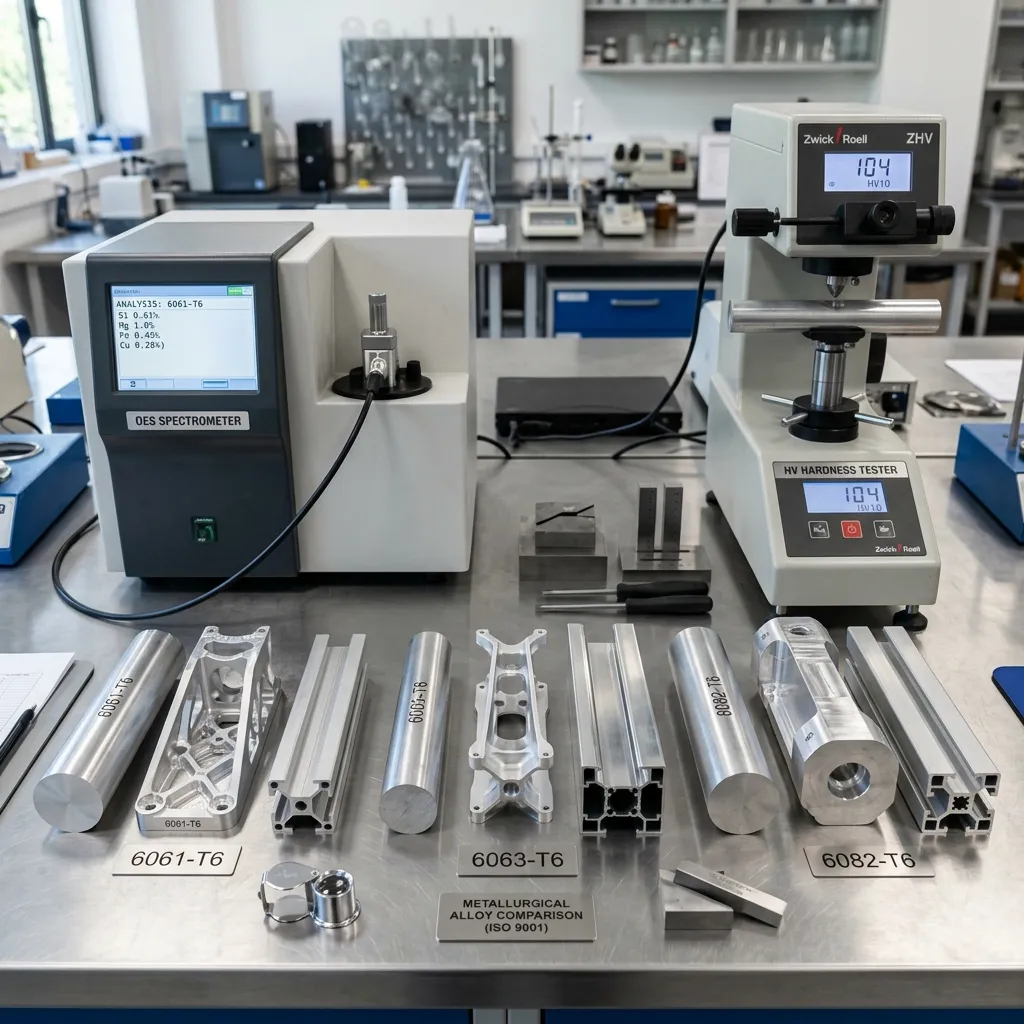
In precision engineering, structural design, and architectural facade fabrication, selecting the correct aluminium alloy is the single most critical engineering decision. The 6000-series (Al-Mg-Si) aluminium alloys dominate the global extrusion landscape, accounting for more than 85% of all extruded profiles due to their exceptional extrudability, moderate-to-high mechanical strength, superior corrosion resistance, and responsiveness to heat treatment.
However, mechanical design engineers, facade consultants, and procurement managers in India frequently confront a pivotal specification dilemma: Should your project specify 6063-T6, 6061-T6, or 6082-T6?
Selecting the wrong grade can lead to catastrophic consequences. Specifying architectural-grade 6063 for high-load structural joints risks mechanical yield failure and fatigue cracking. Conversely, specifying high-strength 6082 for complex thin-walled architectural trims or decorative anodized storefronts results in excessive extrusion die wear, visual surface streaks, and inflated project costs.
Curated by the metallurgical engineering team at Premier Aluminium Traders (authorized Jindal Aluminium Limited distributors in Paharganj, New Delhi since 1978), this comprehensive engineering manual delivers an authoritative, data-dense comparison of chemical compositions, mechanical properties, CNC machinability, weldability, surface finishing, and commercial suitability to help you select the exact alloy grade for your technical application.
1. Executive Summary & Alloy Decision Matrix
The 6000-series family is characterized by magnesium and silicon alloying additions that form strengthening magnesium silicide ($Mg_2Si$) precipitates during artificial aging (T6 heat treatment). However, their performance diverges significantly based on secondary alloying elements:
- Alloy 6063-T6 ("The Architectural Workhorse"): Delivers unmatched extrusion surface finish, superior anodizing optical clarity, and complex thin-wall die capability, making it the undisputed gold standard for architectural fenestration, curtain walls, and interior systems.
- Alloy 6061-T6 ("The Engineering Standard"): The most versatile structural alloy, balancing high yield strength, excellent TIG/MIG weldability, and crisp CNC machinability for automotive, industrial machinery, and marine components.
- Alloy 6082-T6 / HE30 ("The High-Strength Structural Heavyweight"): Fortified with manganese ($Mn$) to control grain structure, 6082 provides the highest mechanical yield and ultimate tensile strength in the 6000 series, replacing low-carbon structural steel in high-load dynamic bridges, cranes, transport frameworks, and high-rise curtain wall mullions.
Quick Engineering Rule of Thumb:
- Choose 6063-T6 when surface aesthetics, tight visual tolerances, decorative anodizing, and complex thin-walled geometry (<1.5 mm) take precedence over heavy mechanical loading.
- Choose 6061-T6 when designing general-purpose machined blocks, structural brackets, robotic frames, and welded assemblies requiring high all-around strength and fracture toughness.
- Choose 6082-T6 when engineering heavy dynamic structural frameworks, continuous high-rise facade mullions under severe wind loads, transport trusses, or offshore platforms requiring maximum proof stress.
2. Comprehensive Chemical Composition Comparison
The mechanical and surface properties of 6063, 6061, and 6082 are fundamentally governed by their chemical compositions per ASTM B221 and Indian Standard (IS) 733 / IS 1285 specifications.
| Chemical Element | 6063 (Architectural Grade) | 6061 (General Structural Grade) | 6082 (High-Strength Structural Grade) |
|---|---|---|---|
| Silicon (Si) | 0.20% – 0.60% | 0.40% – 0.80% | 0.70% – 1.30% |
| Magnesium (Mg) | 0.45% – 0.90% | 0.80% – 1.20% | 0.60% – 1.20% |
| Iron (Fe) | Max 0.35% | Max 0.70% | Max 0.50% |
| Copper (Cu) | Max 0.10% | 0.15% – 0.40% | Max 0.10% |
| Manganese (Mn) | Max 0.10% | Max 0.15% | 0.40% – 1.00% |
| Chromium (Cr) | Max 0.10% | 0.04% – 0.35% | Max 0.25% |
| Zinc (Zn) | Max 0.10% | Max 0.25% | Max 0.20% |
| Titanium (Ti) | Max 0.10% | Max 0.15% | Max 0.10% |
| Aluminium (Al) | Remainder (~98.9%) | Remainder (~97.9%) | Remainder (~96.5%) |
Metallurgical Analysis of Alloying Chemistry:
- The Manganese (Mn) Effect in 6082: The deliberate addition of 0.40% to 1.00% Manganese in 6082 forms fine intermetallic dispersoids ($Al_{12}(Fe,Mn)_3Si$). These dispersoids inhibit grain boundary recrystallization during high-temperature extrusion and solution heat treatment, resulting in a refined, fibrous grain structure that boosts yield strength by 15% to 20% over 6061.
- The Copper (Cu) Role in 6061: Alloy 6061 incorporates 0.15% to 0.40% Copper to promote solid solution strengthening and accelerate precipitation kinetics. However, this copper content slightly diminishes anodizing optical clarity compared to 6063 and marginally increases pitting susceptibility in aggressive marine chloride environments.
- High Purity Balance in 6063: Alloy 6063 limits Iron, Copper, and Manganese to trace levels. This low-impurity balance minimizes insoluble intermetallic phase clusters at the surface, ensuring the mirror-smooth extrusion finish and crystal-clear anodic oxide layer that defines high-end architectural metalwork.
3. Mechanical & Physical Properties Comparison
The following engineering data matrix compares the nominal and guaranteed mechanical properties for 6063, 6061, and 6082 in the standard T6 temper (solution heat-treated and artificially peak-aged) per ASTM B221M and IS 733 standards.
| Engineering Property | Standard Unit | 6063-T6 | 6061-T6 | 6082-T6 |
|---|---|---|---|---|
| Ultimate Tensile Strength (UTS) | MPa (psi) | 215 MPa (31,200 psi) | 290 MPa (42,000 psi) | 310 MPa (45,000 psi) |
| 0.2% Proof Stress (Yield Strength) | MPa (psi) | 170 MPa (24,700 psi) | 240 MPa (34,800 psi) | 260 MPa (37,700 psi) |
| Elongation at Break ($A_{50mm}$) | % | 8% – 12% | 8% – 10% | 8% – 10% |
| Brinell Hardness (HBW) | HB (10/500) | 73 HB | 95 HB | 100 HB |
| Webster Hardness (HW) | HW | 12 – 14 HW | 15 – 17 HW | 16 – 18 HW |
| Shear Strength | MPa (psi) | 150 MPa (21,800 psi) | 205 MPa (29,700 psi) | 210 MPa (30,500 psi) |
| Fatigue Strength (500M cycles) | MPa | 68 MPa | 95 MPa | 100 MPa |
| Modulus of Elasticity (E) | GPa ($10^6$ psi) | 68.9 GPa (10.0 Mpsi) | 68.9 GPa (10.0 Mpsi) | 70.0 GPa (10.1 Mpsi) |
| Thermal Conductivity | W/m·K | 200 – 209 W/m·K | 167 – 180 W/m·K | 170 – 190 W/m·K |
| Electrical Conductivity | % IACS | 50% – 53% IACS | 40% – 43% IACS | 40% – 42% IACS |
| Volumetric Density | g/cm³ ($kg/m^3$) | 2.69 g/cm³ (2690 kg/m³) | 2.70 g/cm³ (2700 kg/m³) | 2.71 g/cm³ (2710 kg/m³) |
| Melting Range | °C | 600°C – 655°C | 580°C – 650°C | 555°C – 650°C |
4. In-Depth Metallurgical Breakdown by Alloy Grade
a) 6063-T6 ("The Architectural Workhorse")
Alloy 6063 is widely celebrated as the world's premier architectural aluminium alloy. It was specifically formulated to maximize extrusion press speeds and allow the production of highly intricate hollow profiles with razor-thin walls (down to 0.8 mm) that would be impossible to extrude in higher-strength alloys.
Metallurgical Advantages:
- Superior Surface Quality: Minimal micro-segregation and absence of coarse intermetallic phases provide a pristine surface finish straight from the extrusion press die.
- Unrivaled Anodizing Response: Forms an exceptionally uniform, transparent anodic layer ($Al_2O_3$), allowing brilliant natural silver, champagne, bronze, and deep black electro-coloring without hazing or cloudy streaks.
- Thermal Dissipation: Its high thermal conductivity (~205 W/m·K) makes 6063 the top choice for electronic heatsinks and LED thermal dissipation housings.
Primary Industrial & Architectural Applications:
- Commercial curtain walls, structural glazing framing, and unitized transoms.
- High-end architectural sliding windows, casement doors, and Domal series fenestration.
- Modular office partitions, interior demountable wall channels, and false ceiling grids.
- Electronic heat sink extrusions, LED strip housings, and architectural louvers.
b) 6061-T6 ("The Engineering Standard")
Often referred to as the "Swiss Army Knife" of engineering aluminium alloys, 6061 is the global benchmark for structural fabrication, precision CNC machining, and heavy-duty welded assemblies.
Metallurgical Advantages:
- Balanced Strength-to-Weight Ratio: Yield strength of 240 MPa enables substantial weight savings over structural steel while maintaining robust resistance to mechanical deflection.
- Superior Fracture Toughness: Retains excellent ductility and fracture toughness across extreme temperature ranges, from cryogenic storage (-196°C) up to 100°C continuous service.
- Corrosion Resistance: Forms a tightly adhering, self-healing oxide layer that resists atmospheric corrosion, industrial pollutants, and neutral water environments.
Primary Engineering & Industrial Applications:
- High-precision CNC milled components, fixtures, robotic end-effectors, and automation jigs.
- Commercial vehicle sub-frames, truck body beds, bus chassis rails, and railway interior framing.
- Marine decking components, yacht railings, and offshore gangways.
- Hydraulic manifolds, pneumatic cylinder barrels, and fluid distribution blocks.
c) 6082-T6 / HE30 ("The High-Strength Heavyweight")
Known in Europe as structural alloy EN AW-6082 and in older British/Indian standards as HE30, alloy 6082 is the highest-strength commercial alloy in the 6000 series. It was specifically developed as a structural replacement for 6061 in high-load dynamic applications across Europe and is now widely specified in India for mission-critical infrastructure projects.
Metallurgical Advantages:
- Peak Proof Stress: With a guaranteed yield strength of 260 MPa (and typical values exceeding 280 MPa in Jindal extrusions), 6082 delivers approximately 10% to 15% higher load-bearing capacity than 6061-T6 and over 50% higher strength than 6063-T6.
- Dynamic Fatigue Resistance: The manganese-modified fibrous microstructure provides superior resistance to cyclic dynamic stress, vibration fatigue, and impact shock loading.
- Machinability with High Surface Finish: Produces tight, curled metal chips during high-speed CNC turning and milling operations, reducing tool clogging.
Primary Structural Applications:
- High-rise commercial curtain wall mullions subject to extreme gusting wind pressures (>2.5 kPa).
- Industrial cranes, gantry systems, roof trusses, and modular event stage trusses.
- Heavy transport frameworks, railway coach body shells, and defense bridge components.
- High-stress marine structural modules and offshore platform framing.
5. Fabrication, Machining & Surface Finishing Performance
Selecting an alloy requires evaluating how the material behaves under physical cutting, welding, bending, and chemical finishing operations in the workshop.
a) CNC Machinability & Chip Morphology
- Alloy 6063-T6 (Machinability Rating: 50%): Can be machined, but tends to produce continuous, ductile, "gummy" chips that can wrap around spinning end-mills and mar the finished surface. Requires high-rake polished carbide tooling and continuous flood coolant.
- Alloy 6061-T6 (Machinability Rating: 70%): Delivers clean, crisp chip breaking and excellent surface roughness ($R_a < 0.8\text{ }\mu m$). It is the default standard for general CNC milling, tapping, and turning.
- Alloy 6082-T6 (Machinability Rating: 80%): Produces tight, brittle, broken chips that clear easily from deep pockets. It enables faster feeds and speeds during high-velocity milling of solid billets.
b) Welding Performance & Heat Affected Zone (HAZ)
All three alloys exhibit excellent weldability using Gas Tungsten Arc Welding (TIG/GTAW) and Gas Metal Arc Welding (MIG/GMAW). However, engineers must account for the Heat Affected Zone (HAZ) strength reduction:
- Strength Drop: Exposure to welding temperatures dissolves the strengthening $Mg_2Si$ precipitates, reducing tensile strength in the HAZ by approximately 30% to 40% in the as-welded condition.
- Filler Wire Selection:
- ER4043 (Al-Si): Recommended for lower crack sensitivity, smoother bead appearance, and higher fluidity when welding 6063 and 6061.
- ER5356 (Al-Mg): Essential for structural assemblies in 6082 and 6061 where higher post-weld joint shear strength and subsequent anodizing color matching are required.
c) Bending, Cold Forming & Minimum Radii
In the peak-aged T6 temper, cold bending must be executed with appropriate inside bend radii ($R$) relative to metal thickness ($T$) to prevent tensile tearing on the outer bend radius:
- 6063-T6: Minimum inside bend radius = $1.5\text{ to }2.0 \times T$.
- 6061-T6: Minimum inside bend radius = $2.5\text{ to }3.0 \times T$.
- 6082-T6: Minimum inside bend radius = $3.0\text{ to }4.0 \times T$.
- Engineering Tip: If acute or complex mandrel bending is required, procure profiles in the T4 temper (soft, ductile state), execute the mechanical forming operations, and subsequently artificial-age the parts to T6 temper in an aging oven.
d) Anodizing & Powder Coating Optical Response
- 6063-T6: The undisputed leader. Anodizes to a crystal-clear, brilliant metallic finish with flawless color uniformity. Ideal for high-spec Class 1 (25-micron) architectural facades.
- 6061-T6: Anodizes well for corrosion protection, but its copper and silicon content gives natural silver anodizing a slightly yellowish or hazy appearance. Excellent for hard-coat industrial anodizing (Type III).
- 6082-T6: Due to its high manganese content ($0.4\text{--}1.0%$), natural silver anodizing tends to develop a dull, grayish-slate hue. For 6082, dark bronze, black anodizing, or electrostatic powder coating is strongly recommended.
6. Project Application Selector & Engineering Matrix
Use this practical decision matrix to select the optimal alloy grade based on your specific structural, aesthetic, and environmental requirements:
| Application / Project Type | Primary Engineering Requirement | Recommended Grade | Critical Metallurgical Reason |
|---|---|---|---|
| High-Rise Curtain Wall Mullions | High moment of inertia, wind load resistance ($>2.5\text{ kPa}$) | 6082-T6 (or heavy 6063-T6) | Higher yield strength (260 MPa) prevents deflection without increasing profile bulk |
| Luxury Slimline Windows & Doors | Ultra-thin sightlines, sharp corners, pristine anodizing | 6063-T6 | Superior extrudability into complex hollow geometries with mirror surface |
| Heavy CNC Machine Fixtures & Tooling | Dimensional stability, rigid clamping, high thread strength | 6061-T6 / 6082-T6 | High hardness (95–100 HB) prevents thread stripping and galling under bolt torque |
| Electrical Switchgear Busbars | Maximum electrical conductivity ($>55%\text{ IACS}$) | 6101-T6 (or 6063-T6) | Formulated specifically for low electrical resistivity with high short-circuit strength |
| Solar Ground Mount & Rooftop Racking | High strength-to-weight ratio, outdoor corrosion resistance | 6063-T6 / 6061-T6 | Optimal balance of structural span capacity and resistance to monsoon UV/rain |
| Automotive Sub-Frames & Transport Beds | Dynamic fatigue resistance, crash impact energy absorption | 6082-T6 | Refined grain structure absorbs cyclic road vibration and dynamic stress |
| Electronic Enclosures & Heatsinks | High thermal conductivity ($>200\text{ W/m}\cdot\text{K}$) | 6063-T6 | Highest thermal dissipation coefficient in the 6000 series |
7. Sourcing Genuine Jindal Extrusions with Traceable Tempers
Specifying the correct alloy grade is only half the equation—the material must be heat-treated to the precise metallurgical temper to achieve its rated mechanical strength.
Understanding the Critical Temper Designations:
- T4 Temper (Solution Heat-Treated & Naturally Aged): Soft, highly ductile state suitable for severe bending and cold pressing. Yield strength is only ~90–110 MPa.
- T5 Temper (Cooled from Extrusion & Artificially Aged): Rapidly air-quenched at the extrusion press press platen and baked in an aging oven. Provides moderate strength (~130–150 MPa yield) suitable for standard residential window framing.
- T6 Temper (Fully Solution Heat-Treated & Peak Artificially Aged): Water-quenched or high-velocity mist-quenched at temperatures above 520°C, followed by precision aging at 175°C for 6 to 8 hours. Delivers guaranteed peak yield strength (170 MPa for 6063, 240 MPa for 6061, 260 MPa for 6082).
Why Sourcing from Premier Aluminium Traders Protects Your Specifications:
Local scrap re-melters frequently sell un-aged or under-quenched profiles labeled as "T6" that test at less than 8 Webster Hardness.
When you procure through Premier Aluminium Traders (authorized Jindal Aluminium Limited dealers in Paharganj, New Delhi), you ensure:
- 100% Certified Primary Billet Alloys: Direct supply chain traceability from Jindal Aluminium Limited's primary cast houses and extrusion presses.
- True T6 Heat-Treatment Guarantee: Every batch is verified for minimum hardness (12–14 HW for 6063, 15–17 HW for 6061, 16–18 HW for 6082).
- Manufacturer Test Certificates (MTC): Genuine 3.1 chemical spectrography and tensile test certificates supplied with every commercial dispatch.
- Massive Physical Stock in New Delhi: Ready inventory of solid round bars (6 mm to 100 mm), flat bars, square/rectangular box tubes, angles, and custom dies ready for immediate loading.
8. Frequently Asked Questions (FAQs)
1. Is 6082 aluminium stronger than 6061-T6?
Yes. Alloy 6082-T6 delivers approximately 10% to 15% higher tensile and yield strength than 6061-T6. It has an Ultimate Tensile Strength of 310 MPa and a 0.2% Proof Stress of 260 MPa, compared to 290 MPa and 240 MPa respectively for 6061-T6. Its manganese content gives it superior dynamic load and fatigue resistance.
2. Which alloy is best for architectural anodizing: 6063 or 6061?
Alloy 6063-T6 is significantly superior for architectural anodizing. It has minimal iron and copper impurities, producing an optically clear, streak-free anodic layer with excellent color uniformity in natural silver, champagne, bronze, and black finishes. Alloy 6061 contains copper, which can impart a slight yellowish or hazy cast during decorative anodizing.
3. Can 6063-T6 aluminium be used for structural load-bearing applications?
Alloy 6063-T6 is widely used in architectural structural framing such as curtain walls, storefronts, and window mullions. However, for heavy-duty engineering structures (cranes, dynamic machine frames, bridges, and transport beds), 6061-T6 or 6082-T6 is required to handle the higher mechanical stresses and dynamic shock loads.
4. What is the difference in machinability between 6061-T6 and 6063-T6?
Alloy 6061-T6 offers substantially better CNC machinability than 6063-T6. The higher hardness and alloy composition of 6061-T6 allow it to form crisp, tightly broken metal chips and achieve mirror-smooth surface finishes ($R_a < 0.8\text{ }\mu m$). Alloy 6063-T6 is softer and more ductile, creating continuous "gummy" chips that can wrap around cutters and tear during machining.
5. What filler wire should be used to weld 6082 and 6061 aluminium?
When welding 6082 or 6061 using TIG or MIG processes:
- ER5356 (Al-Mg 5%): Recommended for general structural welding where maximum joint shear strength, toughness, and post-weld anodizing color match are required.
- ER4043 (Al-Si 5%): Recommended when lower crack sensitivity, higher weld pool fluidity, and operating temperatures exceeding 65°C are critical.
6. Where can I buy certified Jindal 6063, 6061, and 6082 extrusions in Delhi NCR?
Certified Jindal Aluminium extrusions in 6063-T6, 6061-T6, and 6082-T6 can be sourced directly from Premier Aluminium Traders, located at 3/8, D.B. Gupta Road, Paharganj, New Delhi - 110055 (Phone: +91-9891097111 / 011-41657680). They provide physical stock inspection, cut-to-length services, and verified Mill Test Certificates.
9. Technical Consultation & Certified Procurement Desk
Need assistance selecting the optimal alloy grade or die profile for your engineering blueprints? Avoid material failure and budget overruns by consulting with North India's foremost aluminium specialists.
Partner with Premier Aluminium Traders:
- Authorized Jindal Aluminium Stockist: Sourcing directly from Jindal Aluminium Limited since 1978.
- Complete 6000-Series Inventory: Immediate availability of 6063, 6061, 6082, and 6101 profiles in rods, flats, tubes, and custom sections.
- In-House Value-Added Services: Precision cutting, hole punching, custom RAL powder coating, and architectural anodizing.
- Fast Regional Dispatch: Same-day loading and secure transport across Delhi NCR, Haryana, Uttar Pradesh, Rajasthan, and pan-India.
Contact Our Engineering Desk Today:
- Address: Premier Aluminium Traders, 3/8, D.B. Gupta Road, Paharganj, New Delhi - 110055
- Direct Phone / WhatsApp: +91-9891097111 / 011-41657680
- Email: premieraluminiumtraders@gmail.com
- Website: www.premieraluminiumtraders.com
- Get an Instant Quote: Click here to submit your engineering BOQ for a factory-certified B2B quotation