Blog
How to Identify & Verify Genuine Jindal Aluminium Extrusions in Delhi NCR
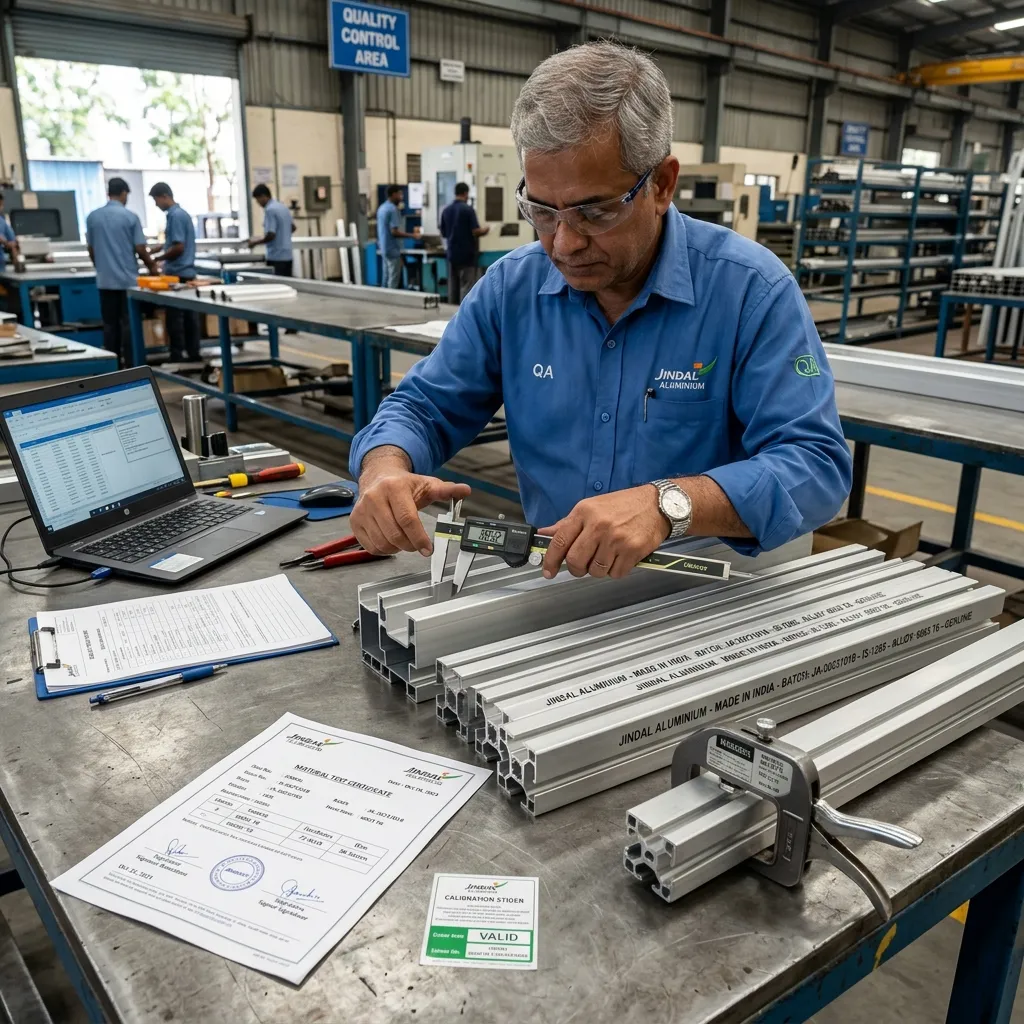
In the rapidly expanding construction and infrastructure sectors of Delhi NCR, Noida, Gurugram, and North India, aluminium extrusions represent the structural backbone of contemporary architecture. From high-rise curtain walls and unitized structural glazing to commercial office partitions and high-traffic entryway systems, architectural aluminum must withstand severe structural wind loads, seismic movements, and thermal fluctuations.
Jindal Aluminium Limited (JAL) is universally recognized as the gold standard of aluminium extrusions in India, commanding over 30% of the domestic market share due to its primary billet purity, strict metallurgical tolerances, and state-of-the-art manufacturing facilities. However, this high brand equity has made Jindal Aluminium a prime target for counterfeiters and unorganized scrap-recycling extruders across wholesale markets in North India.
For real estate developers, structural glazing contractors, facade consultants, and procurement managers, unknowingly installing duplicate or sub-standard aluminium profiles introduces catastrophic liability risks—ranging from structural frame collapse under monsoon wind pressures to brittle cracking, seal failure, and severe surface discoloration.
This definitive technical buyer's guide, compiled by the materials quality assurance team at Premier Aluminium Traders (authorized Jindal Aluminium distributors since 1978 in Paharganj, New Delhi), delivers an actionable 6-point inspection protocol, metallurgical comparison tables, laboratory verification procedures, and strategic sourcing guidelines to guarantee 100% genuine Jindal Aluminium on your job sites.
1. Executive Summary: The Problem of Counterfeits
The Indian aluminium market is heavily bifurcated between primary smelter billet producers (led by Jindal Aluminium Ltd.) and secondary unorganized re-melters who melt scrap metal with uncontrolled trace element contamination. In local wholesale hubs like Chawri Bazar, Paharganj, and Mayapuri, unscrupulous suppliers often sell sub-standard secondary extrusions deceptively passed off as "Jindal Make" or "Commercial Jindal."
These counterfeit extrusions are fabricated with deliberately thinned wall thicknesses (often 15% to 25% below specified engineering drawings), uncalibrated aging ovens yielding poor T4/T5 heat tempers instead of structural T6 temper, and scrap billets loaded with high iron (Fe) and zinc (Zn) impurities.
Real-World Engineering Risks of Counterfeit Aluminium:
- Structural Deflection & Facade Failure: Under high wind loads in high-rise towers (Delhi NCR Zone IV seismic and 47 m/s basic wind speed), undersized mullions deflect excessively, leading to silicone structural sealant failure, glass panel dislodgement, and fatal facade collapse.
- Brittle Cracking During Fabrication: Inferior alloys lacking homogeneous grain structure crack or fracture during 90-degree corner crimping, mechanical punching, or screw fastening.
- Catastrophic Anodizing & Powder Coating Defects: High iron impurities in recycled scrap cause milky surface hazing, uneven coating adhesion, filiform corrosion, and premature peeling within 12 to 24 months of atmospheric exposure.
- Electrical Overheating in Busbars: Scrap-melted aluminium busbars feature high electrical resistance, triggering severe heat build-up, insulation melting, and industrial electrical fire hazards in distribution panels.
2. The 6-Point Checklist to Verify Genuine Jindal Aluminium
To ensure complete compliance on site, QA/QC engineers and site project managers must implement the following 6-point incoming material inspection protocol before accepting any extrusion dispatch:
a) Factory Continuous Dot-Matrix Laser Marking
Every genuine extrusion manufactured at Jindal Aluminium Limited's Bangalore or Savli plants undergoes computer-controlled continuous dot-matrix laser inkjet printing along the profile body.
Key Inspection Markers to Verify:
- Official Brand Identification: Clear alphanumeric printing reading "JINDAL ALUMINIUM" or the registered "JAL" trademark.
- Alloy & Temper Designation: Explicit material grade specification, such as "6063 T6", "6061 T6", or "6082 T6".
- Die Number Identification: A 4-digit or 5-digit official JAL die number matching the certified Jindal Section Catalog.
- Batch / Cast Identification & Timestamp: Traceable cast tracking code and manufacturing date stamp applied directly on the extrusion line.
Quality Auditor Tip: Counterfeiters often attempt to apply manual rubber stamps or low-resolution surface stickers. True JAL laser markings are embedded into the mill surface, clear, non-smudging, and positioned at recurring regular intervals along the length of each profile.
b) Official Branded Packaging & Tamper-Evident Strapping
Authentic factory dispatches from Jindal Aluminium adhere to stringent industrial packaging standards designed to prevent transit scratching and oxidation:
- Protective Surface Film: Profiles are wrapped with heavy-gauge, UV-stabilized protective masking tape prominently printed with the authentic multi-color Jindal Aluminium Limited corporate logo and handling instructions.
- High-Density Bundle Wrapping: Bulk bundles are bound in high-density polyethylene (HDPE) corrugated craft wrap with heavy-duty plastic edge protectors.
- Tamper-Evident Strapping: Factory strapping features proprietary high-tensile composite banding with embossed batch security clips.
c) Mill Test Certificate (MTC) & Batch Traceability
Never accept a commercial aluminium dispatch without a certified manufacturer Mill Test Certificate (MTC) originating directly from Jindal Aluminium Limited.
An authentic JAL MTC contains the following non-negotiable verification parameters:
- Heat / Cast Number: Direct metallurgical correlation to the melt batch at the primary cast house.
- Chemical Composition Spectrography (% Weight):
- Alloy 6063: Silicon (0.20–0.60%), Magnesium (0.45–0.90%), Iron (max 0.35%), Copper (max 0.10%), Manganese (max 0.10%), Zinc (max 0.10%), Titanium (max 0.10%), Aluminium (Remainder).
- Mechanical Test Values:
- 0.2% Proof Stress (Yield Strength): Minimum 170 MPa (for 6063-T6).
- Ultimate Tensile Strength (UTS): Minimum 215 MPa (for 6063-T6).
- Percentage Elongation (A50mm): Minimum 8.0%.
- Official Authorized Signatory: Digital metallurgical laboratory seal and signature of the Chief Metallurgist at JAL.
d) Dimensional Precision & Weight-per-Length Verification
The most common fraud committed by local scrap extruders is "weight shaving"—reducing profile wall thickness while maintaining outer bounding dimensions. For example, a drawing specifying a 2.0 mm wall thickness is secretly delivered as 1.55 mm, saving the fraudulent supplier 22% in metal while billing the customer at full catalog price.
How to Execute a Field Check:
- Digital Vernier Caliper Measurement: Take micrometer readings across multiple points—the base flange, web center, and screw bosses. Genuine Jindal extrusions maintain wall thickness tolerance within ±0.08 mm to ±0.15 mm per IS 3965.
- Weighing Scale Audit: Cut an exact 1.00-meter sample or weigh a full standard 12-foot (3.657 m) section on a calibrated digital scale.
- Compare Against Catalog Nominal Weight: If the measured weight falls more than 5% below the theoretical catalog weight published in the official Jindal Section Catalog, the material is counterfeit or non-compliant.
e) Hardness & Temper Testing (Webster / Barcol Hardness)
Alloy temper is invisible to the naked eye. Unscrupulous extruders frequently bypass artificial aging in heat-treatment ovens to save on electricity, delivering soft T4 material (naturally aged) disguised as high-strength T6 temper.
Conduct on-site non-destructive hardness testing using a portable Webster Hardness Gauge (Model B):
- Genuine Jindal 6063-T6: Must register 10 to 14 Webster Hardness (HW) (equivalent to 75–85 Vickers Hardness HV or 65–75 Barcol).
- Substandard / Counterfeit Profiles: Typically register between 4 to 8 HW. Material in this soft state will sag under dead loads and deform permanently when subjected to mechanical wind pressures.
f) Authorized Dealer Sourcing & Supply Chain Integrity
The ultimate safeguard against duplicate material is direct procurement through verified, long-standing authorized stockists. Authorized distributors maintain transparent supply chain records, direct billing from Jindal Aluminium Limited's production hubs, and open-door warehouse inspection policies.
3. Genuine Jindal Extrusions vs. Local Counterfeit Profiles
To clearly evaluate the technical and financial risks, review this direct metallurgical comparison between genuine Jindal Aluminium extrusions and substandard local market alternatives:
| Evaluation Parameter | Genuine Jindal Aluminium (JAL) | Local / Substandard Extrusion | Risk & Project Impact |
|---|---|---|---|
| Raw Material Billet | 100% Pure primary aluminium ingots (NALCO / Hindalco prime melt) | Recycled post-consumer scrap melted in uncalibrated local crucible furnaces | Scrap contains iron and zinc inclusions causing micro-cracking and brittleness |
| Alloy Chemistry Control | Tight spectrographic laboratory control per IS 733 / IS 1285 specifications | Uncontrolled trace elements with high iron (>0.6%) and silicon variances | Poor mechanical strength; fails structural wind load compliance |
| Heat Treatment & Aging | Computerized quench systems and precision artificial aging ovens (T6 Temper) | Incomplete cooling, skipped heat cycles, or air-cooled natural aging (T4) | Soft extrusions (low hardness <8 HW); severe deflection under dead load |
| Dimensional Accuracy | High-precision dies manufactured on CNC/EDM wire-cut machinery | Worn, refurbished local dies with sloppy tolerances | Interlocks jam, rubber gaskets fail to seal, causing water leakage |
| Wall Thickness Integrity | Full specified metal thickness meeting strict nominal catalog weights | Deliberately shaved wall thickness (15–25% undersized) | Substantial reduction in moment of inertia (Ixx/Iyy); facade structural hazard |
| Surface Morphology | Mirror-smooth extrusion surface free of scratches, lines, or blisters | Prominent longitudinal die lines, gouges, oxidation spots, and pitting | Unsightly aesthetic finish; requires costly pre-coating grinding |
| Coating Performance | Excellent bonding with Qualicoat-certified powder coating & 25-micron anodizing | Poor chemical conversion; premature blistering, fading, and peeling | Total coating delamination within 1-2 years under sun and monsoon exposure |
| Documentation & MTC | Certified 3.1 Mill Test Certificates with direct heat/batch traceability | Forged, generic, or unavailable test certificates | Immediate disqualification during third-party structural QA/QC audits |
4. How Counterfeits Cause Critical Failures on Site
Using substandard counterfeit profiles triggers severe structural, functional, and financial consequences across various architectural and industrial building applications:
a) Structural Glazing & High-Rise Curtain Walls
In modern commercial facades, aluminium mullions and transoms act as the primary structural skeleton transferring wind loads directly to the building's RCC frame. Counterfeit sections with shaved wall thickness and inferior 6063-T4 metallurgical temper exhibit a severely reduced Moment of Inertia.
Under gusting wind pressures (such as seasonal dust storms and monsoon squalls in Delhi NCR), the structural mullions deflect beyond the permissible L/175 or 20 mm limit. This excessive deflection shears the structural silicone sealant joints holding the double-glazed units (DGU), causing catastrophic glass breakage, severe air infiltration, and building facade collapse.
b) Architectural Sliding Windows & Entrance Doors
In residential and commercial fenestration, using duplicate sections leads to rapid operational degradation:
- Bottom Track Crushing: Heavy double-glazed sliding shutters crush undersized track rails, jamming nylon/brass rollers within 6 months.
- Acoustic and Water Leaks: Out-of-tolerance interlocks fail to mesh with EPDM weatherstrips, permitting external dust, traffic noise, and monsoon rainwater to penetrate luxury indoor spaces.
- Hinged Door Sagging: Commercial aluminium door stiles made from soft recycled profiles bend under the dead weight of tempered glass, resulting in frame rubbing, latch misalignment, and lock failure.
c) Electrical Switchgear Busbars & Power Conduits
Aluminium alloy 6101-T6 is engineered specifically for high electrical conductivity (minimum 55-57% IACS). Unscrupulous traders frequently substitute genuine 6101 electrical busbars with cheap recycled scrap extrusions containing heavy iron, copper, and lead contamination.
These impurities create high electrical resistance points across the busbar run. Under peak electrical loads in HT/LT distribution panels, the increased electrical resistance generates extreme localized temperatures exceeding 120°C, melting cable insulation, tripping master breakers, and igniting devastating industrial electrical fires.
5. Sourcing Guide: Where & How to Buy Authentic Jindal Aluminium in Delhi NCR
Navigating the bustling metal markets of Paharganj, Chawri Bazar, and greater Delhi NCR requires technical vigilance and strategic procurement practices.
Strategic Sourcing Best Practices:
- Ask for the Manufacturer Mill Test Certificate Upfront: Make the delivery of an authentic, batch-coded JAL Test Certificate a mandatory, legally binding condition in your purchase order (PO). Unscrupulous traders will immediately backtrack or attempt to charge extra for "paperwork."
- Beware of Unrealistic "Below Market" Quotations: Primary smelter aluminium pricing is directly linked to London Metal Exchange (LME) and domestic primary benchmark rates (NALCO / Hindalco). Any quotation offering finished "Jindal" extrusions at prices lower than prevailing primary ingot rates plus standard conversion premiums is an immediate red flag indicating scrap-melted counterfeit material.
- Conduct Random Caliper and Hardness Checks at Delivery: Equip your site receiving team with a digital vernier caliper and a Webster hardness tester. Inform the supplier that delivery acceptance is contingent on passing random dimensional and hardness tests.
- Verify Stockist Authorization Credentials: Always purchase through recognized, authorized Jindal Aluminium distributors who maintain massive physical inventories, direct factory billing accounts, and permanent warehousing facilities.
Why Sourcing from Premier Aluminium Traders Guarantees 100% Peace of Mind
Established in 1978 in Paharganj, New Delhi, Premier Aluminium Traders (Premier Sales Corporation) has served as North India's premier authorized dealer and stockist of authentic Jindal Aluminium Limited extrusions for nearly five decades.
When you source through Premier Aluminium Traders, you receive:
- 100% Factory-Direct Genuine JAL Profiles: Every section is sourced directly from Jindal Aluminium's primary manufacturing plants.
- Comprehensive Physical Stock: Massive ready inventory of solid rods, architectural box sections, window tracks, curtain walls, solar structures, and electrical busbars at our New Delhi warehouses.
- Batch-Specific Test Certificates: Complete 3.1 Mill Test Certificates provided with dispatches for seamless consultant and structural auditor approval.
- In-House Value Added Processing: Precision metal cutting, hole punching, custom architectural anodizing, and Qualicoat-certified powder coating.
- Rapid Regional Logistics: Same-day loading and secure transport across Delhi NCR, Haryana, Uttar Pradesh, Rajasthan, and pan-India project sites.
6. Frequently Asked Questions (FAQs)
1. How can I verify if an aluminium section is original Jindal?
To verify an original Jindal Aluminium section, check for: (1) Continuous dot-matrix laser inkjet markings along the profile showing "JINDAL ALUMINIUM" or "JAL", alloy grade, die number, and date stamp; (2) Official Jindal branded protective masking tape; (3) A batch-coded Mill Test Certificate (MTC); (4) Accurate wall thickness and weight matching the official Jindal catalog; and (5) A minimum hardness of 10-12 Webster (HW) for 6063-T6 alloy.
2. Does Jindal Aluminium come with a Mill Test Certificate (MTC)?
Yes, authentic Jindal Aluminium extrusions are always accompanied by an official Mill Test Certificate (MTC) issued by Jindal Aluminium Limited. The MTC provides the batch cast number, spectrographic chemical composition (Si, Mg, Fe), and mechanical test results (Yield Strength, Tensile Strength, and % Elongation).
3. What is the standard hardness of genuine Jindal 6063-T6 extrusions?
Genuine Jindal Aluminium extrusions in alloy 6063 with a T6 temper exhibit a minimum hardness of 10 to 14 Webster Hardness (HW) (approximately 75 to 85 HV Vickers Hardness). Substandard or duplicate profiles usually test below 8 HW due to improper aging.
4. Why are duplicate aluminium sections cheaper than genuine Jindal?
Counterfeit aluminium sections are 15% to 30% cheaper because they are manufactured using low-grade recycled scrap metal instead of pure primary ingots, deliberately shaved in wall thickness to reduce metal weight, and processed without energy-intensive artificial aging ovens.
5. Can fake aluminium affect the quality of powder coating and anodizing?
Yes. Substandard aluminium contains high levels of iron, zinc, and silicone impurities. These impurities cause poor chemical conversion during pre-treatment, resulting in uneven anodizing color, milky haze, micro-blistering, and complete powder coating delamination within 1 to 2 years of weather exposure.
6. Who is an authorized Jindal Aluminium dealer in Paharganj, New Delhi?
Premier Aluminium Traders, located at 3/8, D.B. Gupta Road, Paharganj, New Delhi - 110055 (Phone: +91-9891097111 / 011-41657680), is a premier authorized dealer and stockist of authentic Jindal Aluminium Limited extrusions, serving Delhi NCR and North India since 1978.
7. Ensure 100% Genuine Jindal Aluminium on Your Next Projects
Don't let counterfeit aluminium compromise the structural integrity, safety, and architectural elegance of your prestigious projects. Partner with North India's most trusted Jindal Aluminium stockist and ensure 100% certified quality from day one.
Connect with Our Engineering Sales Desk Today:
- Company: Premier Aluminium Traders (Premier Sales Corporation)
- Address: 3/8, D.B. Gupta Road, Paharganj, New Delhi - 110055
- Direct Phone / WhatsApp: +91-9891097111 / 011-41657680
- Email: premieraluminiumtraders@gmail.com
- Website: www.premieraluminiumtraders.com
- Request a Certified Quote: Click here to submit your project BOQ for an instant B2B quotation