Blog
Aluminium T-Sections & Structural T-Bars: Extrusion Sizing, Weight Chart & Panel Stiffening Guide
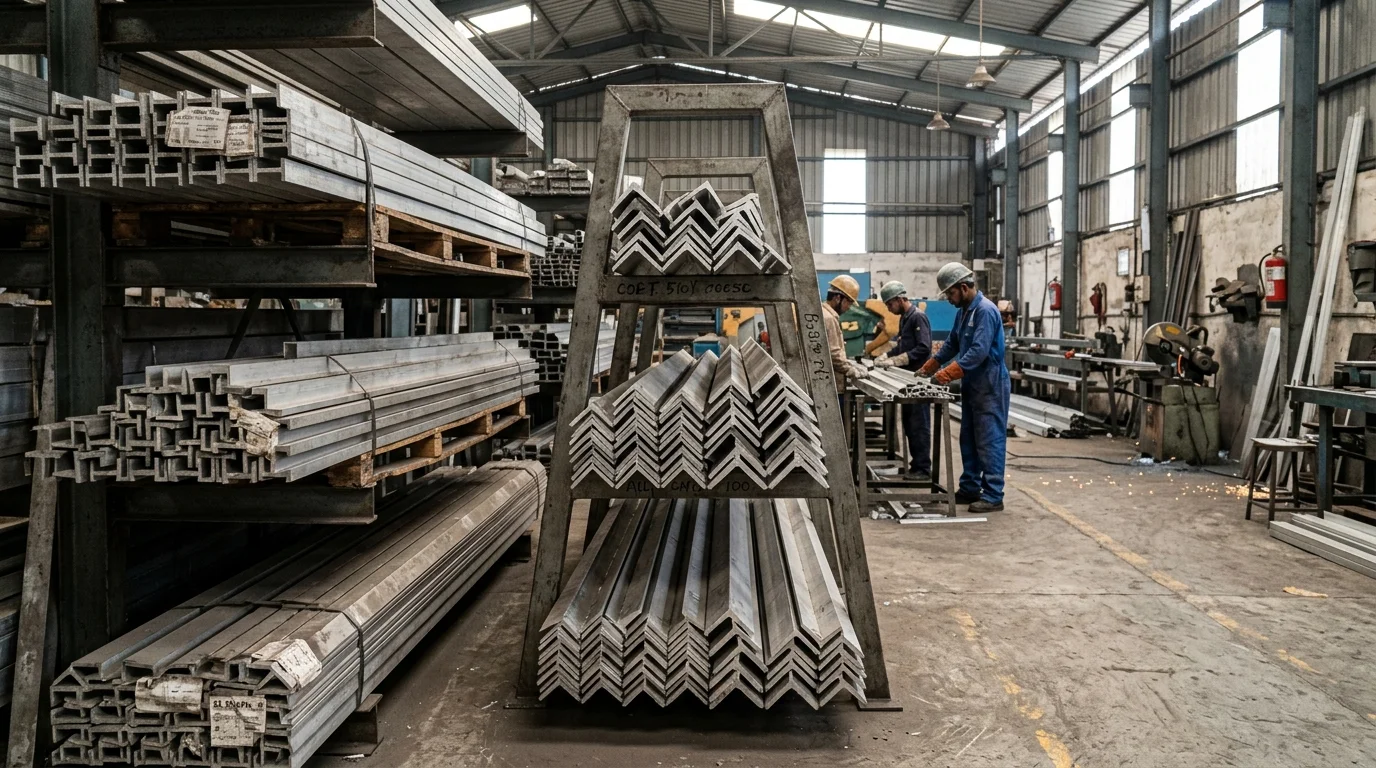
In architectural facade engineering, exterior cladding installation, commercial suspended ceilings, and modular exhibition booth construction, extruded aluminium T-sections—commonly known as T-bars or Tee profiles—play a crucial mechanical role. Featuring a symmetrical horizontal flange joined perpendicularly to a vertical stem (web), the T-profile is engineered to deliver high section modulus and flexural rigidity along its vertical axis while providing a flat continuous mounting surface on both sides of the flange.
Whether functioning as hidden vertical stiffeners bonded to the rear of large Aluminium Composite Panels (ACP) and ceramic tiles to eliminate "oil-canning" flutter under high wind suction, forming structural intermediate transoms in glass curtain wall systems, or creating durable suspended grid ceilings in commercial airports and metro stations, selecting the correct T-section requires balancing flange width ($B$), stem height ($H$), thickness ($t$), and theoretical section weight per meter per IS 733 / IS 1285 standards.
Curated by the structural extrusions desk at Premier Aluminium Traders—authorized distributor and stockist of Jindal Aluminium Limited in Paharganj, New Delhi since 1978—this practical engineering guide breaks down T-section structural mechanics, theoretical weight equations, standard size tables, facade panel stiffener installation techniques, and wholesale procurement across North India.
1. Anatomy of an Extruded T-Section: Engineering Mechanics
The unique structural efficiency of an extruded aluminium T-section stems from its geometric distribution of metal cross-section:
                            FLANGE WIDTH (B)
                 +-----------------------------------+
                 |                                   |  Flange Thickness (t)
                 +-----------------+-----------------+
                                   | |
                                   | |  Stem / Web
                                   | |  Thickness (t)
                      Stem         | |
                      Height (H)   | |  Provides High
                                   | |  Vertical Bending
                                   | |  Resistance (Ixx)
                                   | |
                                   +-+
1. High Vertical Moment of Inertia ($I_{xx}$)
Under horizontal wind pressure acting on an exterior building facade, large panels tend to bow inward and outward. The vertical stem of the T-bar acts as a structural rib, multiplying the profile's Moment of Inertia ($I_{xx}$) and resisting flexural deflection with far less metal weight than a solid rectangular bar.
2. Dual-Sided Flange Bonding
Unlike an L-angle that provides mounting on only one side, the horizontal flange of a T-bar extends symmetrically on both sides of the stem. This enables:
- Seamless butt-joint clamping between adjacent architectural glass or cladding panels.
- Symmetrical adhesive bonding using structural double-sided tape and silicone sealants without introducing eccentric torsional twist.
3. Universal Weight Calculation Formula for Aluminium T-Sections
In commercial procurement across Delhi NCR, aluminium profiles are sold by actual weight (₹/kg). Contractors and structural estimators can compute theoretical weight per meter using this universal equation:
$$\text{Weight per Meter } (kg/m) = (B + H - t) \times t \times 0.00270$$
Where:
- $B$ = Overall horizontal flange width in millimeters ($mm$)
- $H$ = Overall vertical stem height in millimeters ($mm$)
- $t$ = Nominal wall thickness in millimeters ($mm$)
- $0.00270$ = Density of high-purity extruded aluminium ($g/cm^3$)
Worked Workshop Example: 50 x 50 x 5 mm T-Bar
---------------------------------------------
- Flange Width B = 50.0 mm
- Stem Height H = 50.0 mm
- Wall Thickness t = 5.0 mm

Calculation:
Weight (kg/m) = (50.0 + 50.0 - 5.0) * 5.0 * 0.00270
Weight (kg/m) = 95.0 * 5.0 * 0.00270
Weight (kg/m) ≈ 1.283 kg/meter

For a standard 12-foot (3.657 meter) commercial bar:
Total Bar Weight = 1.283 * 3.657 ≈ 4.69 kg
4. Jindal Aluminium T-Section Sizing & Weight Reference Chart
Below is the verified engineering reference chart for standard extruded aluminium T-sections, correlating flange width, stem height, wall thickness, theoretical weights, and primary architectural applications:
| Flange Width $B$ (mm) | Stem Height $H$ (mm) | Thickness $t$ (mm) | Inch Size Equivalent | Theoretical Weight ($kg/m$) | Primary Workshop & Architectural Uses |
|---|---|---|---|---|---|
| $19.05\text{ mm}$ | $19.05\text{ mm}$ | $1.60\text{ mm}$ | $3/4" \times 3/4"$ | $0.158\text{ }kg/m$ | Lightweight suspended ceiling grid tees, cabinet trims |
| $25.4\text{ mm}$ | $25.4\text{ mm}$ | $1.60\text{ mm}$ | $1" \times 1"$ (Light) | $0.213\text{ }kg/m$ | Standard interior false ceiling runner, tile joints |
| $25.4\text{ mm}$ | $25.4\text{ mm}$ | $3.00\text{ mm}$ | $1" \times 1"$ (Heavy) | $0.387\text{ }kg/m$ | Modular exhibition booth frames, partition dividers |
| $38.1\text{ mm}$ | $38.1\text{ mm}$ | $3.00\text{ mm}$ | $1-1/2" \times 1-1/2"$ | $0.593\text{ }kg/m$ | ACP cladding panel vertical stiffener ribs |
| $50.0\text{ mm}$ | $50.0\text{ mm}$ | $3.00\text{ mm}$ | $2" \times 2"$ | $0.786\text{ }kg/m$ | High-span ACP panel backing stiffeners, signboards |
| $50.0\text{ mm}$ | $50.0\text{ mm}$ | $5.00\text{ mm}$ | $2" \times 2"$ (Heavy) | $1.283\text{ }kg/m$ | Facade sub-frame brackets, curtain wall expansion joints |
| $75.0\text{ mm}$ | $50.0\text{ mm}$ | $5.00\text{ mm}$ | $3" \times 2"$ (Unequal) | $1.620\text{ }kg/m$ | High-wind facade transoms, stone cladding sub-rails |
| $75.0\text{ mm}$ | $75.0\text{ mm}$ | $6.00\text{ mm}$ | $3" \times 3"$ | $2.333\text{ }kg/m$ | Heavy structural framing, unitized curtain wall mullion |
| $100.0\text{ mm}$ | $100.0\text{ mm}$ | $6.00\text{ mm}$ | $4" \times 4"$ | $3.143\text{ }kg/m$ | Commercial high-rise wind stiffeners, bridge trims |
| $100.0\text{ mm}$ | $100.0\text{ mm}$ | $10.00\text{ mm}$ | $4" \times 4"$ (Jumbo) | $5.130\text{ }kg/m$ | Heavy marine deck stiffeners, transport car chassis |
5. ACP Cladding Installation: How T-Bars Eliminate "Oil-Canning"
When large Aluminium Composite Panels ($>1.2\text{ m} \times 2.4\text{ m}$) are installed on commercial exterior facades in Delhi NCR, intense solar heating combined with seasonal wind gusts creates thermal expansion buckling known as "oil-canning":
        EXTERIOR ACP CLADDING PANEL
        +-----------------------------------------------+
        |                                               |
        |  [ Structural High-Bond VHB Adhesive Tape ]   |
        |                       +                       |
        |  [ Neutral-Cure Structural Silicone Bead  ]   |
        |                                               |
        +-----------------------+-----------------------+
                                | |
                                | | <--- Jindal 6063-T6 Aluminium T-Bar
                                | |      (Vertical Panel Stiffener)
                                | |
Installation Best Practice:
- Vertical Stiffener Spacing: Bond extruded aluminium T-sections ($38 \times 38\text{ mm}$ or $50 \times 50\text{ mm}$) to the rear of the ACP sheet at intervals not exceeding $600\text{ mm}$.
- Dual Fastening System: Apply continuous structural acrylic foam tape (VHB type) along the T-bar flange to hold the stiffener during curing, flanked by a generous bead of high-modulus neutral-cure structural silicone adhesive.
- Thermal Expansion Slotted Holes: Where T-bars anchor into the primary building structural brackets, always use slotted oval holes to allow vertical thermal expansion ($\approx 1.2\text{ mm per meter}$ across 40°C temperature shifts in Delhi) without inducing panel distortion.
6. Alloy Selection: Architectural 6063-T6 vs. Structural 6082-T6
| Engineering Parameter | Architectural 6063-T6 T-Sections | Heavy Structural 6082-T6 T-Sections |
|---|---|---|
| Primary Specialty | Sleek visible trims, false ceilings, ACP backing | High-load structural facades & dynamic framing |
| Yield Strength (0.2% Proof) | $\ge 170\text{ }MPa$ | $\ge 250\text{ }MPa$ (47% stronger!) |
| Tensile Strength (UTS) | $\ge 205\text{ }MPa$ | $\ge 295\text{ }MPa$ |
| Surface Finish | Pristine, razor-sharp die finish | Heavy industrial finish |
| Anodizing Response | Superior optical clarity (Silver, Gold, Black) | Slate greyish tone (Best with powder coating) |
| Fastener Thread Holding | Good | Exceptional (resists bolt thread stripping) |
| Best Used For | Visible ceiling grids, light cladding | Facade floor cleats, heavy curtain wall stiffeners |
7. Sourcing Genuine Jindal T-Sections at Premier Aluminium Traders
Premier Aluminium Traders is North India’s trusted authorized distributor and stockist of Jindal Aluminium Limited extrusions:
- Central Delhi Ready Stock: Full size range of equal and unequal T-sections available for same-day dispatch from our Paharganj warehouse.
- Certified Primary Billets: Extruded exclusively from primary alloy billets with zero recycled scrap contamination, ensuring maximum ductility, fatigue strength, and corrosion defense.
- Mill Test Certificates (MTC): Genuine Jindal factory certificates verifying alloy grade, temper, and tensile strength provided with every commercial dispatch.
- In-House Value-Added Services: Precision CNC circular cold sawing, custom hole punching, and architectural powder coating in standard RAL shades.
Explore related extrusions and profiles:
- Jindal Aluminium Extrusions Catalog
- Jindal Curtain Wall Sections
- Jindal Aluminium Flat Bars
- Jindal Section Weight Chart Guide
8. Frequently Asked Questions (FAQs)
1. What is the advantage of using an aluminium T-section over an angle section for panel joints?
An aluminium T-section provides a symmetrical mounting flange on both sides of the stem, allowing two adjacent cladding panels to be supported by a single central rib without eccentric torsional twisting. An angle section only supports one side, requiring twice as many profiles or inducing unbalanced loads.
2. Can aluminium T-bars be used in suspended acoustic ceilings?
Yes. Lightweight aluminium T-bars in alloy 6063-T6 are widely used for suspended grid ceilings in hospitals, corporate offices, and commercial malls because they are 100% rust-proof, non-magnetic, and maintain perfect horizontal alignment without sagging.
3. What is the standard commercial bar length for Jindal T-sections?
Standard commercial extruded lengths are 12 feet (3.657 meters) and 16 feet (4.876 meters). Custom extruded lengths up to 24 feet (7.315 meters) can be manufactured for continuous multi-story facade mullion framing.
4. Are Jindal aluminium T-bars weldable using TIG or MIG?
Yes. Both 6063-T6 and 6082-T6 T-bars exhibit outstanding weldability. Use ER4043 filler wire for general architectural assemblies or ER5356 filler wire when high dynamic shear strength is required.
5. Where can I buy certified Jindal aluminium T-sections in Delhi NCR?
Genuine Jindal Aluminium T-sections and structural T-bars can be sourced directly from Premier Aluminium Traders, located at 3/8, D.B. Gupta Road, Paharganj, New Delhi - 110055 (Phone: +91-9891097111 / 011-41657680). Immediate loading and daily dispatches across Delhi NCR, Haryana, Rajasthan, and Uttar Pradesh.