Blog
Aluminium Chequered Plates & Industrial Sheets: 5-Bar Tread Sizing, Weight Chart & Flooring Guide
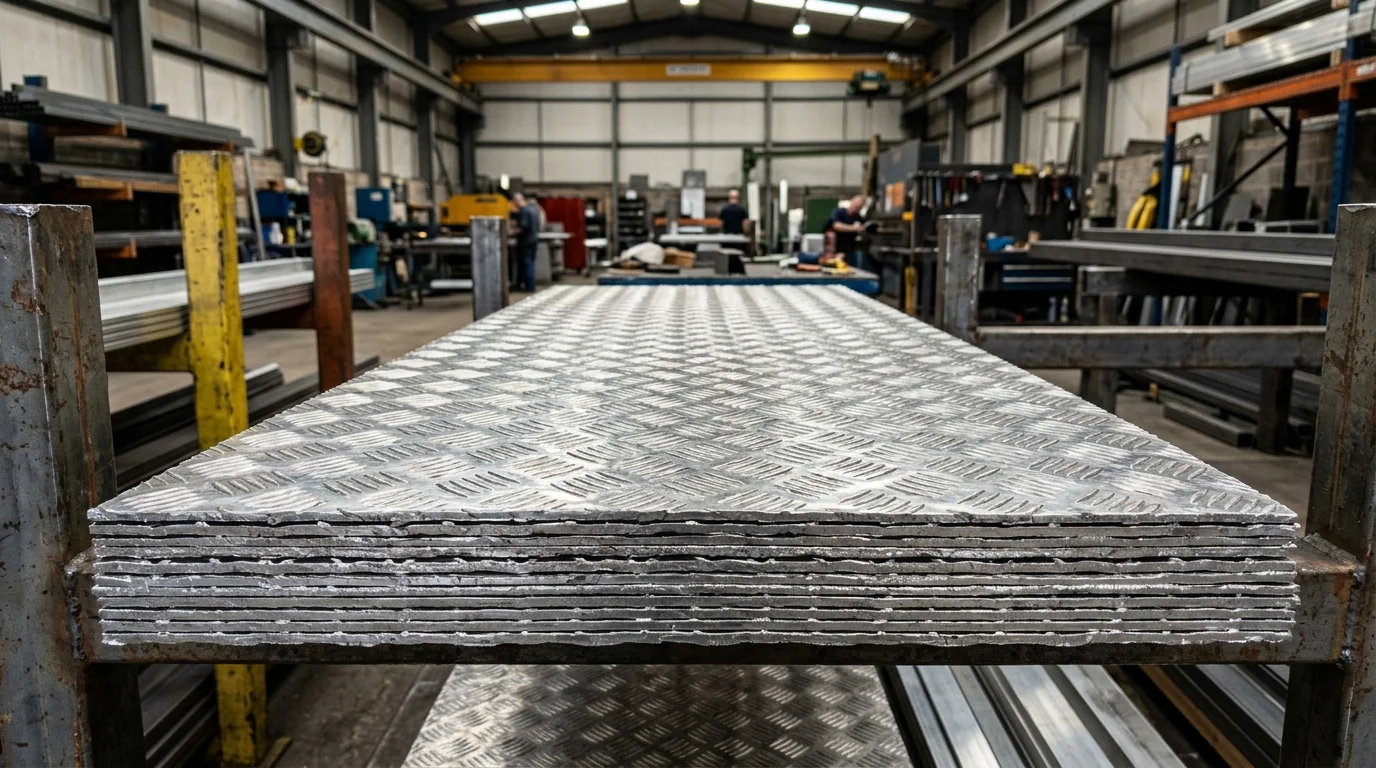
In industrial safety engineering, commercial transport vehicle manufacturing, public infrastructure construction, and architectural interior cladding, aluminium chequered plates—also known as tread plates, diamond plates, or 5-bar floor plates—represent the premier choice for durable, slip-resistant flooring. Engineered with raised, embossed 5-bar pattern lugs, these plates provide omnidirectional traction underfoot while delivering the permanent corrosion resistance and substantial weight savings unique to aluminium.
From the anti-skid gangway floors of commercial passenger buses (Tata, Ashok Leyland) and cold storage threshold ramps to generator acoustic canopies, emergency stair treads, and cleanroom entrance flooring, aluminium plates eliminate the relentless rust and repainting associated with mild steel floor plates. However, procuring the right sheet requires understanding the difference between base thickness and overall tread height, calculating theoretical weight per sheet, selecting between Alloy 3105, 5052, and 6061-T6, and knowing how to shear and brake-press bend without surface cracking.
Curated by the flat-rolled products and sheet metals desk at Premier Aluminium Traders in Paharganj, New Delhi (established 1978), this comprehensive commercial guide provides verified weight charts for 5-bar chequered plates and plain sheets, bending best practices, alloy selection matrices, and wholesale procurement guidelines across North India.
1. 5-Bar Diamond Pattern: Why It Dominates Industrial Flooring
Aluminium tread plates are manufactured with several raised pattern styles, but the 5-bar (quintet) design is universally specified across Indian and global engineering codes:
                  5-BAR EMBOSSED TREAD PATTERN
         +-----------------------------------------------+
         |   /////       \\\\\\      /////       \\\\\\  | <--- Alternating Lug Groups
         |   /////       \\\\\\      /////       \\\\\\  |      Provide 360° Anti-Skid
         |                                               |
         |   \\\\\\      /////       \\\\\\      /////   |
         |   \\\\\\      /////       \\\\\\      /////   |
         +-----------------------------------------------+
           |                                           |
           |<-- Base Metal Thickness (e.g., 3.0 mm) -->|
           +=== Raised Pattern Lug (1.0 - 1.5 mm high)=+
1. Omnidirectional Slip Resistance (R10 / R11 Rating)
Single-tear patterns offer traction primarily in one direction. The alternating 90° orientation of the 5-bar pattern provides equal frictional grip regardless of approach angle, preventing slip accidents even in the presence of engine oil, coolant washdowns, or monsoon rainwater.
2. Self-Draining & Easy Sanitization
Unlike steel grating that traps debris or deep diamond grooves that accumulate dirt, the rounded profiles of the 5-bar lugs allow water to drain freely through channels, making them easy to pressure-wash in dairy plants, food processing facilities, and hospital corridors.
3. Substantial Dead-Weight Reduction Over Steel
Steel chequered plate ($3\text{ mm}$ base) weighs roughly $25.5\text{ kg/m}^2$. An equivalent aluminium chequered plate weighs approximately $9.25\text{ kg/m}^2$—a massive 64% weight reduction. In commercial vehicle bodies (buses, ambulances, delivery trucks), this weight saving directly increases payload capacity and cuts fuel consumption.
2. Weight Formulas: Plain Sheets vs. 5-Bar Chequered Plates
Aluminium flat products are billed per kilogram based on calibrated digital scale weighment. Calculating theoretical weight ensures accurate project budgeting:
Formula A: Plain Aluminium Sheet
$$\text{Weight per Square Meter } (kg/m^2) = \text{Thickness } (mm) \times 2.71$$
$$\text{Weight per Standard 8' x 4' Sheet } (kg) = \text{Thickness } (mm) \times 2.71 \times 2.977$$
(Where $2440\text{ mm} \times 1220\text{ mm} = 2.977\text{ m}^2$ is the standard commercial $8\text{ ft} \times 4\text{ ft}$ sheet area).
Formula B: 5-Bar Chequered Tread Plate
Because the raised embossed lugs add approximately $1.10\text{ to }1.40\text{ kg/m}^2$ of aluminium above the base sheet thickness:
$$\text{Weight per Square Meter } (kg/m^2) \approx (\text{Base Thickness in mm} \times 2.71) + 1.25\text{ }kg$$
3. Verified Sizing & Weight Chart: 5-Bar Chequered Plates vs. Plain Sheets
Below is the verified engineering reference chart for standard commercial sheet sizes ($8\text{ ft} \times 4\text{ ft}$ / $2440 \times 1220\text{ mm}$ and $10\text{ ft} \times 4\text{ ft}$ / $3050 \times 1220\text{ mm}$):
| Base Thickness (mm) | Plain Sheet Weight ($kg/m^2$) | 5-Bar Chequered Weight ($kg/m^2$) | Weight per 8' x 4' Plain Sheet ($kg$) | Weight per 8' x 4' Chequered Sheet ($kg$) | Primary Industrial & Transport Applications |
|---|---|---|---|---|---|
| $1.00\text{ mm}$ | $2.71\text{ }kg$ | — | $8.07\text{ }kg$ | — | Electrical panel backplates, acoustic cladding |
| $1.50\text{ mm}$ | $4.07\text{ }kg$ | $5.20\text{ }kg$ | $12.10\text{ }kg$ | $15.48\text{ }kg$ | Light vehicle wall protection, toolboxes, cabinet kickplates |
| $2.00\text{ mm}$ | $5.42\text{ }kg$ | $6.55\text{ }kg$ | $16.14\text{ }kg$ | $19.50\text{ }kg$ | Bus interior flooring, generator canopy panels |
| $2.50\text{ mm}$ | $6.78\text{ }kg$ | $7.90\text{ }kg$ | $20.17\text{ }kg$ | $23.52\text{ }kg$ | Elevator car flooring, emergency stair landings |
| $3.00\text{ mm}$ | $8.13\text{ }kg$ | $9.25\text{ }kg$ | $24.20\text{ }kg$ | $27.54\text{ }kg$ | Commercial bus & truck main deck floor, ramps |
| $4.00\text{ mm}$ | $10.84\text{ }kg$ | $11.95\text{ }kg$ | $32.27\text{ }kg$ | $35.58\text{ }kg$ | Factory catwalks, industrial mezzanine flooring |
| $5.00\text{ mm}$ | $13.55\text{ }kg$ | $14.65\text{ }kg$ | $40.34\text{ }kg$ | $43.61\text{ }kg$ | Heavy forklift loading ramps, marine dock decks |
| $6.00\text{ mm}$ | $16.26\text{ }kg$ | $17.35\text{ }kg$ | $48.41\text{ }kg$ | $51.65\text{ }kg$ | Heavy machinery platforms, railway car transitions |
4. Sheet Alloy Selection: 3105 vs. 5052 vs. 6061-T6
Selecting the correct alloy ensures the sheet withstands both structural loading and workshop bending:
| Performance Metric | Commercial Alloy 3105 / 3003 | Marine Grade Alloy 5052-H32 | Structural Alloy 6061-T6 |
|---|---|---|---|
| Primary Specialty | General fabrication & ductile bending | Extreme corrosion defense & transport | Heavy load bearing & high strength |
| Tensile Strength (UTS) | $130 - 175\text{ }MPa$ | $210 - 260\text{ }MPa$ | $\ge 290\text{ }MPa$ (Highest) |
| Brake-Press Bending | Flawless tight bends without cracking | Excellent ($1.5 \times \text{thickness}$ radius) | Requires larger radius ($2.5 - 3.0T$) |
| Corrosion Resistance | Good atmospheric resistance | Outstanding (Monsoon, coastal & salt-spray) | Superior atmospheric resistance |
| Weldability (MIG/TIG) | Good | Superb with ER5356 wire | Excellent with ER4043 wire |
| Typical Use | Toolboxes, kickplates, wall trims | Bus flooring, ambulances, fuel tank covers | Structural decking, machine tables |
5. Workshop Fabrication: Shearing, Bending & Fastening Tips
        GUILLOTINE SHEARING                       PRESS-BRAKE BENDING
        -------------------                       -------------------
   * Sharp, burr-free high-carbon blades     * Bend PERPENDICULAR to rolling grain
   * Set blade clearance to 6% of thickness  * Use minimum inside radius: R = 1.5 x T
   * Clamp securely with urethane pads       * Position smooth side outward if tight bend
   * Prevents sheet edge deformation         * Prevents outer surface stress cracking
1. Bending Direction Relative to Rolling Grain
Rolled aluminium sheets have a distinct longitudinal grain orientation from the rolling mill:
- Rule of Thumb: Always bend perpendicular (across) the rolling grain whenever possible. Bending parallel to the grain severely increases the risk of tensile cracks along the outer bend line, especially in thicknesses $\ge 3.0\text{ mm}$.
- If bending chequered plates with the pattern on the outside face, ensure the press brake punch nose radius is at least $1.5\text{ to }2.0 \times \text{plate base thickness}$.
2. Fastening to Steel Sub-Structures
When fastening aluminium floor plates onto mild steel truck chassis or industrial staircase channel runners:
- Secure with countersunk stainless steel (SS304) self-drilling screws or heavy-duty aluminium structural rivets.
- Apply an anti-corrosion barrier coating (zinc-rich primer or EPDM tape) on the steel cross-members before laying the aluminium plate to eliminate galvanic rust.
6. Sourcing Quality Aluminium Plates at Premier Aluminium Traders
Premier Aluminium Traders maintains extensive inventories of flat-rolled aluminium products and chequered tread plates at our central Delhi facility:
- Ready Stock in Paharganj: Standard sheets ($8' \times 4'$, $10' \times 4'$, and $10' \times 5'$) available across all thicknesses from $1.0\text{ mm}$ to $6.0\text{ mm}$ for immediate loading.
- Certified Metal Quality: High-purity primary alloy sheets with uniform embossed pattern depth, consistent surface brightness, and zero oil staining.
- Factory Test Traceability: Mill test certificates verifying alloy grade, temper, and mechanical elongation supplied with commercial dispatches.
- Value-Added Shearing: In-house computerized guillotine shearing to cut custom-dimension floor panels and stair treads to exact site measurements.
Explore related products across our catalog:
- Aluminium Sheets & Plates
- Jindal Aluminium Flat Bars
- Jindal Extrusions Complete Catalog
- Section Weight Chart Guide
7. Frequently Asked Questions (FAQs)
1. What is the difference between aluminium chequered plate and diamond plate?
"Chequered plate" and "diamond plate" are interchangeable commercial terms. In India, the 5-bar (quintet) chequered pattern is the predominant industry standard because its alternating five-lug clusters provide superior omnidirectional slip resistance compared to traditional single-diamond patterns.
2. Why should I use aluminium chequered plate instead of mild steel floor plate?
Aluminium chequered plate is 64% lighter than mild steel, 100% rust-proof, non-sparking, and never requires expensive periodic repainting. In commercial vehicles, the dramatic weight reduction lowers fuel costs and increases legal payload capacity.
3. Can aluminium chequered plates be welded using MIG welding?
Yes. Plates in Alloy 5052 or 6061 are easily welded to aluminium structural frames using pulsed MIG welding with ER5356 filler wire and pure argon shielding gas.
4. What thickness is recommended for commercial bus flooring?
For passenger bus main aisle floors, $2.0\text{ mm}$ to $3.0\text{ mm}$ base thickness 5-bar chequered plate is the industry standard, providing adequate impact resistance over structural cross-members spaced at $300\text{ to }400\text{ mm}$ intervals.
5. Where can I buy certified aluminium chequered plates in Delhi NCR?
Authentic, high-grade aluminium chequered plates and plain industrial sheets can be purchased directly from Premier Aluminium Traders, located at 3/8, D.B. Gupta Road, Paharganj, New Delhi - 110055 (Phone: +91-9891097111 / 011-41657680). Fast regional dispatch across Delhi NCR, Haryana, Uttar Pradesh, and Rajasthan.