Blog
Aluminium Busbars vs. Copper Busbars: 6101-T6 Sizing, Ampacity Rating & Switchgear Cost Analysis
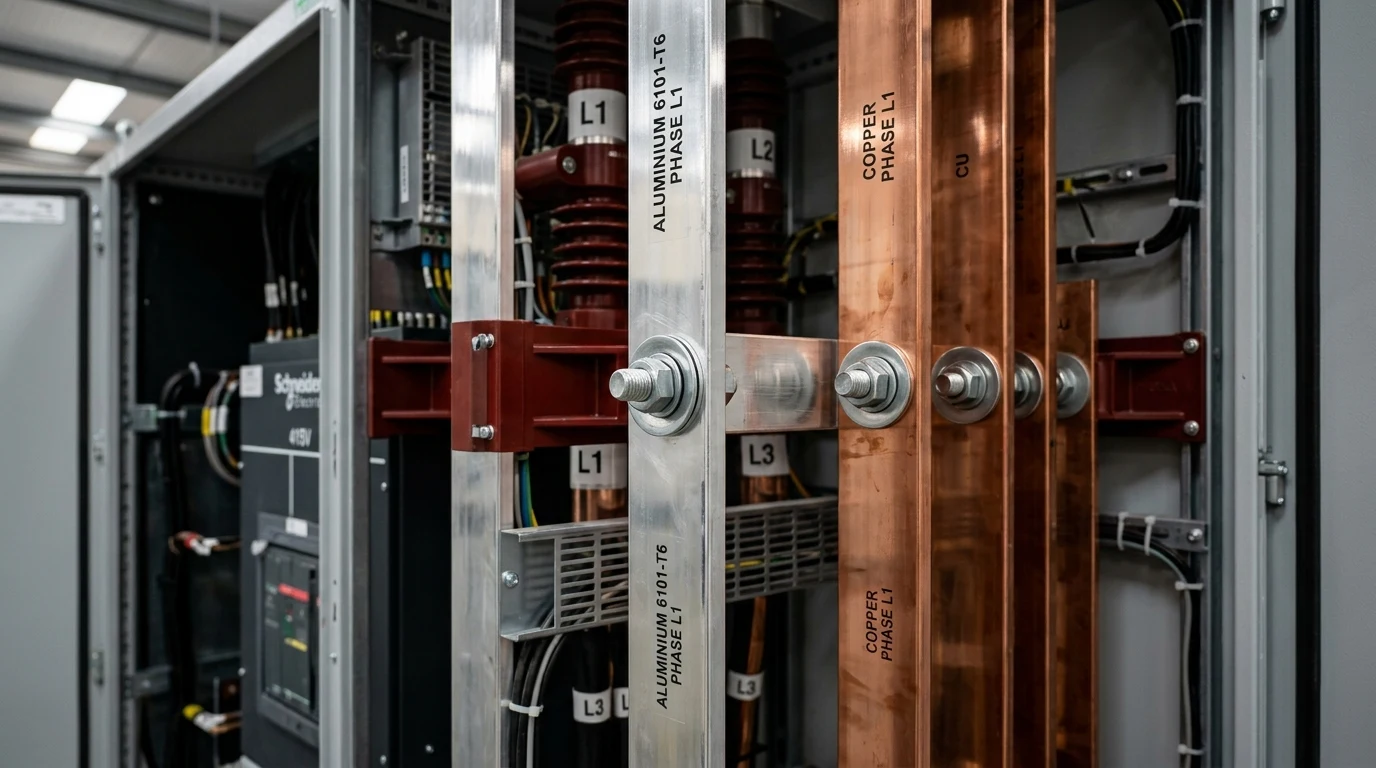
In industrial electrical distribution, switchgear manufacturing, and control panel engineering, the debate between aluminium and copper conductors has shifted decisively. Volatile global copper commodity prices, tightening project budgets, and the aggressive pursuit of weight reduction in low-voltage (LV) and medium-voltage (MV) panels have led original equipment manufacturers (OEMs) and electrical contractors across India to standardize on high-grade electrical aluminium busbars.
However, substituting copper with aluminium is not simply a matter of a 1-to-1 dimensional replacement. Designing a safe, efficient, and code-compliant electrical distribution system requires a rigorous understanding of metallurgy, electrical resistivity, cross-sectional ampacity derating, thermal expansion differentials, and joint connection techniques.
Curated by the technical applications team at Premier Aluminium Traders—authorized distributor and stockist of Jindal Aluminium Limited in New Delhi since 1978—this engineering guide breaks down the science of Alloy 6101-T6 electrical flat bars, ampacity calculations, jointing best practices per IS 5082 / IEC 61439, and the real-world economic savings achievable in commercial switchgear design.
1. Metallurgical Comparison: Electrical-Grade Aluminium vs. Electrolytic Copper
To properly size an electrical busbar, engineers must examine the intrinsic physical, electrical, and thermal properties of the conductive metals.
While Electrolytic Tough Pitch (ETP) Copper (Alloy C11000) remains the baseline reference for 100% IACS (International Annealed Copper Standard), modern electrical conductor grade aluminium alloys—specifically Jindal Alloy 6101-T6 and EC-Grade 1350-O/H111—provide exceptional conductivity at a fraction of copper's mass and price.
| Property | Jindal Alloy 6101-T6 (Electrical Heat-Treated) | EC Grade 1350-H111 (Pure Aluminium) | ETP Copper (C11000 Electrolytic) | Engineering Significance |
|---|---|---|---|---|
| Electrical Conductivity (% IACS) | 57% – 60% | 61.0% | 100% | Defines current-carrying capability per unit cross-section |
| Electrical Resistivity at 20°C ($\mu\Omega\cdot cm$) | $2.87 - 3.02$ | 2.80 | 1.72 | Governs $I^2R$ resistive heat dissipation |
| Density ($g/cm^3$) | $2.70$ | 2.70 | $8.96$ | Copper is 3.32x heavier than aluminium |
| Ultimate Tensile Strength (UTS) | $205 - 240\text{ }MPa$ | $90 - 110\text{ }MPa$ | $220 - 260\text{ }MPa$ | 6101-T6 withstands high short-circuit electrodynamic forces |
| 0.2% Proof Stress (Yield) | $\ge 170\text{ }MPa$ | $\ge 40\text{ }MPa$ | $\ge 200\text{ }MPa$ | Prevents busbar deformation under magnetic surge currents |
| Thermal Expansion Coefficient ($/^\circ C$) | $23.0 \times 10^{-6}$ | $23.5 \times 10^{-6}$ | $16.5 \times 10^{-6}$ | Requires Belleville spring washers on bolted joints |
| Thermal Conductivity ($W/m\cdot K$) | $200 - 215$ | 230 | 385 | Dictates convective and radiative cooling in panels |
| Raw Material Cost Ratio | 1x (Baseline) | 0.95x | 3.8x – 4.5x higher | Primary driver of capital expenditure savings |
Why Alloy 6101-T6 is the Industry Standard for Switchboards
While pure EC-grade aluminium (Alloy 1350) achieves slightly higher conductivity (61% IACS), it is mechanically soft with low yield strength ($< 50\text{ }MPa$). During catastrophic short-circuit conditions (e.g., $50\text{ }kA$ for 1 second), magnetic repulsion forces between parallel phases can bend soft conductors, resulting in flashovers.
Jindal Alloy 6101-T6 contains controlled additions of magnesium ($0.35 - 0.80%$) and silicon ($0.30 - 0.70%$). Through precise artificial age hardening (T6 temper), it delivers a robust yield strength exceeding $170\text{ }MPa$ while preserving an electrical conductivity of $57 - 60%\text{ }IACS$. This unique balance enables compact panel layouts capable of passing CPRI and IEC 61439 short-circuit type tests.
2. Cross-Sectional Sizing & The "1.6x Rule"
Because aluminium has approximately $60%$ the conductivity of copper, an aluminium busbar requires roughly 1.55 to 1.60 times the cross-sectional area of an equivalent copper busbar to carry identical electrical current at the same operating temperature rise.
$$\frac{A_{Al}}{A_{Cu}} \approx \sqrt{\frac{\rho_{Al}}{\rho_{Cu}}} \approx \sqrt{\frac{2.87}{1.72}} \approx 1.29 \text{ (DC basis)}$$
When factoring in AC skin effect, surface radiative heat loss, and convective cooling inside ventilated panels, the practical design sizing multiplier stabilizes at $1.55 \times \text{to } 1.65 \times$.
  Copper Busbar (Baseline)           Aluminium Busbar 6101-T6 (Equivalent Ampacity)
  +----------------------+          +--------------------------------------+
  | 50mm x 5mm           |          | 60mm x 6.5mm (or 75mm x 5mm)         |
  | Cross Area: 250 mm²  |          | Cross Area: 390 - 400 mm² (~1.6x)    |
  | Weight: ~2.24 kg/m   |          | Weight: ~1.08 kg/m  (52% LIGHTER!)   |
  +----------------------+          +--------------------------------------+
The Weight-to-Conductivity Paradox
Even though the aluminium busbar requires a 60% larger cross-sectional area, aluminium’s density ($2.70\text{ }g/cm^3$) is less than one-third that of copper ($8.96\text{ }g/cm^3$).
$$\text{Weight Ratio} = 1.6 \times \left(\frac{2.70}{8.96}\right) \approx 0.48$$
Result: An aluminium busbar engineered to match the exact ampacity and temperature rise of a copper busbar weighs 52% less. This dramatic weight reduction slashes panel cabinet structural steel requirements, eases transport logistics, and simplifies on-site hoisting.
3. Jindal 6101-T6 Aluminium Busbar Ampacity Sizing Chart
The following engineering reference table presents continuous current-carrying capacity for standard extruded flat bars under typical Indian switchgear operating conditions:
- Ambient Air Temperature: $40^\circ C$
- Permissible Busbar Temperature: $85^\circ C$ ($\Delta T = 45^\circ C$ rise)
- Standard: IS 5082 / IEC 61439-1
- Frequency: $50\text{ }Hz$ AC
| Flat Bar Dimension ($Width \times Thick$) | Cross-Section Area ($mm^2$) | Weight per Meter ($kg/m$) | Single Bar Ampacity (AC, $50Hz$) | Double Bar Ampacity ($||$) | Triple Bar Ampacity ($||~|$) | Equivalent Copper Rating ($Width \times Thick$) |
| :--- | :--- | :--- | :--- | :--- | :--- | :--- |
| $25 \times 3\text{ }mm$ | $75$ | $0.203$ | $165\text{ }A$ | $285\text{ }A$ | — | $20 \times 3\text{ }mm$ |
| $25 \times 5\text{ }mm$ | $125$ | $0.338$ | $230\text{ }A$ | $395\text{ }A$ | — | $25 \times 3\text{ }mm$ |
| $40 \times 6\text{ }mm$ | $240$ | $0.648$ | $410\text{ }A$ | $710\text{ }A$ | $980\text{ }A$ | $30 \times 5\text{ }mm$ |
| $50 \times 6\text{ }mm$ | $300$ | $0.810$ | $500\text{ }A$ | $860\text{ }A$ | $1,190\text{ }A$ | $40 \times 5\text{ }mm$ |
| $50 \times 10\text{ }mm$ | $500$ | $1.350$ | $700\text{ }A$ | $1,210\text{ }A$ | $1,675\text{ }A$ | $50 \times 6\text{ }mm$ |
| $75 \times 10\text{ }mm$ | $750$ | $2.025$ | $960\text{ }A$ | $1,650\text{ }A$ | $2,280\text{ }A$ | $60 \times 8\text{ }mm$ |
| $100 \times 10\text{ }mm$ | $1,000$ | $2.700$ | $1,220\text{ }A$ | $2,100\text{ }A$ | $2,900\text{ }A$ | $80 \times 10\text{ }mm$ |
| $125 \times 10\text{ }mm$ | $1,250$ | $3.375$ | $1,480\text{ }A$ | $2,540\text{ }A$ | $3,510\text{ }A$ | $100 \times 10\text{ }mm$ |
| $150 \times 12\text{ }mm$ | $1,800$ | $4.860$ | $1,980\text{ }A$ | $3,400\text{ }A$ | $4,700\text{ }A$ | $125 \times 10\text{ }mm$ |
Note: Multi-bar arrangements assume a minimum space between adjacent bars equal to the bar thickness ($1t$). Painted or heat-shrink sleeved busbars exhibit higher thermal radiation emissivity, often increasing ampacity by 10% to 15% compared to bare aluminium.
4. Bolting & Jointing Best Practices: Preventing Contact Degradation
When electrical failures occur in switchboards, over 90% trace back to improper bolted joints rather than conductor failure. Aluminium requires specific engineering practices to ensure permanent, maintenance-free contact resistance.
       [ Hex Head High-Tensile Bolt (Grade 8.8) ]
                         |
                 [ Flat Steel Washer ]
                         |
            [ Conical Belleville Spring Washer ]
                         |
      ===============================================
       ALUMINIUM BUSBAR A (Cleaned + Anti-Oxidant)
      ===============================================
       ALUMINIUM BUSBAR B (Cleaned + Anti-Oxidant)
      ===============================================
                         |
                 [ Flat Steel Washer ]
                         |
                   [ Hex Nut ]
1. The Aluminium Oxide Layer
Bare aluminium spontaneously forms a microscopically thin, chemically inert aluminium oxide ($Al_2O_3$) film upon air contact. Because aluminium oxide is an electrical insulator, mating contact surfaces must be lightly abraded with a non-metallic abrasive pad (such as Scotch-Brite) under a protective coat of anti-oxidation jointing compound (zinc-particle suspended contact grease).
2. Belleville Spring Washers (Thermal Creep Compensation)
Aluminium has a higher thermal expansion coefficient ($23 \times 10^{-6}/^\circ C$) than high-tensile steel bolts ($12 \times 10^{-6}/^\circ C$). Under repeated thermal cycling from full load to zero load:
- Without spring washers, the expanding aluminium crushes slightly against rigid steel bolts.
- When cooling down, the joint loosens, increasing contact resistance and leading to thermal runaway.
- Solution: Always install Belleville (conical disc) spring washers. The Belleville washer flexes to absorb expansion and maintains steady clamp pressure throughout the equipment's lifespan.
3. Recommended Tightening Torques (Grade 8.8 Hardware)
- M8 Hardware: $20 - 25\text{ }Nm$
- M10 Hardware: $40 - 45\text{ }Nm$
- M12 Hardware: $70 - 75\text{ }Nm$
- M16 Hardware: $160 - 170\text{ }Nm$
4. Plating: Tin Plating vs. Silver Plating
For industrial installations exposed to humidity or chemical vapors, aluminium flat bars are electro-tinned ($8 - 12\text{ }\mu m$ tin thickness). Tin plating completely eliminates oxide formation at bolted joints, enables direct bolting to copper equipment terminals without galvanic corrosion, and maintains low contact resistance over decades.
5. Economic Analysis: Why Switchgear Builders Save 55%–65%
Let us compare the bill of materials (BOM) cost for a 3-phase, 4-wire, $2,000\text{ }A$ Main Distribution Board (MDB) busbar trunking run of $10\text{ }meters$:
Design Requirement: 2000 A Continuous Current, 3P+N (3x Phase + 1x Half-Neutral)
Total Conductive Length: 3.5 runs x 10 meters = 35 meters total conductor
| Parameter | Copper Solution (C11000 ETP) | Aluminium Solution (Jindal 6101-T6) | Cost & Engineering Variance |
|---|---|---|---|
| Busbar Configuration | 2 runs of $50 \times 10\text{ }mm$ per phase | 2 runs of $100 \times 10\text{ }mm$ per phase | Aluminium has 2x cross-section |
| Total Weight Required | $\approx 313.6\text{ }kg$ | $\approx 189.0\text{ }kg$ | 124.6 kg weight reduction (-40%) |
| Raw Material Price (Approx. ₹/kg) | ₹920 / kg | ₹285 / kg | Copper is 3.2x pricier per kg |
| Total Conductor Material Cost | ₹2,88,512 | ₹53,865 | ₹2,34,647 SAVED (-81% on raw metal!) |
| Plating, Hardware & Fabrication Cost | ₹18,000 | ₹32,000 (Includes tin plating + Belleville hardware) | Slightly higher fabrication for Al |
| Net Finished Busbar Cost | ₹3,06,512 | ₹85,865 | Net Cost Savings: ₹2,20,647 (72% Savings) |
Even when accounting for slightly larger enclosure cabinetry and specialized Belleville hardware, panel builders routinely achieve 50% to 65% net savings across their overall electrical distribution assemblies by standardizing on Jindal 6101-T6 aluminium busbars.
6. Sourcing Genuine Jindal 6101-T6 Busbars at Premier Aluminium Traders
As an authorized dealer and stockist of Jindal Aluminium Limited, Premier Aluminium Traders maintains ready-to-ship inventories of electrical-grade aluminium flat bars and rods at our central Delhi warehouses:
- Alloys Stocked: Genuine Jindal EC Grade (1350-O, 1350-H111) and High-Strength Electrical Grade (6101-T6).
- Standard Dimensions: Widths from $20\text{ }mm$ to $200\text{ }mm$; thicknesses from $3\text{ }mm$ to $25\text{ }mm$.
- Edge Radii: Full rounded edges (Form B) and radiused corners per IS 5082 to minimize corona discharge in medium-voltage assemblies.
- Mill Test Certificates (MTC): 100% batch traceability guaranteeing electrical conductivity (% IACS), chemical composition, and tensile yield strength.
- Value-Added Services: Precision cut-to-length services, CNC hole punching, and automated surface tin plating.
Explore our full inventory:
- Jindal Aluminium Flat Bars & Busbars
- Jindal Aluminium Round Rods & Conductors
- Jindal Extrusions Complete Catalog
Frequently Asked Questions (FAQs)
Can 6101-T6 aluminium busbars be bent to 90 degrees without cracking?
Yes. Jindal 6101-T6 flat bars can be bent cleanly to $90^\circ$ both flatwise (easy way) and edgewise (hard way) provided the proper internal bend radius is respected. For 6101-T6 flatwise bending, the minimum internal bend radius should be $1.5 \times \text{to } 2.0 \times \text{the bar thickness}$. Never use sharp-edged dies designed for ductile annealed copper.
What is the difference between IS 5082 and IS 733 for electrical busbars?
IS 5082 is the specific Indian Standard governing wrought aluminium and aluminium alloys for electrical purposes (busbars, flat bars, and solid conductors), detailing strict electrical resistivity limits ($\le 3.02\text{ }\mu\Omega\cdot cm$ for 6101-T6). IS 733 is a general standard for wrought aluminium bars and sections for structural and general engineering uses without mandatory electrical conductivity testing.
Does connecting an aluminium busbar directly to a copper breaker terminal cause corrosion?
Direct bare copper-to-aluminium contact in humid or industrial atmospheres can cause bimetallic (galvanic) corrosion because copper and aluminium have a galvanic potential difference of approximately $0.45\text{ }V$. To prevent this, either:
- Electro-tin plate the aluminium busbar ($8 - 12\text{ }\mu m$ tin barrier), or
- Interpose a bimetallic copper-clad aluminium friction-welded transition plate (Al-Cu bimetal sheet).
How does ambient temperature affect aluminium busbar current ratings?
Standard ampacity ratings assume a $40^\circ C$ ambient temperature. In high-ambient environments common across North India ($50^\circ C$ in summer plants), a derating factor of $0.88$ must be applied. In enclosed non-ventilated IP54/IP65 panels, internal air temperatures can exceed $60^\circ C$, requiring busbar cross-sections to be increased accordingly.
Request Wholesale Quotations & Technical Data Sheets
Planning an electrical switchboard, busduct trunking, or industrial substation project? Contact the technical sales desk at Premier Aluminium Traders for immediate price schedules, factory MTCs, and customized stocking solutions.
- Address: 5233, G.B. Road, Near Ajmeri Gate, New Delhi - 110006
- Phone: +91 98111 98926 / 011-23212885
- Email: sales@premieraluminium.com
- Web Inquiry: Contact Premier Aluminium Traders