Blog
Aluminium Tent & German Hanger Structure Profiles: Alloy Selection, Wind-Load Safety & Event Dome Framing
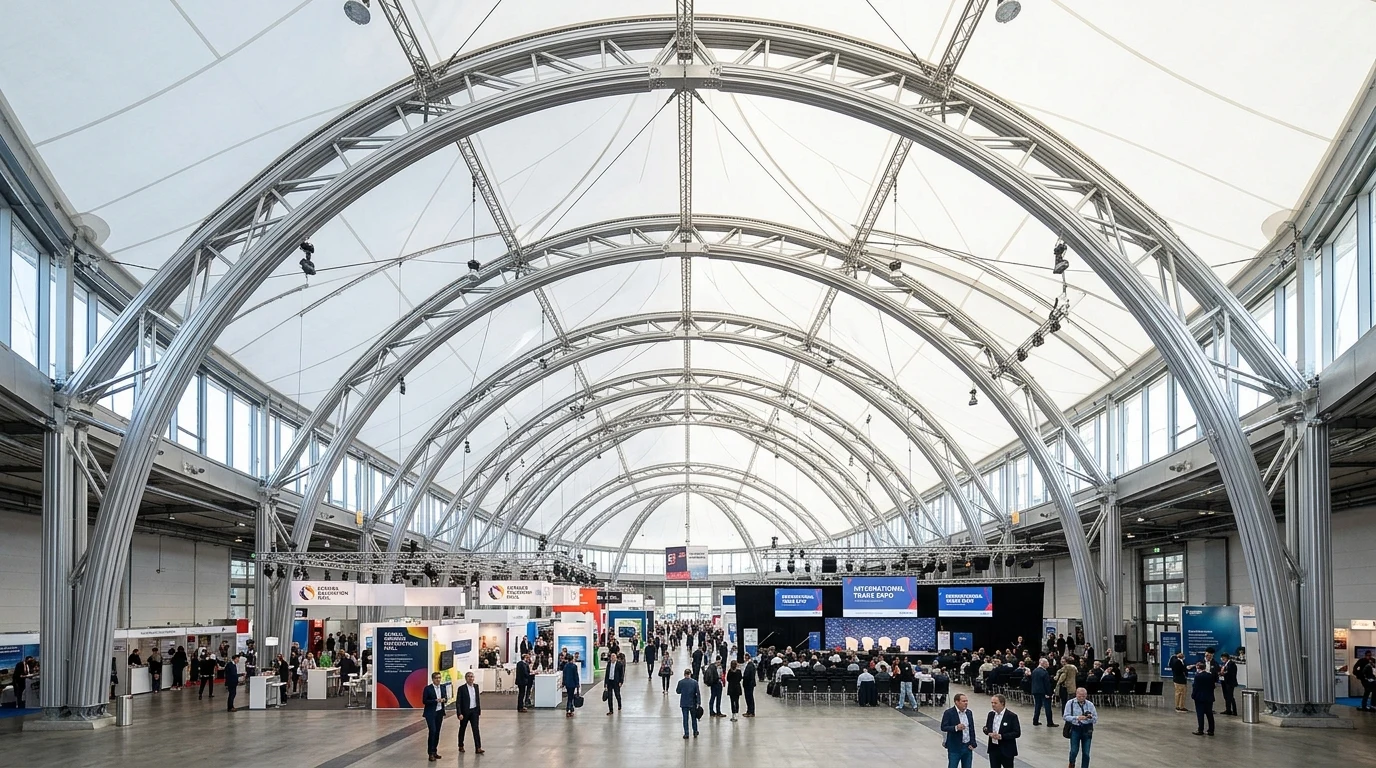
Temporary clear-span structures, universally known across India as German Hangers, have revolutionized the event infrastructure, industrial warehousing, exhibition, and sports dome industries. Whether hosting international trade expos at Pragati Maidan, sheltering lavish destination weddings across Delhi NCR and Rajasthan, or serving as rapid-deployment logistic warehouses for e-commerce giants, modern modular hangars eliminate internal support pillars to provide 100% unobstructed floor space.
The structural backbone of every heavy-duty German hanger is the extruded aluminium structural beam profile. Unlike traditional mild steel scaffolding or truss systems that are heavy, rust-prone, and hazardous to erect, high-tensile aluminium extrusions engineered by Jindal Aluminium Limited deliver unmatched strength-to-weight ratios, rapid bolt-together assembly, and decades of outdoor durability.
Curated by the structural extrusion specialists at Premier Aluminium Traders—authorized distributor of Jindal Aluminium Limited in New Delhi since 1978—this technical guide explores German hanger anatomy, alloy tempering (6061-T6 vs. 6082-T6), wind-load resistance per IS 875, Keder channel fabric compatibility, and wholesale sourcing for event fabricators.
1. Why German Hangers Standardized on Extruded Aluminium
Prior to the introduction of modular aluminium extrusion systems, large-span temporary hangars were erected using fabricated MS tubular steel trusses. The shift toward specialized extruded aluminium profiles occurred because of five decisive structural and commercial advantages:
  Traditional Steel Truss Assembly         Modular Aluminium German Hanger Profile
  ---------------------------------        ---------------------------------------
  * Steel Density: ~7.85 g/cm³             * Aluminium Density: ~2.70 g/cm³ (65% Lighter!)
  * Requires Heavy Mobile Cranes           * Erected with Light Winches & Manpower
  * Prone to Flaking Rust & Paint Spalls   * Naturally Anodized (Corrosion-Free)
  * Heavy Transport Logistics (High Fuel)  * Modular Nesting Profiles (Lower Freight Cost)
  * Laborious Nut-Bolt Welding at Height   * Integrated Keder Channels for Slide-in PVC
| Engineering Metric | Extruded Aluminium (6061-T6 / 6082-T6) | Mild Steel Tubular Truss (IS 4923 / IS 1239) |
|---|---|---|
| Material Density | $2.70\text{ }g/cm^3$ | $7.85\text{ }g/cm^3$ (2.9x heavier) |
| Tensile Yield Strength | $\ge 240\text{ }MPa$ (High structural resilience) | $210 - 250\text{ }MPa$ (Comparable) |
| Erection & Dismantling Speed | 3 to 4 times faster via modular slide channels | Slow, requires on-site pin alignment and crane rigging |
| Transport Capacity per Truck | 3,000 to 4,000 sq. meters of hangar framing per 32-ft trailer | Only 1,000 to 1,500 sq. meters per trailer due to gross vehicle weight limits |
| Weather & Moisture Exposure | Zero corrosion; maintenance-free in rain, mud, and humidity | Rusts quickly when scratched; frequent repainting required |
| Fabric Attachment System | Built-in extruded Keder slots (weather-tight slide-in) | Manual rope lacing or steel clips (prone to wind tear) |
| Scrap Value Retention | 80% to 85% of base primary metal value | Less than 20% residual value |
2. Anatomical Breakdown of a German Hanger System
A modular clear-span German hangar consists of primary extruded arch frames interconnected by horizontal purlins and cross-bracing steel cables:
                         [ Ridge Crown Apex Connection ]
                                    /     \
                                   /       \
       [ Rafter Beam (4-Groove) ] /         \ [ Rafter Beam (4-Groove) ]
                                 /           \
                                /             \
   [ Eave Corner Connector ]   +---------------+   [ Eave Corner Connector ]
               |               | Purlin Spacer |               |
               |                                               |
      [ Upright Leg Column ]                         [ Upright Leg Column ]
      (4-Groove Keder Profile)                       (4-Groove Keder Profile)
               |                                               |
      [ Heavy Steel Base Plate ]                    [ Heavy Steel Base Plate ]
      =======================================================================
                            GROUND / CONCRETE SLAB
1. Main Upright Columns & Rafter Beams
The primary structural load-bearing extrusions. These large hollow rectangular beams feature integrated Keder slide channels (grooves) running along the outer edges:
- 4-Groove Profiles: Used for standard intermediate arches. Two outer grooves accept the heavy PVC roof and wall fabric slides, while the two side grooves receive modular bracket hardware, purlins, and wall panels.
- 2-Groove Profiles: Used for end-gable frames where fabric slides on only one side.
- Common Cross-Section Sizes:
- $150\text{ }mm \times 120\text{ }mm \times 4\text{ }mm$ (Span: $10\text{ }m - 15\text{ }m$)
- $204\text{ }mm \times 120\text{ }mm \times 4\text{ }mm$ (Span: $15\text{ }m - 20\text{ }m$)
- $250\text{ }mm \times 110\text{ }mm \times 4.5\text{ }mm$ (Span: $20\text{ }m - 30\text{ }m$)
- $300\text{ }mm \times 125\text{ }mm \times 5\text{ }mm$ (Span: $30\text{ }m - 40\text{ }m+$ clear span)
2. Intermediate Purlins (Roof & Side Beams)
Rectangular hollow sections or specialized channel profiles connecting adjacent arches at $5\text{ }meter$ bay spacings. Purlins prevent rafter buckling, support lighting trusses, and secure interior lining fabrics.
3. Ridge Crown & Eave Connection Inserts
Heavy-duty hot-dip galvanized steel plate inserts that slide snugly inside the hollow ends of the aluminium rafters and columns. Secured with high-tensile Grade 8.8 galvanized safety pins and cotter clips to form rigid structural knee and apex joints.
4. Fabric Tensioning Tubes & Base Anchors
Extruded round aluminium tubes ($60\text{ }mm$ OD) slotted into the hemmed pockets of the PVC fabric walls. Threaded tension ratchets pull the fabric drum-tight to eliminate wind flapping.
3. Structural Wind-Load Compliance per IS 875 (Part 3)
Temporary hangars must maintain impeccable safety standards. A collapse during a public exhibition or industrial storm poses severe legal and human safety hazards. Under IS 875 (Part 3: Wind Loads on Buildings and Structures), clear-span hangars are engineered to resist wind speeds from $120\text{ }km/h\text{ }to\text{ }140\text{ }km/h$ ($33 - 39\text{ }m/s$).
Critical Engineering Parameters:
- Section Modulus ($Z_{xx}$): The moment of inertia of the aluminium upright columns must be sufficient to limit horizontal deflection at the eave joint to within $H/50$ under maximum windward gust suction.
- Uplift Forces & Ballast Engineering: While aluminium's lightweight property is advantageous for transport, it makes empty hangars susceptible to wind uplift. Steel ground anchors (spiral earth stakes or expandable mechanical concrete fasteners) must be engineered according to soil shear capacity:
- Soft Soil / Lawn: $1.2\text{ }m$ to $1.5\text{ }m$ ribbed steel ground stakes.
- Asphalt / Compacted Earth: Chemical expansion anchor bolts.
- Finished Pavement / Tiles: Modular cast-concrete ballast blocks ($500 - 1,500\text{ }kg$ per column base).
- Cross-Bracing Tension Rods: Diagonal aircraft-grade galvanized steel wire ropes ($10\text{ }mm - 14\text{ }mm$ with heavy turnbuckles) are installed in the end bays and roof panels to transfer horizontal shear forces directly into ground anchors.
4. Metallurgical Excellence: Alloy 6061-T6 & 6082-T6
Using ordinary architectural aluminium (such as unhardened 6063-T4 or recycled commercial scrap) for German hangers is extremely dangerous. Structural hangars demand high-tensile structural-grade alloys:
| Metallurgical Property | Structural Grade 6082-T6 | High-Tensile 6061-T6 | Architectural 6063-T6 | Sub-Standard Commercial Scrap |
|---|---|---|---|---|
| Primary Alloying Elements | $Si: 0.7-1.3%, Mg: 0.6-1.2%, Mn: 0.4-1.0%$ | $Mg: 0.8-1.2%, Si: 0.4-0.8%, Cu: 0.15-0.4%$ | $Mg: 0.45-0.9%, Si: 0.2-0.6%$ | Uncontrolled scrap melt |
| Ultimate Tensile Strength (UTS) | $\ge 295\text{ }MPa$ | $\ge 260\text{ }MPa$ | $\ge 205\text{ }MPa$ | $\le 140\text{ }MPa$ |
| 0.2% Proof Stress (Yield) | $\ge 240\text{ }MPa$ | $\ge 240\text{ }MPa$ | $\ge 170\text{ }MPa$ | $\le 90\text{ }MPa$ |
| Elongation at Break ($A_{50}$) | $8% - 10%$ | $8% - 10%$ | $8% - 12%$ | $< 3%$ (Brittle!) |
| Hardness (Webster / Brinell) | $\ge 14\text{ }HW$ / $95\text{ }HB$ | $\ge 14\text{ }HW$ / $95\text{ }HB$ | $10 - 12\text{ }HW$ / $75\text{ }HB$ | Soft spots |
| Structural Fatigue Resistance | Exceptional under cyclical wind loads | Excellent | Moderate | Fails under cyclic stress |
Why Jindal 6082-T6 & 6061-T6 Are Chosen by India's Top Fabricators
- Manganese Addition in 6082: The inclusion of Manganese ($Mn$) refines the grain boundary structure, providing superior impact resistance and dynamic shear resistance during repeated erection cycles.
- Genuine Primary Billets: Extruded exclusively from high-purity primary billets, ensuring consistent wall thickness tolerance without internal voids, microscopic cracks, or die slivers.
- Clear Architectural Anodizing: Extrusions feature an $8\text{ }to\text{ }12\text{ }\mu m$ anodized film that prevents grey aluminium oxidation residue from rubbing off onto expensive white German PVC tent covers.
5. Clear-Span Sizing Guide for Event & Warehouse Structures
| Clear Span Width | Bay Spacing | Main Column Profile Dimension | Eave Height | Ridge Height | Max Wind Rating | Typical Use Cases |
|---|---|---|---|---|---|---|
| $10\text{ }Meters$ ($33\text{ }ft$) | $3\text{ }m$ or $5\text{ }m$ | $120 \times 68 \times 3.0\text{ }mm$ | $3.0\text{ }m$ | $4.6\text{ }m$ | $100\text{ }km/h$ | VIP hospitality lounges, security check zones, dining halls |
| $15\text{ }Meters$ ($50\text{ }ft$) | $5\text{ }m$ | $166 \times 88 \times 3.0\text{ }mm$ | $4.0\text{ }m$ | $6.4\text{ }m$ | $120\text{ }km/h$ | Corporate product launches, regional exhibition pavilions |
| $20\text{ }Meters$ ($66\text{ }ft$) | $5\text{ }m$ | $204 \times 120 \times 4.0\text{ }mm$ | $4.0\text{ }m$ | $7.2\text{ }m$ | $120\text{ }km/h$ | Wedding halls, trade fairs, industrial raw material storage |
| $25\text{ }Meters$ ($82\text{ }ft$) | $5\text{ }m$ | $250 \times 110 \times 4.5\text{ }mm$ | $4.0\text{ }m - 5.0\text{ }m$ | $8.0\text{ }m$ | $130\text{ }km/h$ | Automotive assembly lines, logistics transit hubs, concerts |
| $30\text{ }Meters$ ($100\text{ }ft$) | $5\text{ }m$ | $250 \times 125 \times 5.0\text{ }mm$ | $5.0\text{ }m - 6.0\text{ }m$ | $10.0\text{ }m$ | $130\text{ }km/h$ | Mega sports domes, aircraft maintenance hangars |
| $40\text{ }Meters$ ($132\text{ }ft$) | $5\text{ }m$ | $300 \times 125 \times 5.5\text{ }mm$ | $6.0\text{ }m$ | $12.5\text{ }m$ | $140\text{ }km/h$ | International conventions, jumbo logistics warehouses |
6. Sourcing Genuine Jindal Tent Sections at Premier Aluminium Traders
Premier Aluminium Traders is recognized across North India as the premier bulk distributor for event infrastructure and clear-span hangar extrusions:
- Ready Stock of Standard Dies: Ready inventories of $120\text{ }mm$, $166\text{ }mm$, $204\text{ }mm$, and $250\text{ }mm$ 4-groove and 2-groove tent beam dies.
- Custom Die Development: Ability to extrude custom polygonal, curved dome, arcum, and double-decker structural profiles directly via Jindal Aluminium Limited.
- Certified Temper & Alloy: Supplied with Jindal factory Mill Test Certificates verifying 6061-T6 / 6082-T6 alloy chemistry and mechanical yield strength.
- Logistics Advantage: Centrally located in Delhi with rapid direct dispatch across Uttar Pradesh, Haryana, Punjab, Rajasthan, and nationwide.
Explore related structural product lines:
- Jindal Aluminium Tent Sections
- Jindal Aluminium Heavy Extrusions
- Jindal Aluminium Pipes & Tubes
- Jindal Aluminium Flat Bars
Frequently Asked Questions (FAQs)
What is the expected lifespan of an aluminium German hanger frame?
A structural German hanger framed with Jindal 6061-T6 / 6082-T6 anodized aluminium has an operational lifespan exceeding $25\text{ }to\text{ }30\text{ }years$, even with continuous outdoor erection and dismantling cycles. In contrast, the PVC fabric covers typically require replacement or washing every $5\text{ }to\text{ }8\text{ }years$.
What is a "Keder" groove and why is it essential for German hangers?
A Keder groove is an extruded circular cavity with a narrow longitudinal slit along the edge of the aluminium rafter or column. The PVC fabric cover has a high-density flexible PVC core cord (typically $8\text{ }mm\text{ }to\text{ }10\text{ }mm$ diameter) welded into its hem. The fabric slides directly into the aluminium groove from ground level, creating a 100% windproof, watertight joint without screws or clips.
Can a German hanger be expanded in length after initial installation?
Yes. That is the defining benefit of modular German hangers. Because hangars are designed in standard $5\text{ }meter$ bay increments, an existing $20\text{ }m \times 30\text{ }m$ hangar can easily be expanded to $20\text{ }m \times 50\text{ }m$ or $100\text{ }m$ simply by bolting additional intermediate arches and purlins into place.
Is on-site welding required when assembling an aluminium German hanger?
Zero welding is required. The entire structure is 100% prefabricated. Columns, rafters, purlins, and tension cables are joined using galvanized steel internal connection sleeves, precision-bored holes, high-tensile steel pins, and turnbuckles. This allows a $1,000\text{ }sq. meter$ hangar to be safely erected in under 48 hours.
Request Wholesale Quotations & Structural Die Catalogs
Expanding your event infrastructure inventory or manufacturing temporary industrial hangars? Contact the technical sales desk at Premier Aluminium Traders for immediate bundle pricing, technical cross-section drawings, and Jindal factory allocations.
- Address: 5233, G.B. Road, Near Ajmeri Gate, New Delhi - 110006
- Phone: +91 98111 98926 / 011-23212885
- Email: sales@premieraluminium.com
- Inquire Online: Contact Premier Aluminium Traders