Blog
Jindal Aluminium Angle Sections (Equal & Unequal): Sizing, Weight Chart & Structural Framing Guide
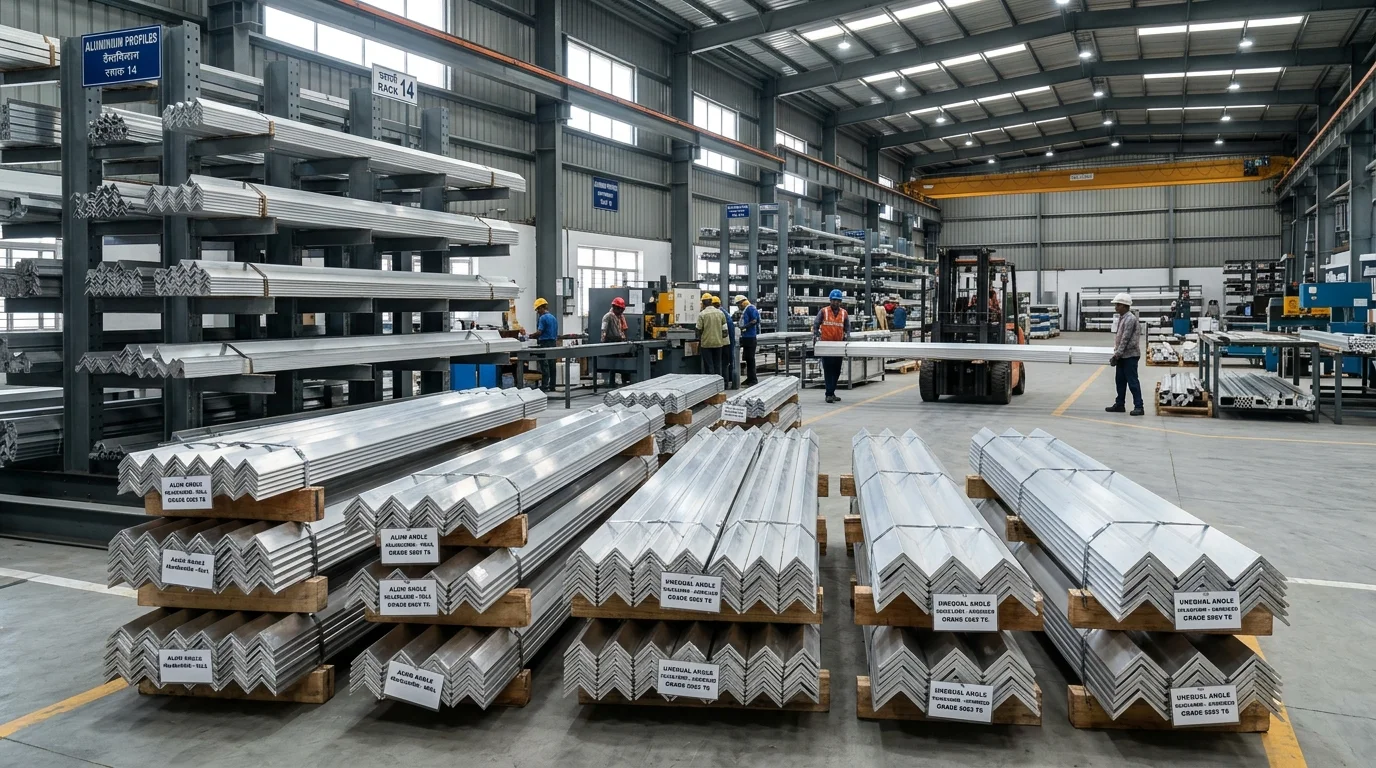
In industrial fabrication, architectural fenestration, solar racking structures, and electrical panel construction, extruded aluminium angle sections—commonly known as L-angles—are the universal building blocks for structural joints, corner reinforcements, perimeter trim, and heavy equipment mounting brackets. Combining high mechanical stiffness with rust immunity and ease of machining, aluminium angles replace heavy mild steel angles while reducing dead weight by over 65%.
Whether engineering continuous perimeter brackets for glass curtain wall transoms, bolting vibration-resistant solar panel framing on industrial rooftops, or bracing heavy electrical switchgear cabinets, selecting the correct angle profile requires balancing leg dimensions ($A \times B$), wall thickness ($t$), corner fillet radii, and theoretical section weight per meter. Sourcing certified extrusions manufactured by Jindal Aluminium Limited ensures tight dimensional tolerances, uniform wall thickness, and reliable structural strength across every batch.
Curated by the technical sales desk at Premier Aluminium Traders—authorized distributor and stockist of Jindal Aluminium Limited in Paharganj, New Delhi since 1978—this practical engineering and workshop guide breaks down equal vs. unequal angle geometry, theoretical weight calculation formulas, standard size schedules, drilling and cold-miter fabrication rules, and wholesale procurement for fabricators across North India.
1. Equal vs. Unequal Angles: Which Profile Fits Your Job?
Extruded aluminium angles are categorized into two primary geometric designs based on leg proportion:
        EQUAL ANGLE (A = B)                       UNEQUAL ANGLE (A > B)
         +---------------+                         +-----------------------------+
         |               |                         |                             |
         |               |                         |                             |
         |   Leg A       |                         |   Long Leg A                |
         |               |                         |   (Vertical Stiffener)      |
         |               |                         |                             |
         +-------+       |                         +-------+                     |
         |       |       |                         |       |                     |
   Leg B |       |       |                   Leg B |       |                     |
         +-------+-------+                         +-------+---------------------+
           Wall Thickness (t)                        Wall Thickness (t)
1. Equal Aluminium Angles ($A = B$)
- Geometry: Both legs share identical widths at a 90° angle (e.g., $25 \times 25\text{ mm}$, $50 \times 50\text{ mm}$, $100 \times 100\text{ mm}$).
- Best Used For: Corner edge guards, symmetrical framing, solar panel perimeter clamps, industrial shelf brackets, and general-purpose structural braces where mechanical loads act equally from both axes.
2. Unequal Aluminium Angles ($A > B$)
- Geometry: One leg is noticeably longer than the other (e.g., $50 \times 25\text{ mm}$, $75 \times 50\text{ mm}$, $100 \times 50\text{ mm}$).
- Best Used For: Asymmetrical structural loading where bending forces act predominantly along one direction. The longer leg is oriented vertically to resist gravitational sag and wind deflection, while the shorter leg provides a compact mounting surface against walls, beams, or columns. Ideal for curtain wall floor brackets, facade sub-frames, and bus body longitudinal stringers.
2. Universal Weight Calculation Formula for Aluminium Angles
In commercial metal trading, raw materials are priced per kilogram based on actual weighment. Knowing the theoretical weight per meter allows contractors and estimators to calculate project costs with precision:
$$\text{Weight per Meter } (kg/m) = (A + B - t) \times t \times 0.00270$$
Where:
- $A$ = Width of first leg in millimeters ($mm$)
- $B$ = Width of second leg in millimeters ($mm$)
- $t$ = Wall thickness in millimeters ($mm$)
- $0.00270$ = Nominal density factor of high-purity extruded aluminium ($g/cm^3$)
Worked Workshop Example: 50 x 50 x 5 mm Equal Angle
---------------------------------------------------
- Leg A = 50 mm
- Leg B = 50 mm
- Thickness t = 5 mm

Calculation:
Weight (kg/m) = (50 + 50 - 5) * 5 * 0.00270
Weight (kg/m) = 95 * 5 * 0.00270
Weight (kg/m) ≈ 1.283 kg/meter

For a standard 12-foot (3.657 meter) commercial bar:
Total Bar Weight = 1.283 * 3.657 ≈ 4.69 kg
3. Jindal Aluminium Angle Sizing & Weight Chart
Below is the verified engineering reference chart for standard equal and unequal extruded aluminium angles, correlating outer dimensions, wall thicknesses, theoretical weights, and primary workshop applications:
Part A: Equal Aluminium Angles ($A = B$)
| Outer Dimensions $A \times B$ (mm) | Wall Thickness $t$ (mm) | Inch Size Equivalent | Theoretical Weight ($kg/m$) | Weight per 12-ft Bar ($kg$) | Primary Workshop Applications |
|---|---|---|---|---|---|
| $12.0 \times 12.0\text{ mm}$ | $1.50\text{ mm}$ | $\approx 1/2" \times 1/2"$ | $0.091\text{ }kg/m$ | $0.33\text{ }kg$ | Showcase trims, electronics chassis edge trims |
| $19.05 \times 19.05\text{ mm}$ | $1.60\text{ mm}$ | $3/4" \times 3/4"$ | $0.158\text{ }kg/m$ | $0.58\text{ }kg$ | Light furniture framing, false ceiling perimeter angle |
| $25.0 \times 25.0\text{ mm}$ | $1.50\text{ mm}$ | $1" \times 1"$ | $0.196\text{ }kg/m$ | $0.72\text{ }kg$ | Standard architectural corner trims, partition stops |
| $25.0 \times 25.0\text{ mm}$ | $3.00\text{ mm}$ | $1" \times 1"$ (Heavy) | $0.381\text{ }kg/m$ | $1.39\text{ }kg$ | Industrial machine guard frames, solar module clamps |
| $38.1 \times 38.1\text{ mm}$ | $3.00\text{ mm}$ | $1-1/2" \times 1-1/2"$ | $0.593\text{ }kg/m$ | $2.17\text{ }kg$ | Electrical switchgear panel supports, racking |
| $50.0 \times 50.0\text{ mm}$ | $3.00\text{ mm}$ | $2" \times 2"$ | $0.786\text{ }kg/m$ | $2.87\text{ }kg$ | Solar ground mounting cross-braces, HVAC frames |
| $50.0 \times 50.0\text{ mm}$ | $5.00\text{ mm}$ | $2" \times 2"$ (Heavy) | $1.283\text{ }kg/m$ | $4.69\text{ }kg$ | Structural brackets, heavy shelf cantilevers |
| $50.0 \times 50.0\text{ mm}$ | $6.00\text{ mm}$ | $2" \times 2"$ (Extra Heavy) | $1.523\text{ }kg/m$ | $5.57\text{ }kg$ | High-load bolted connectors, industrial mezzanine |
| $75.0 \times 75.0\text{ mm}$ | $6.00\text{ mm}$ | $3" \times 3"$ | $2.333\text{ }kg/m$ | $8.53\text{ }kg$ | Facade anchor brackets, transport vehicle sub-frames |
| $100.0 \times 100.0\text{ mm}$ | $6.00\text{ mm}$ | $4" \times 4"$ | $3.143\text{ }kg/m$ | $11.49\text{ }kg$ | Heavy structural framing, continuous wind brackets |
| $100.0 \times 100.0\text{ mm}$ | $10.00\text{ mm}$ | $4" \times 4"$ (Jumbo) | $5.130\text{ }kg/m$ | $18.76\text{ }kg$ | Crane runway brackets, heavy bridge deck fittings |
Part B: Unequal Aluminium Angles ($A > B$)
| Outer Dimensions $A \times B$ (mm) | Wall Thickness $t$ (mm) | Inch Size Equivalent | Theoretical Weight ($kg/m$) | Weight per 12-ft Bar ($kg$) | Primary Structural Applications |
|---|---|---|---|---|---|
| $25.0 \times 12.0\text{ mm}$ | $1.50\text{ mm}$ | $\approx 1" \times 1/2"$ | $0.144\text{ }kg/m$ | $0.53\text{ }kg$ | Window sash perimeter stops, cabinet door reveals |
| $38.0 \times 25.0\text{ mm}$ | $3.00\text{ mm}$ | $\approx 1-1/2" \times 1"$ | $0.486\text{ }kg/m$ | $1.78\text{ }kg$ | Cable tray support arms, bus interior luggage rails |
| $50.0 \times 25.0\text{ mm}$ | $3.00\text{ mm}$ | $2" \times 1"$ | $0.583\text{ }kg/m$ | $2.13\text{ }kg$ | Solar racking purlin clips, cladding sub-frame rails |
| $75.0 \times 50.0\text{ mm}$ | $5.00\text{ mm}$ | $3" \times 2"$ | $1.620\text{ }kg/m$ | $5.92\text{ }kg$ | Curtain wall mullion-to-slab anchor cleats |
| $100.0 \times 50.0\text{ mm}$ | $6.00\text{ mm}$ | $4" \times 2"$ | $2.333\text{ }kg/m$ | $8.53\text{ }kg$ | Heavy facade expansion joint connectors |
| $150.0 \times 75.0\text{ mm}$ | $8.00\text{ mm}$ | $6" \times 3"$ | $4.687\text{ }kg/m$ | $17.14\text{ }kg$ | High-rise unitized facade transoms, railway car frames |
4. Workshop Fabrication: Cutting, Drilling & Bolting Best Practices
Extruded aluminium angles are straightforward to work with using standard metal shop tools, provided proper techniques are observed:
        COLD CIRCULAR SAWING                     PRECISION HOLE DRILLING
        --------------------                     -----------------------
   * TCT Blade with Triple Chip Grind       * High-speed steel (HSS) with 118° point
   * Negative rake (-5° to 0°)              * Maintain 2.0x bolt diameter edge distance
   * Coolant wax stick or spray mist         * Deburr holes on both inner & outer faces
   * Eliminates burrs and heat warping      * Use SS304 or SS316 fasteners with nylon washers
1. Bolt Hole Edge Distance Rule
When punching or drilling bolt holes in aluminium angle flanges, always maintain a minimum edge distance to prevent tensile tear-out under heavy mechanical loads:
- Minimum Distance to Cut Edge: At least $2.0 \times \text{nominal bolt diameter}$ (e.g., for an M10 bolt, center of hole must be $\ge 20\text{ mm}$ from the edge).
- Minimum Distance to Inside Corner Fillet: Ensure washer and bolt head clear the internal root radius completely to avoid bending the bolt during torque tightening.
2. Preventing Galvanic Corrosion at Joint Bolting
When bolting aluminium angles to structural mild steel columns or RCC concrete slabs:
- Never allow raw carbon steel to contact the aluminium directly.
- Always install neoprene or EPDM isolating gaskets between the aluminium and steel interface.
- Fasten exclusively using Grade 304 or 316 stainless steel bolts fitted with non-conductive nylon or EPDM washers under the nut and bolt head.
5. Alloy Grade Guide: 6063-T6 vs. 6082-T6
The choice of alloy grade dictates whether your angle profile is optimized for aesthetic architectural finishes or heavy structural load-bearing:
| Engineering Parameter | Architectural 6063-T6 Angles | High-Strength Structural 6082-T6 Angles |
|---|---|---|
| Primary Focus | Pristine surface aesthetics & sharp detail | Maximum mechanical yield strength & shock resistance |
| Yield Strength (0.2% Proof) | $\ge 170\text{ }MPa$ | $\ge 250\text{ }MPa$ (47% stronger!) |
| Tensile Strength (UTS) | $\ge 205\text{ }MPa$ | $\ge 295\text{ }MPa$ |
| Webster Hardness | $10 - 14\text{ }HW$ | $15 - 18\text{ }HW$ |
| Anodizing Response | Crystal clear, mirror-uniform silver, champagne, black | Industrial finish; best with dark bronze or powder coat |
| CNC Machining & Tapping | Softer; requires sharp tools and lubrication | Crisp chip formation; excellent thread grip |
| Best Used For | Glazing stops, window trims, cabinet frames | Floor cleat brackets, solar purlin bracing, truck bodies |
6. Sourcing Genuine Jindal Angle Sections at Premier Aluminium Traders
As an authorized stockist and distributor of Jindal Aluminium Limited, Premier Aluminium Traders maintains Delhi NCR's most comprehensive physical inventory of extruded equal and unequal angle sections:
- Ready-to-Ship Warehouse Inventory: Massive daily stock of standard equal and unequal sizes from $12 \times 12\text{ mm}$ up to $100 \times 100\text{ mm}$ in central Paharganj, New Delhi.
- High-Purity Primary Billets: Extruded exclusively from certified primary alloy billets, guaranteeing 100% rust immunity, structural durability, and uniform wall thickness without scrap contamination.
- Mill Test Certificates (MTC): Genuine Jindal factory test certificates verifying yield strength, tensile strength, and Webster hardness provided with commercial dispatches.
- Value-Added Processing Services: In-house precision circular cold sawing to exact drawing lengths ($\pm 0.5\text{ mm}$), slot hole punching, and custom architectural powder coating in standard RAL shades.
Explore related extrusions and profiles:
- Jindal Aluminium Extrusions Catalog
- Jindal Aluminium Flat Bars
- Jindal Aluminium Pipes & Tubes
- Jindal Section Weight Chart Guide
7. Frequently Asked Questions (FAQs)
1. What is the standard length of Jindal aluminium angle sections?
Jindal Aluminium angles are manufactured in standard stock lengths of 12 feet (3.657 meters) and 16 feet (4.876 meters). For large commercial projects such as continuous curtain wall transoms or solar purlin spans, custom lengths up to 24 feet (7.315 meters) can be supplied on special order.
2. Can aluminium angles be welded using TIG or MIG?
Yes. Both 6063-T6 and 6082-T6 angles exhibit excellent weldability using AC TIG or pulsed MIG processes. For structural frames that will be powder-coated, ER4043 filler wire is recommended for high weld pool fluidity and low crack sensitivity. For assemblies that will undergo decorative clear anodizing, ER5356 filler wire is preferred to prevent dark weld seams.
3. Are aluminium angles strong enough to replace structural mild steel angles?
Yes. While mild steel has a higher modulus of elasticity, structural aluminium angles in Alloy 6082-T6 offer a yield strength of $\ge 250\text{ }MPa$, which is comparable to standard IS 2062 Grade E250 structural mild steel. Switching to aluminium eliminates corrosion and rust maintenance while reducing total structural dead load by approximately 65%.
4. How do I prevent galvanic corrosion when mounting aluminium angles outdoors?
To avoid galvanic corrosion, isolate the aluminium from carbon steel or wet concrete by installing EPDM rubber or neoprene separator pads, and fasten exclusively using Grade 304 or 316 stainless steel bolts fitted with insulating nylon washers.
5. Where can I buy certified Jindal aluminium angle sections in Delhi NCR?
Genuine Jindal Aluminium equal and unequal angle sections can be purchased directly from Premier Aluminium Traders, located at 3/8, D.B. Gupta Road, Paharganj, New Delhi - 110055 (Phone: +91-9891097111 / 011-41657680). Fast delivery is available across Delhi, Noida, Gurgaon, Faridabad, Ghaziabad, Haryana, Rajasthan, and Uttar Pradesh.