Blog
Jindal Aluminium Round Rods: Precision CNC Machining, Alloy 6082-T6 vs 6061-T6 & Section Weight Chart
In high-precision manufacturing, CNC turning centers, aerospace component fabrication, and industrial automation, solid aluminium round rods are fundamental engineering stock. From precision turned motor shafts, automotive sensor housings, and hydraulic valve spools to electrical earthing studs and defense hardware, the dimensional roundness, metallurgical purity, and tensile strength of the extruded round bar directly dictate machining efficiency, tool wear, and finished component tolerances.
However, selecting the right round rod requires careful engineering consideration. Machinists and procurement managers must choose the optimal alloy temper (such as structural Alloy 6082-T6 vs. versatile Alloy 6061-T6), account for thermal expansion differentials during high-speed turning, verify diameter tolerances per IS 733 / ASTM B221, and cross-reference exact theoretical weights against mill test certificates.
Curated by the technical engineering division at Premier Aluminium Traders—authorized distributor and stockist of Jindal Aluminium Limited in New Delhi since 1978—this authoritative technical manual provides CNC machinists, component OEMs, and fabrication engineers with a comprehensive guide to Jindal round rod catalog specifications, alloy metallurgy, CNC feed/speed parameters, and wholesale procurement.
1. Quick Alloy Selection Guide: Which Grade Do You Need for Your Job?
When ordering solid aluminium round rods from Premier Aluminium Traders, you don't need to decipher complicated chemistry tables. What matters on your shop floor is how the metal performs: how cleanly it cuts on your machines, how much load it can carry, how easily it welds, and how smooth it looks after finishing.
       [ READY-TO-SHIP JINDAL SOLID ROUND RODS ]
                           |
        +------------------+------------------+
        |                                     |
   [ ALLOY 6082-T6 ]                     [ ALLOY 6061-T6 ]
   * Best for CNC lathes & turning       * Best all-rounder for general engineering
   * Crisp, short chips that break clean * Excellent for welding & marine exposure
   * Highest strength in 6000 series     * Superior corrosion resistance
The 4 Major Round Rod Alloys Explained in Plain English:
- Jindal 6082-T6 (Precision Machining & Structural Grade): The gold standard for CNC machine shops across Delhi NCR. It cuts cleanly without sticking to lathe tools, produces short curly chips, and carries high mechanical loads. Ideal for shafts, pins, bushings, and motor couplings.
- Jindal 6061-T6 (General Engineering & Welding Grade): The most versatile all-around alloy. It welds easily, resists corrosion even in harsh outdoor or marine environments, and is widely used for welded frames, brackets, and automotive assemblies.
- Jindal 6063-T6 (Architectural & Anodizing Grade): Chosen when aesthetic appearance is the top priority. It has a mirror-smooth surface that takes clear natural silver, champagne, or black anodizing flawlessly. Slightly softer to machine than 6082.
- Alloy 2014-T6 (Heavy-Duty Defense & Aircraft Grade): Engineered for maximum strength where steel-like toughness is required at one-third the weight. Primarily used in defense equipment, aircraft fittings, and heavy-duty gears.
Practical Workshop Comparison: Which Alloy Fits Your Project?
| Practical Factor | Jindal 6082-T6 (Machining Grade) | Jindal 6061-T6 (General Engineering) | Jindal 6063-T6 (Architectural Grade) | Alloy 2014-T6 (Defense & Aircraft) |
|---|---|---|---|---|
| Best Used For | High-speed CNC turning, shafts, bushings | Welded structures, marine parts, brackets | Architectural trim, decorative turned parts | Heavy-load defense pins, gears, aircraft |
| CNC Machining Speed | Best – Short, crisp chips, zero tool sticking | Good – Smooth cutting with flood coolant | Fair – Softer metal, requires sharp tools | Superior – Free-cutting, steel-like finish |
| Strength & Load Capacity | High ($295\text{ }MPa$) – Resists bending | Medium-High ($260\text{ }MPa$) | Standard ($205\text{ }MPa$) | Ultra-High ($435\text{ }MPa$) – Heavy duty |
| Welding with TIG / MIG | Very Good (Using 4043 / 5356 filler wire) | Excellent – The industry standard for welding | Excellent – Easy to weld | Specialized welding procedures needed |
| Rust & Weather Defense | Excellent – Never rusts in outdoor weather | Superior – Resists rain, mud, and road salts | Outstanding – Ideal for building facades | Moderate – Anodizing recommended |
| Anodized Surface Appearance | Clean silver finish with subtle satin sheen | Smooth, takes colored anodizing well | Pristine, mirror-like architectural luster | Slightly yellowish cast |
| Stock in Delhi Warehouse | Ready Stock ($\varnothing 6\text{ mm}$ to $200\text{ mm}$) | Ready Stock (Full size range) | Ready Stock (Standard sizes) | Supplied on project order |
Why CNC Machinists Prefer 6082-T6 Over Standard 6063
If you have ever had soft aluminium gum up your lathe cutting tool or create long stringy chips that wrap around the chuck and scratch your finished parts, you were likely cutting architectural grade 6063.
In contrast, Jindal 6082-T6 is hardened specifically for high-speed machine tools. Chips snap off cleanly, your cutting inserts last significantly longer, and you achieve a smooth, bright finish right off the tool without needing extra sanding or polishing.
2. Jindal Aluminium Round Rod Section Weight Chart
The theoretical weight of a solid extruded aluminium round rod is calculated using the standard volumetric density of high-purity aluminium ($\rho = 2.70\text{ }g/cm^3$ or $2700\text{ }kg/m^3$):
$$\text{Weight per Meter } (kg/m) = \frac{\pi \times D^2 \times 2.70}{4000} \approx 0.0021206 \times D^2$$
(Where $D$ is the rod diameter in millimeters).
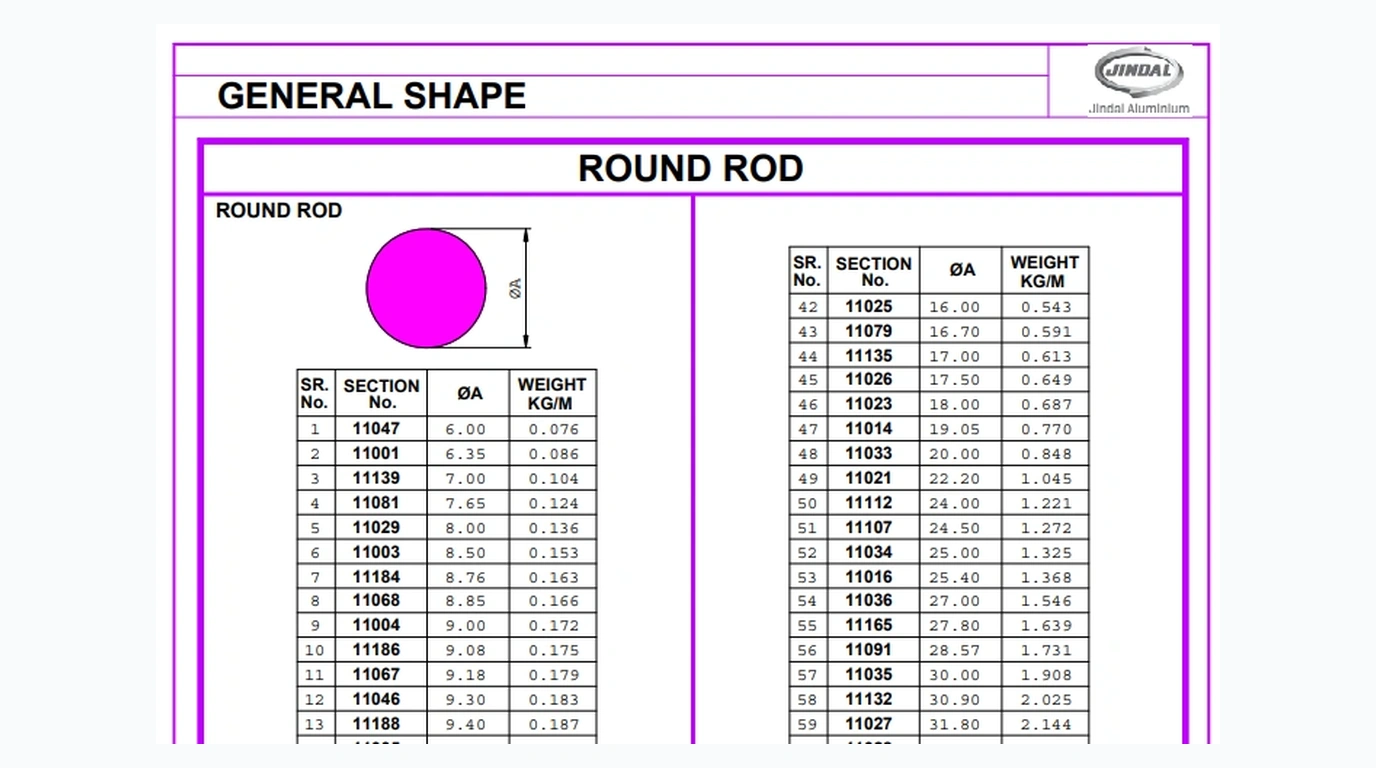
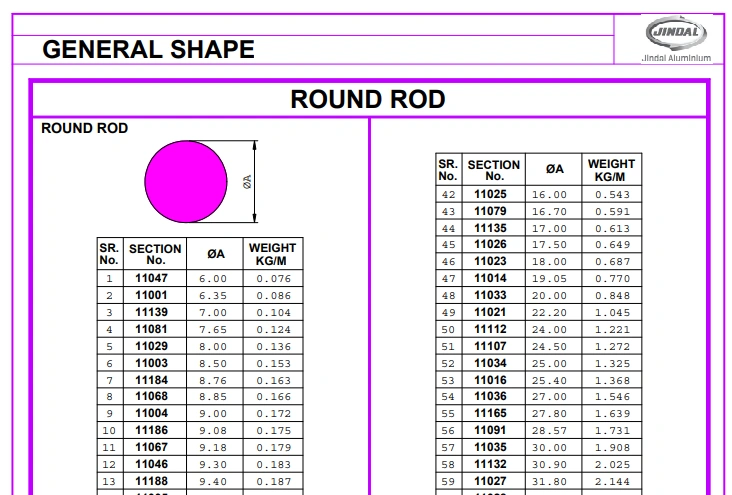
Below is the verified engineering weight schedule for standard Jindal Aluminium Round Rods extracted from the official General Shapes catalog:
| Jindal Section No. | Outer Diameter $\varnothing A$ (mm) | Outer Diameter (Inches Equivalent) | Theoretical Weight per Meter ($kg/m$) | Cross-Section Area ($mm^2$) | Common Engineering Applications |
|---|---|---|---|---|---|
| 11047 | $6.00\text{ mm}$ | $\approx 0.236"$ | $0.076\text{ }kg/m$ | $28.27$ | Precision pins, electronics grounding rivets |
| 11001 | $6.35\text{ mm}$ | $1/4"$ | $0.086\text{ }kg/m$ | $31.67$ | Threaded standoffs, electrical terminal pins |
| 11139 | $7.00\text{ mm}$ | $\approx 0.275"$ | $0.104\text{ }kg/m$ | $38.48$ | Miniature dowel pins, control linkage arms |
| 11081 | $7.65\text{ mm}$ | $\approx 0.301"$ | $0.124\text{ }kg/m$ | $45.96$ | Textile machinery guides, sensor housings |
| 11029 | $8.00\text{ mm}$ | $\approx 0.315"$ | $0.136\text{ }kg/m$ | $50.27$ | M8 tie rods, pneumatic guide pins |
| 11003 | $8.50\text{ mm}$ | $\approx 0.335"$ | $0.153\text{ }kg/m$ | $56.75$ | Custom automotive spacers, bushings |
| 11184 | $8.76\text{ mm}$ | $\approx 0.345"$ | $0.163\text{ }kg/m$ | $60.27$ | High-tolerance precision turned pins |
| 11068 | $8.85\text{ mm}$ | $\approx 0.348"$ | $0.166\text{ }kg/m$ | $61.51$ | Specialized machine instrument shafts |
| 11004 | $9.00\text{ mm}$ | $\approx 0.354"$ | $0.172\text{ }kg/m$ | $63.62$ | Lock cylinders, instrumentation fittings |
| 11025 | $16.00\text{ mm}$ | $\approx 0.630"$ | $0.543\text{ }kg/m$ | $201.06$ | M16 high-tensile studs, hinge pins |
| 11079 | $16.70\text{ mm}$ | $\approx 0.657"$ | $0.591\text{ }kg/m$ | $219.04$ | Custom motor shaft couplings |
| 11135 | $17.00\text{ mm}$ | $\approx 0.669"$ | $0.613\text{ }kg/m$ | $226.98$ | Valve components, pneumatic pistons |
| 11026 | $17.50\text{ mm}$ | $\approx 0.689"$ | $0.649\text{ }kg/m$ | $240.53$ | Hydraulic cylinder rod blanks |
| 11023 | $18.00\text{ mm}$ | $\approx 0.709"$ | $0.687\text{ }kg/m$ | $254.47$ | Industrial rollers, fixture locating pins |
| 11014 | $19.05\text{ mm}$ | $3/4"$ | $0.770\text{ }kg/m$ | $285.02$ | Standard turned shafts, heavy bolts |
| 11033 | $20.00\text{ mm}$ | $\approx 0.787"$ | $0.848\text{ }kg/m$ | $314.16$ | CNC turned hubs, linear bearing shafts |
| 11021 | $22.20\text{ mm}$ | $7/8"$ | $1.045\text{ }kg/m$ | $387.08$ | Fluid valve bodies, pump impellers |
| 11112 | $24.00\text{ mm}$ | $\approx 0.945"$ | $1.221\text{ }kg/m$ | $452.39$ | Heavy-duty connecting pins |
| 11034 | $25.00\text{ mm}$ | $\approx 0.984"$ | $1.325\text{ }kg/m$ | $490.87$ | High-speed spindle shafts, bearings |
| 11016 | $25.40\text{ mm}$ | $1.0"$ | $1.368\text{ }kg/m$ | $506.71$ | Standard 1-inch turned automotive parts |
| 11036 | $27.00\text{ mm}$ | $\approx 1.063"$ | $1.546\text{ }kg/m$ | $572.56$ | Precision gear blanks, pulley hubs |
| 11091 | $28.57\text{ mm}$ | $1-1/8"$ | $1.731\text{ }kg/m$ | $641.06$ | Aerospace brackets, sensor housings |
| 11035 | $30.00\text{ mm}$ | $\approx 1.181"$ | $1.908\text{ }kg/m$ | $706.86$ | Heavy machinery drive shafts, rollers |
| 11027 | $31.80\text{ mm}$ | $1-1/4"$ | $2.144\text{ }kg/m$ | $794.23$ | Marine propulsion shafts, flange hubs |
Premier Aluminium Traders also stocks heavy-gauge Jindal solid round rods in diameters up to $200\text{ mm}$ and beyond for forging dies, heavy flanges, and aerospace structural billets.
3. Dimensional Tolerances per IS 733 and ASTM B221
For high-speed automated bar feeders on CNC turning centers, tight dimensional tolerance is paramount to prevent bar vibration, chuck slippage, and premature collet wear.
          +----------------------------------------------+
          | <-------------- DIAMETER (ØA) -------------> |
          +----------------------------------------------+
          |      STRAIGHTNESS DEVIATION <= 1.5 mm/m      |
          +----------------------------------------------+
1. Diameter Tolerance
Under IS 733 (Wrought Aluminium and Aluminium Alloy Bars, Rods, and Sections), extruded round bars adhere to strict diameter limits:
- Up to $12\text{ mm}$: $\pm 0.20\text{ mm}$
- $12\text{ mm}$ to $25\text{ mm}$: $\pm 0.25\text{ mm}$
- $25\text{ mm}$ to $50\text{ mm}$: $\pm 0.35\text{ mm}$
- $50\text{ mm}$ to $100\text{ mm}$: $\pm 0.50\text{ mm}$
2. Straightness Tolerance
Excessive camber or bow in a $3\text{ meter}$ or $6\text{ meter}$ rod creates severe centrifugal whipping inside high-RPM lathe spindles. Jindal round rods undergo mechanized roller-straightening, ensuring straightness deviation does not exceed $1.5\text{ mm per meter}$ of length, satisfying the most rigorous Swiss-type sliding headstock requirements.
3. Ovality / Roundness Limits
The difference between maximum and minimum diameter at any cross-section is held within half the total diameter tolerance band, guaranteeing uniform chuck gripping force across 3-jaw and collet chucks.
4. CNC Machining & Turning Best Practices for Aluminium Rods
To achieve mirror-like surface finishes ($Ra \le 0.4\text{ }\mu m$) and eliminate built-up edge (BUE), CNC programmers should implement the following engineering parameters:
  CNC Turning Parameter           Recommended Setting (Alloy 6082-T6 / 6061-T6)
  ---------------------           ---------------------------------------------
  Cutting Speed (Vc)              350 - 900 m/min (High-speed turning)
  Feed Rate (Roughing)            0.20 - 0.45 mm/rev
  Feed Rate (Finishing)           0.05 - 0.15 mm/rev
  Tool Material                   PCD (Polycrystalline Diamond) or Uncoated Micrograin Carbide
  Insert Rake Angle               High Positive (+15° to +20°) with polished mirror flute
  Coolant Delivery                High-pressure emulsion (6% to 8% water-soluble oil)
1. Preventing Built-Up Edge (BUE)
Aluminium tends to adhere or friction-weld itself to the cutting tool edge if cut too slowly or without proper coolant. When cutting speeds are too low ($< 150\text{ }m/min$), aluminium sticks to the cutter tip, causing surface tearing and dimensional drift. Always maintain high peripheral surface speeds ($V_c \ge 400\text{ }m/min$) and continuous flood coolant to keep tool-workpiece interface temperatures below $150^\circ C$.
2. Deep-Hole Drilling and Tapping
When drilling into solid round rods:
- Use parabolic-flute drills with wide chip valleys to facilitate chip ejection.
- Apply peck-drilling cycles for holes deeper than $3 \times \text{diameter}$.
- For internal threads, utilize fluteless cold-forming taps instead of standard cutting taps. Cold-forming work-hardens the internal aluminium grain structure, increasing thread shear pull-out strength by over $30%$.
5. Sourcing Genuine Jindal Round Rods at Premier Aluminium Traders
As an authorized distributor and stockist of Jindal Aluminium Limited, Premier Aluminium Traders maintains Delhi NCR's largest dedicated inventory of commercial and aerospace-grade aluminium solid bars:
- Alloys Readily Stocked: 6082-T6, 6061-T6, 6063-T6, 2014-T6, and EC Grade 1350/6101.
- Diameter Availability: Full diameter coverage from $6.00\text{ mm}$ micro-rods up to $200.0\text{ mm}$ heavy structural billets.
- Factory Mill Test Certificates (MTC): 100% batch traceability guaranteeing certified alloy purity and mechanical yield/hardness ratings.
- In-House Value-Added Services: Precision CNC circular sawing to exact billet lengths ($\pm 0.5\text{ mm}$ tolerance), chamfering, center-drilling, and protective plastic shrink wrapping.
Explore our full inventory:
- Jindal Aluminium Rods & Bars
- Jindal Aluminium Flat Bars
- Jindal Aluminium Pipes & Tubes
- Jindal Extrusions Complete Catalog
Frequently Asked Questions (FAQs)
What is the difference between extruded aluminium rod and cold-drawn aluminium rod?
Extruded round rod is manufactured by forcing heated aluminium billets through an extrusion die at high pressure, delivering excellent mechanical properties and cost-effectiveness for general CNC machining. Cold-drawn rod undergoes secondary cold drawing through a tungsten carbide sizing die, which provides ultra-tight dimensional tolerances ($\pm 0.03\text{ mm}$) and higher yield strength, ideal for high-precision Swiss screw machining.
Why is 6082-T6 round rod preferred over 6063-T6 for turned components?
Alloy 6063 is an architectural alloy optimized for smooth surface finish and complex hollow profiles, but it has a low yield strength ($170\text{ }MPa$) and forms long, gummy chips during machining that wrap around spindles. Alloy 6082 contains manganese, delivering a higher yield strength ($250\text{ }MPa$) and clean chip-breaking behavior that allows aggressive CNC turning without surface gouging.
Can aluminium round rods be welded to structural frames?
Yes. Jindal 6061-T6 and 6082-T6 round bars are readily weldable using TIG (GTAW) or MIG (GMAW) processes. Alloy 4043 filler wire is recommended for crack resistance, while Alloy 5356 filler wire is preferred when high joint shear strength or subsequent color anodizing is required.
How do I calculate the weight of a custom diameter aluminium rod?
Multiply the square of the diameter in millimeters by $0.0021206$: $$\text{Weight }(kg/m) = D^2 \times 0.0021206$$ For example, for a $50\text{ mm}$ round rod: $50^2 \times 0.0021206 = 2500 \times 0.0021206 = 5.301\text{ }kg/m$.
Request Wholesale Quotations & Factory Test Certificates
Manufacturing turned automotive components, hydraulic couplings, or precision machine shafts? Contact the engineering sales desk at Premier Aluminium Traders for immediate volume rates, factory mill test certificates, and daily dispatch schedules.
- Address: 5233, G.B. Road, Near Ajmeri Gate, New Delhi - 110006
- Phone: +91 98111 98926 / 011-23212885
- Email: sales@premieraluminium.com
- Web Inquiry: Contact Premier Aluminium Traders