Blog
Aluminium Square Rods & Square Bars with Radius: Tooling, Jigs, Sizing & Jindal Weight Specification
In tool and die engineering, custom machine manufacturing, automation fixturing, and heavy electrical switchgear, solid aluminium square rods and square bars are among the most versatile structural stock materials. Whether serving as precision modular locating blocks on CNC machining vises, heavy mounting brackets for robotic arms, wear-resistant structural guide rails, or heavy conductor tap-off blocks in electrical substations, the dimensional accuracy, flat surface parallelism, and corner integrity of an extruded square bar determine the precision of the entire mechanical assembly.
However, mechanical design engineers frequently encounter a crucial metallurgical and geometric distinction: Sharp-Cornered Square Bars vs. Square Bars with Radius. While smaller square rods ($6\text{ mm}$ to $32\text{ mm}$) are traditionally extruded with sharp $90^\circ$ corners for precise squaring, heavy-gauge solid square bars ($85\text{ mm}$ up to $152.4\text{ mm}$) require precision corner radiuses ($R = 0.8\text{ mm}$ to $3.0\text{ mm}$) to mitigate stress concentration, prevent die cracking, and eliminate notch embrittlement.
Curated by the technical metals desk at Premier Aluminium Traders—authorized distributor and stockist of Jindal Aluminium Limited in New Delhi since 1978—this engineering manual explores square rod metallurgy, tooling applications, stress concentration thermodynamics, verified Jindal catalog weight specifications, and wholesale procurement across North India.
1. Sharp Corners vs. Radiused Corners: The Engineering Science
When solid square aluminium bars are subjected to mechanical bending, cyclic vibration, or high-pressure clamping, the geometric transition at the four corners dictates structural reliability:
      SHARP SQUARE BAR (11700 Series)               SQUARE BAR WITH RADIUS (12000 Series)
      +-----------------------------+               .-----------------------------.
      |                             |              /                               \
      |                             |             |                                 |
      |   High Stress Concentration |             |     Relieved Corner Stress      |
      |   Risk of Anodizing Chipping|             |     Optimal Die Flow & Toughness|
      |                             |             |                                 |
      |                             |              \                               /
      +-----------------------------+               '-----------------------------'
            Sharp 90° Corner                             Controlled Corner Radius (R)
1. Stress Concentration Factor ($K_t$)
Under external dynamic loads or torsional twisting, sharp internal or external corners act as natural stress raisers. The theoretical stress concentration factor ($K_t$) for an abrupt $90^\circ$ sharp corner can exceed $2.5\text{ to }3.0$. By introducing an engineered corner radius of $R = 1.0\text{ mm}$ to $3.0\text{ mm}$, peak localized stresses are reduced by over $40%$, drastically increasing the fatigue life of heavy structural brackets subjected to cyclic loading.
2. Extrusion Die Flow Dynamics in Heavy Billets
When extruding massive solid blocks like Jindal Section No. 12381 ($150\text{ mm} \times 150\text{ mm}$ weighing a massive $60.74\text{ }kg/m$), the hydraulic extrusion press exerts over $4,000\text{ metric tons}$ of force. Forcing hot plasticized aluminium into sharp die corners creates extreme frictional shear at the die corners, risking die breakage and microscopic corner tears. Engineered corner radii allow smooth, laminar metal flow, ensuring internal density without microscopic voids.
3. Surface Finishing & Anodizing Durability
During hard architectural or engineering anodizing ($25\text{ to }50\text{ }\mu m$), the anodic oxide film grows perpendicular to the metal surface. On sharp $90^\circ$ edges, the oxide layers meet awkwardly, forming a brittle, porous seam prone to chipping. Square bars with radius provide a smooth, continuous surface contour that accepts a uniform, chip-resistant anodized layer.
2. Jindal Square Bar Section Weight & Dimension Catalog
The theoretical weight of a sharp solid extruded aluminium square bar is calculated via the volumetric formula:
$$\text{Weight per Meter } (kg/m) = A^2 \times 0.00270$$
(Where $A$ is the square side dimension in millimeters, and density $\rho = 2.70\text{ }g/cm^3$).
For square bars with corner radius $R$, the weight is modified by subtracting the corner fillet volume:
$$\text{Weight with Radius } (kg/m) = \left[ A^2 - (4 - \pi)R^2 \right] \times 0.00270 \approx \left[ A^2 - 0.8584 R^2 \right] \times 0.00270$$
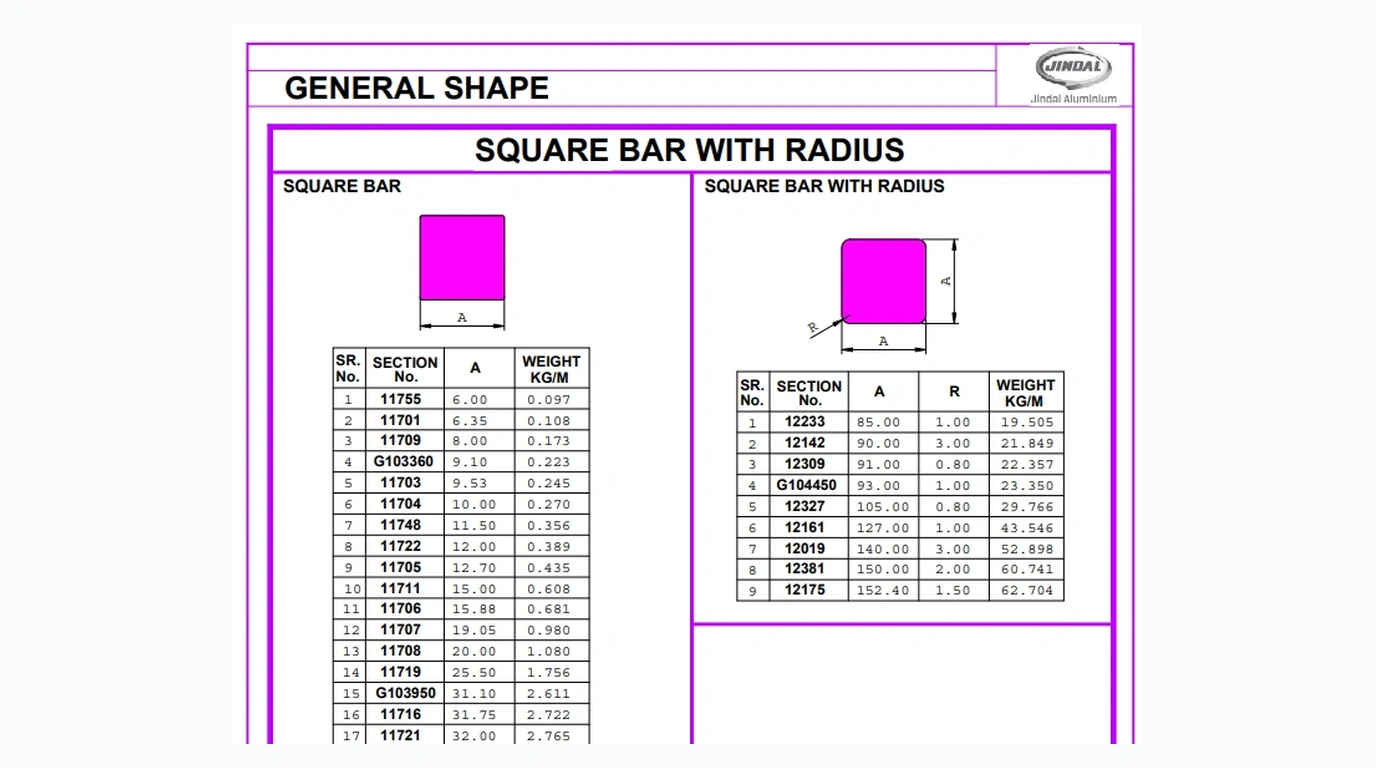
Below is the verified engineering weight schedule from the official Jindal Aluminium General Shapes catalog:
Part A: Standard Sharp Square Bars (Jindal 11700 Series)
| Jindal Section No. | Side Dimension $A$ (mm) | Inch Size Equivalent | Theoretical Weight ($kg/m$) | Cross-Section Area ($mm^2$) | Primary Applications |
|---|---|---|---|---|---|
| 11755 | $6.00\text{ mm}$ | $\approx 0.236"$ | $0.097\text{ }kg/m$ | $36.00$ | Miniature precision keys, electrical shunts |
| 11701 | $6.35\text{ mm}$ | $1/4"$ | $0.108\text{ }kg/m$ | $40.32$ | Small fixture locating blocks, stop pins |
| 11709 | $8.00\text{ mm}$ | $\approx 0.315"$ | $0.173\text{ }kg/m$ | $64.00$ | Machine alignment keys, sliding tracks |
| G103360 | $9.10\text{ mm}$ | $\approx 0.358"$ | $0.223\text{ }kg/m$ | $82.81$ | Custom textile machinery components |
| 11703 | $9.53\text{ mm}$ | $3/8"$ | $0.245\text{ }kg/m$ | $90.82$ | Standard tooling keys, sensor mounts |
| 11704 | $10.00\text{ mm}$ | $\approx 0.394"$ | $0.270\text{ }kg/m$ | $100.00$ | Modular automation blocks, guide rails |
| 11748 | $11.50\text{ mm}$ | $\approx 0.453"$ | $0.356\text{ }kg/m$ | $132.25$ | Lock parts, special precision tooling |
| 11722 | $12.00\text{ mm}$ | $\approx 0.472"$ | $0.389\text{ }kg/m$ | $144.00$ | Assembly fixtures, pneumatic stops |
| 11705 | $12.70\text{ mm}$ | $1/2"$ | $0.435\text{ }kg/m$ | $161.29$ | Standard 1/2" tooling keys, clamps |
| 11711 | $15.00\text{ mm}$ | $\approx 0.590"$ | $0.608\text{ }kg/m$ | $225.00$ | Structural brackets, spacer blocks |
| 11706 | $15.88\text{ mm}$ | $5/8"$ | $0.681\text{ }kg/m$ | $252.17$ | Heavy tooling clamps, electrical tap-offs |
| 11707 | $19.05\text{ mm}$ | $3/4"$ | $0.980\text{ }kg/m$ | $362.90$ | Machine tool beds, alignment blocks |
| 11708 | $20.00\text{ mm}$ | $\approx 0.787"$ | $1.080\text{ }kg/m$ | $400.00$ | Heavy modular frames, linear rail base |
| 11719 | $25.50\text{ mm}$ | $\approx 1.004"$ | $1.756\text{ }kg/m$ | $650.25$ | Precision CNC milling fixture bases |
| G103950 | $31.10\text{ mm}$ | $\approx 1.224"$ | $2.611\text{ }kg/m$ | $967.21$ | Heavy machinery mounting blocks |
| 11716 | $31.75\text{ mm}$ | $1-1/4"$ | $2.722\text{ }kg/m$ | $1008.06$ | Robotic arm mounting flanges, pedestals |
| 11721 | $32.00\text{ mm}$ | $\approx 1.260"$ | $2.765\text{ }kg/m$ | $1024.00$ | Heavy structural toolholders |
Part B: Heavy Structural Square Bars with Radius (Jindal 12000 Series)
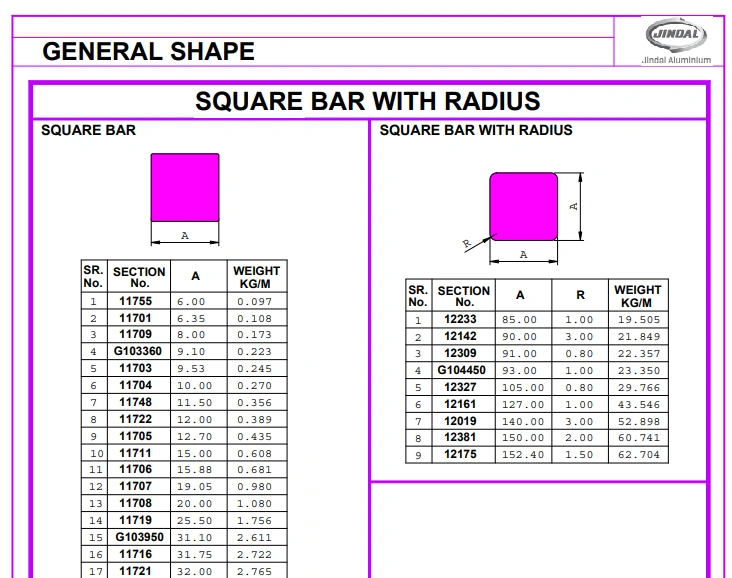
| Jindal Section No. | Side Dimension $A$ (mm) | Corner Radius $R$ (mm) | Theoretical Weight ($kg/m$) | Cross-Section Area ($mm^2$) | Heavy Industrial Applications |
|---|---|---|---|---|---|
| 12233 | $85.00\text{ mm}$ | $1.00\text{ mm}$ | $19.505\text{ }kg/m$ | $7224.1$ | Heavy machinery pedestals, mold bases |
| 12142 | $90.00\text{ mm}$ | $3.00\text{ mm}$ | $21.849\text{ }kg/m$ | $8092.3$ | Forging die shoes, hydraulic manifold blocks |
| 12309 | $91.00\text{ mm}$ | $0.80\text{ mm}$ | $22.357\text{ }kg/m$ | $8280.5$ | Precision surface plate risers, fixtures |
| G104450 | $93.00\text{ mm}$ | $1.00\text{ mm}$ | $23.350\text{ }kg/m$ | $8648.1$ | Heavy press bolster plates |
| 12327 | $105.00\text{ mm}$ | $0.80\text{ mm}$ | $29.766\text{ }kg/m$ | $11024.5$ | Aerospace structural machining billets |
| 12161 | $127.00\text{ mm}$ (5") | $1.00\text{ mm}$ | $43.546\text{ }kg/m$ | $16128.1$ | Heavy mold cores, turbine test blocks |
| 12019 | $140.00\text{ mm}$ | $3.00\text{ mm}$ | $52.898\text{ }kg/m$ | $19592.3$ | Heavy marine propulsion thrust brackets |
| 12381 | $150.00\text{ mm}$ | $2.00\text{ mm}$ | $60.741\text{ }kg/m$ | $22496.6$ | Massive structural machine frames |
| 12175 | $152.40\text{ mm}$ (6") | $1.50\text{ mm}$ | $62.704\text{ }kg/m$ | $23223.7$ | Jumbo aerospace forging stock |
3. Tooling, Jigs & Fixturing: CNC Milling Best Practices
Aluminium square bars are the material of choice for modular machining fixtures due to their high stiffness, non-magnetic properties, and superior thermal stability.
       [ CNC Spindle with Face Mill ]
                     |
                     v
   +------------------------------------+
   |  Jindal 6082-T6 Square Bar Stock   |  <--- Uniform Parallel Faces
   +------------------------------------+
   | Precision Ground Milling Vise Jaw  |
   ======================================
              MACHINE BED
1. Clamping Parallelism & Face Squaring
When squaring stock in a machine vise:
- Jindal extruded square bars possess exceptional face-to-face perpendicularity ($\pm 0.5^\circ$), allowing direct clamping in precision vise jaws without custom shimming.
- For high-speed face milling, use high-positive rake indexable face mills ($45^\circ$ lead angle) with polished uncoated carbide or PCD inserts. Maintain cutting speeds between $600\text{ and }1,200\text{ }m/min$ with light, high-feed passes to eliminate part distortion from internal residual stress.
2. Deep Cavity Milling & Pocketing
When milling deep cavities in large solid billets (such as the $100\text{ mm}$ to $150\text{ mm}$ square blocks):
- Ramp into the material using a helical interpolation angle of $2^\circ\text{ to }3^\circ$ rather than straight plunging.
- Employ high-pressure through-spindle coolant or air blast to evacuate dense aluminium chips, preventing chip re-cutting that causes tool breakage.
4. Mechanical Properties: 6082-T6 vs. 6061-T6 vs. 7075-T6
| Property | Jindal Alloy 6082-T6 | Jindal Alloy 6061-T6 | Ultra-High Strength 7075-T6 |
|---|---|---|---|
| Yield Strength ($0.2%$ Proof) | $\ge 250\text{ }MPa$ | $\ge 240\text{ }MPa$ | $\ge 480\text{ }MPa$ |
| Ultimate Tensile Strength (UTS) | $\ge 295\text{ }MPa$ | $\ge 260\text{ }MPa$ | $\ge 540\text{ }MPa$ |
| Brinell Hardness ($HB$) | $95\text{ }HB$ | $95\text{ }HB$ | $150\text{ }HB$ |
| Modulus of Elasticity ($E$) | $70\text{ }GPa$ | $69\text{ }GPa$ | $72\text{ }GPa$ |
| Weldability (TIG / MIG) | Excellent | Excellent | Poor (Susceptible to cracking) |
| Corrosion Resistance | Superior | Outstanding | Moderate (Requires plating/anodizing) |
For standard tooling blocks, automation frames, and structural assemblies, Jindal 6082-T6 and 6061-T6 provide the best combination of strength, weldability, and cost-effectiveness.
5. Sourcing Jindal Square Bars at Premier Aluminium Traders
Premier Aluminium Traders maintains the largest wholesale warehouse inventory of extruded square bars in North India:
- Full Dimensional Range: Stocked from $6.00\text{ mm}$ small square keys up to $152.4\text{ mm (6-inch)}$ massive solid billets.
- Certified T6 Temper: Fully artificial aged in Jindal’s computerized heat-treatment furnaces to guarantee uniform hardness across the entire cross-section.
- Precision Billeteering: In-house heavy-duty horizontal band saws capable of cutting square billets up to $300\text{ mm}$ with clean, square, burr-free ends.
- Fast Dispatch Across North India: Daily dispatches from our central Delhi facility to industrial clusters across Gurgaon, Manesar, Faridabad, Noida, Baddi, and Ludhiana.
Explore our full range of solid profiles:
- Jindal Aluminium Rods & Bars
- Jindal Aluminium Flat Bars
- Jindal Aluminium Extruded Profiles
- Jindal Aluminium Pipes
Frequently Asked Questions (FAQs)
Why do large square bars have rounded corners instead of sharp edges?
Large solid square bars ($85\text{ mm}$ and above) are extruded with corner radii ($R = 0.8\text{ mm}$ to $3.0\text{ mm}$) to relieve hydraulic stress during extrusion, protect die tooling, and lower stress concentration factors ($K_t$) during high-load mechanical service.
How do I calculate the weight of a square aluminium bar?
For sharp corners, multiply the square of the side in millimeters by $0.00270$: $$\text{Weight }(kg/m) = A^2 \times 0.00270$$ For example, a $20\text{ mm}$ square bar weighs: $20^2 \times 0.00270 = 400 \times 0.00270 = 1.080\text{ }kg/m$.
Can Jindal square bars be tapped with standard machine threads?
Yes. Both 6061-T6 and 6082-T6 square bars exhibit clean, tear-free threading characteristics. When tapping blind holes, use spiral-flute taps with high-quality aluminium cutting oil to ensure chip ejection.
Are ultrasonic test (UT) reports available for heavy square billets?
Yes. For defense, aerospace, or critical hydraulic manifold blocks, Premier Aluminium Traders can supply heavy Jindal square billets with complete ultrasonic testing certification to ensure 100% internal sound density free of pinholes or inclusions.
Request Wholesale Quotations & Sizing Consultations
Fabricating tooling jigs, machine pedestals, or heavy structural brackets? Contact the engineering sales desk at Premier Aluminium Traders for immediate bundle rates, factory MTCs, and cut-to-size billet allocations.
- Address: 5233, G.B. Road, Near Ajmeri Gate, New Delhi - 110006
- Phone: +91 98111 98926 / 011-23212885
- Email: sales@premieraluminium.com
- Web Inquiry: Contact Premier Aluminium Traders