Blog
Aluminium Hex Rods & Hexagonal Bars: High-Speed Fastener Turning, Hydraulic Fittings & Machinability Guide
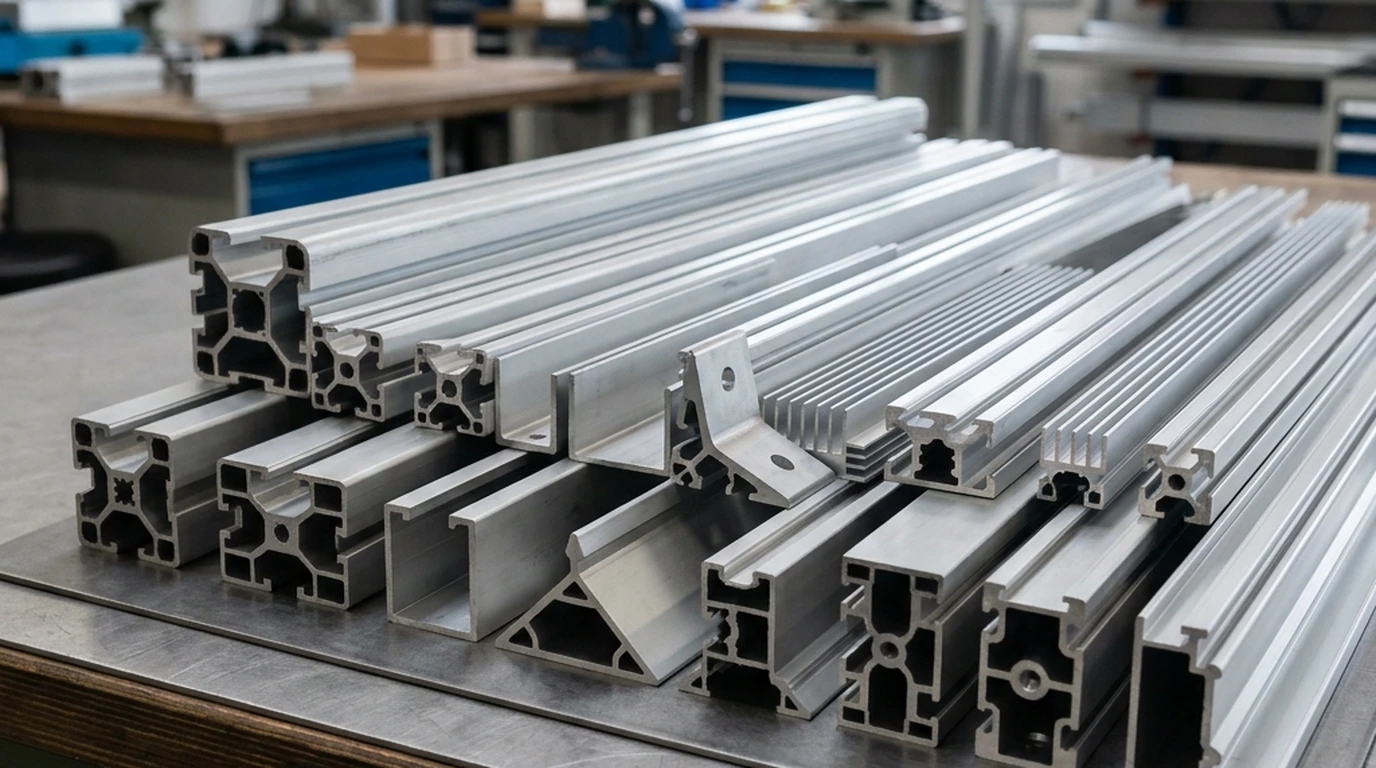
In high-volume component manufacturing, automatic screw machining, fluid power systems, and automotive assembly, solid extruded aluminium hexagonal bars (hex rods) represent the ultimate efficiency standard. Widely utilized for producing threaded hex nuts, standoff spacers, hydraulic hose fittings, pneumatic manifolds, and aerospace fluid connectors, hex bars eliminate the costly and time-consuming secondary milling operations required to machine wrench flats on cylindrical round bars.
With the electric vehicle (EV) revolution demanding aggressive weight reduction across battery thermal management lines, and industrial automation shifting away from heavy brass components to lightweight, corrosion-free aluminium fittings, demand for high-strength Alloy 6082-T6 and 6061-T6 hex rods has surged across India.
Curated by the precision turned parts division at Premier Aluminium Traders—authorized distributor and stockist of Jindal Aluminium Limited in New Delhi since 1978—this engineering manual explores hex bar geometry, across-flats tolerances, weight calculation formulas, CNC single-point threading parameters, and wholesale procurement for component fabricators.
1. Why Component Manufacturers Choose Extruded Hex Bar over Round Bar
Machining threaded fasteners, valve bodies, or pipe nipples from standard round bar stock requires turning the diameter and then indexing the spindle to mill six separate flats:
  METHOD A: Machining from Round Bar           METHOD B: Extruded Hex Bar (Jindal)
  ----------------------------------           -----------------------------------
  * Requires Round Bar Stock                   * Pre-formed Precision Hexagonal Flats
  * Indexing Spindle or Live Tooling Needed    * Zero Wrench-Flat Milling Required
  * 40% - 50% Raw Material Wasted as Swarf     * Near-Net-Shape Raw Material
  * Slower Cycle Times (45 - 60 sec/part)      * Ultra-Fast Cycle Times (12 - 18 sec/part)
  * Higher Cutting Tool Wear                   * Maximum CNC Spindle Productivity
| Manufacturing Variable | Solid Extruded Hex Bar | Solid Round Bar (Milled Flats) | Production Impact |
|---|---|---|---|
| Machining Cycle Time | $12 - 18\text{ seconds}$ per fitting | $45 - 65\text{ seconds}$ per fitting | 60% to 70% faster output |
| Material Swarf Waste | Low ($15% - 20%$) | High ($45% - 55%$) | Massive raw material cost savings |
| Tooling Cost | Standard turning and threading inserts | Requires expensive end mills + live tooling C-axis | Slashes tooling capital expenses |
| Wrench Flat Parallelism | Die-extruded to $\pm 0.15\text{ mm}$ | Dependent on machine axis backlash | Guaranteed wrench fit every time |
| Surface Finish on Flats | Smooth extruded mill finish | Tool cutter witness marks | Superior aesthetics and anodizing |
By utilizing pre-formed Jindal aluminium hexagonal bars, CNC machine shops operating Swiss-type screw machines or multi-spindle automatic lathes achieve dramatically lower cost-per-part while maximizing production throughput.
2. Geometric Standards: Across-Flats ($S$) vs. Across-Corners ($e$)
A regular hexagon exhibits precise trigonometric relationships between its inscribed diameter (Across Flats, $S$) and its circumscribed diameter (Across Corners, $e$):
                       / \
                      /   \
                     /     \
                    |       |  <--- Width Across Corners (e)
                    |   S   |  <--- Width Across Flats (S)
                    |       |
                     \     /
                      \   /
                       \ /
$$\text{Across-Corners Dimension: } e = \frac{S}{\cos(30^\circ)} = \frac{2}{\sqrt{3}} \times S \approx 1.1547 \times S$$
$$\text{Cross-Sectional Area: } A = \frac{\sqrt{3}}{2} \times S^2 \approx 0.8660 \times S^2$$
Theoretical Weight Formula for Aluminium Hex Bar
Taking the volumetric density of high-purity extruded aluminium as $\rho = 2.70\text{ }g/cm^3$ ($0.0027\text{ }kg/cm^3$):
$$\text{Weight per Meter } (kg/m) = 0.8660 \times S^2 \times 0.00270 \approx 0.0023383 \times S^2$$
(Where $S$ is the width across flats in millimeters).
3. Jindal Aluminium Hex Bar Sizing & Weight Chart
Below is the engineering reference table for standard extruded aluminium hex bars, correlating across-flats dimensions ($S$), across-corners dimensions ($e$), theoretical weights, and standard fastener/fitting applications:
| Width Across Flats $S$ (mm) | Across Corners $e$ (mm) | Inch Size Equivalent | Theoretical Weight ($kg/m$) | Matching Metric Thread Range | Primary Engineering Applications |
|---|---|---|---|---|---|
| $10.00\text{ mm}$ | $11.55\text{ mm}$ | $\approx 0.394"$ | $0.234\text{ }kg/m$ | M6 Nuts / Studs | Electronic PCB standoffs, drone frame spacers |
| $12.00\text{ mm}$ | $13.86\text{ mm}$ | $\approx 0.472"$ | $0.337\text{ }kg/m$ | M7 / M8 Light | Sensor couplings, pneumatic bleed screws |
| $13.00\text{ mm}$ | $15.01\text{ mm}$ | $\approx 0.512"$ | $0.395\text{ }kg/m$ | M8 Standard Nuts | ISO standard M8 fasteners, automotive brackets |
| $14.00\text{ mm}$ | $16.17\text{ mm}$ | $\approx 0.551"$ | $0.458\text{ }kg/m$ | G 1/8" BSPP | Pneumatic push-in fittings, miniature valves |
| $17.00\text{ mm}$ | $19.63\text{ mm}$ | $\approx 0.669"$ | $0.676\text{ }kg/m$ | M10 Standard | Hydraulic flare nuts, brake line connectors |
| $19.00\text{ mm}$ | $21.94\text{ mm}$ | $3/4"$ | $0.844\text{ }kg/m$ | M12 Standard | EV coolant manifold connectors, air nipples |
| $22.00\text{ mm}$ | $25.40\text{ mm}$ | $\approx 0.866"$ | $1.132\text{ }kg/m$ | M14 / G 1/4" BSPP | High-pressure hydraulic adapters, hose ends |
| $24.00\text{ mm}$ | $27.71\text{ mm}$ | $\approx 0.945"$ | $1.347\text{ }kg/m$ | M16 Standard | Industrial machine bolts, tie-rod couplers |
| $27.00\text{ mm}$ | $31.18\text{ mm}$ | $\approx 1.063"$ | $1.705\text{ }kg/m$ | M18 / G 3/8" BSPP | Heavy fluid manifolds, fuel filter fittings |
| $30.00\text{ mm}$ | $34.64\text{ mm}$ | $\approx 1.181"$ | $2.104\text{ }kg/m$ | M20 Standard | Industrial valve stems, structural tie bars |
| $32.00\text{ mm}$ | $36.95\text{ mm}$ | $1-1/4"$ | $2.394\text{ }kg/m$ | G 1/2" BSPP / NPT | Hydraulic quick-disconnect couplers |
| $36.00\text{ mm}$ | $41.57\text{ mm}$ | $\approx 1.417"$ | $3.030\text{ }kg/m$ | M24 Standard | High-tensile crane bolts, heavy equipment |
| $41.00\text{ mm}$ | $47.34\text{ mm}$ | $\approx 1.614"$ | $3.931\text{ }kg/m$ | M27 / G 3/4" BSPP | Marine hydraulic adapters, chemical valves |
| $46.00\text{ mm}$ | $53.12\text{ mm}$ | $\approx 1.811"$ | $4.948\text{ }kg/m$ | M30 Standard | High-pressure oilfield adapters, flanges |
| $50.00\text{ mm}$ | $57.74\text{ mm}$ | $\approx 1.969"$ | $5.846\text{ }kg/m$ | G 1" BSPP | Large flow cooling manifolds, pump headers |
| $65.00\text{ mm}$ | $75.06\text{ mm}$ | $\approx 2.559"$ | $9.879\text{ }kg/m$ | M42 / G 1-1/2" | Heavy aerospace actuator bodies, couplings |
4. CNC Machining & Threading Guidelines for Hex Bars
When turning hexagonal bars, the interrupted cut during initial facing and outside diameter turning creates repetitive mechanical impacts on the tool tip until the cylindrical shoulder is established.
       [ Hex Bar Stock Rotating in Spindle ]
                         |
      +------------------+------------------+
      | Interrupted Cut (Flats to Round)    |
      | Use Tough Micrograin Carbide Grade  |
      +------------------+------------------+
                         |
      [ Continuous Single-Point Threading ]
      | 60° Metric or 55° BSPP Insert       |
      | 4 to 6 Infeed Passes with Coolant   |
      +-------------------------------------+
1. Tool Selection for Interrupted Cuts
- Use tough, impact-resistant micrograin carbide inserts with PVD TiAlN or TiN coatings (or uncoated polished K10/K20 submicron grade).
- Maintain an entering angle of $90^\circ$ or $93^\circ$ to minimize radial deflection during initial flat-to-round turning.
2. Thread Cutting Parameters
- Internal Threading: For blind holes, use fluteless cold-forming taps. Because aluminium flows plastically, formed threads have smooth root radiuses free of micro-notches, increasing dynamic fatigue resistance by $35%$.
- External Threading: On CNC lathes, use single-point threading inserts with modified flank infeed ($29^\circ$) to direct cutting forces onto one edge of the insert, preventing chip jamming.
5. Replacing Brass & Steel with Aluminium Hex Fittings
For decades, hydraulic fittings and pneumatic adapters were made from Free-Cutting Brass (IS 319 / CW614N) or zinc-plated leaded steel (11SMnPb30). Modern engineering has triggered a massive shift toward Jindal 6082-T6 and 6061-T6 Hex Bars:
| Property | Jindal Alloy 6082-T6 Hex Bar | Free-Cutting Brass (CW614N) | Mild Leaded Steel (11SMnPb30) |
|---|---|---|---|
| Density | $2.70\text{ }g/cm^3$ (Ultra-light) | $8.45\text{ }g/cm^3$ (3.1x heavier!) | $7.85\text{ }g/cm^3$ (2.9x heavier!) |
| Tensile Strength (UTS) | $\ge 295\text{ }MPa$ | $360 - 440\text{ }MPa$ | $380 - 500\text{ }MPa$ |
| Corrosion Resistance | Superior; naturally rust-proof | Good, but tarnishes green | Prone to red rust once zinc coating chips |
| Environmental Compliance | 100% Lead-Free (RoHS Compliant) | Contains $2.5% - 3.5%$ Toxic Lead | Contains up to $0.35%$ Lead |
| Raw Material Cost per Volume | Lowest (₹280 - ₹310 / kg) | High (₹620 - ₹680 / kg) | Low per kg, but 3x heavier per part |
In automotive electric vehicle (EV) battery cooling lines and aircraft hydraulic blocks, switching from brass to Jindal aluminium hex bars reduces total component assembly weight by over 65%, directly boosting vehicle range and fuel efficiency.
6. Sourcing Jindal Hex Rods at Premier Aluminium Traders
Premier Aluminium Traders is North India’s leading stockist of certified Jindal Aluminium Hexagonal Bars:
- Alloy Tempers Available: 6082-T6, 6061-T6, 6063-T6, and 2014-T6 for defense applications.
- Stock Availability: Sizes from $10.0\text{ mm}$ up to $65.0\text{ mm}$ across flats in ready-to-ship bundles.
- Tolerances: Extruded to precision commercial tolerances per IS 733 and ASTM B221, guaranteeing trouble-free loading in automatic bar feeders.
- Traceability: Supplied with Jindal factory Mill Test Certificates verifying alloy composition and hardness.
Explore our comprehensive solid bar catalog:
- Jindal Aluminium Rods & Hex Bars
- Jindal Aluminium Flat Bars
- Jindal Extrusions Full Range
- Jindal Aluminium Pipes & Tubes
Frequently Asked Questions (FAQs)
What is the formula for calculating aluminium hex bar weight per meter?
Multiply the square of the across-flats dimension ($S$ in mm) by $0.0023383$: $$\text{Weight }(kg/m) = S^2 \times 0.0023383$$ For example, for a $19\text{ mm}$ hex bar: $19^2 \times 0.0023383 = 361 \times 0.0023383 = 0.844\text{ }kg/m$.
Can aluminium hex fittings handle high hydraulic pressures?
Yes. When machined from Jindal 6082-T6 or 6061-T6 with adequate wall thickness, aluminium hydraulic adapters routinely withstand operating pressures exceeding $250\text{ to }350\text{ bar}$ ($3,600 - 5,000\text{ PSI}$) with a 4:1 burst pressure safety factor, conforming to SAE J514 and ISO 8434 standards.
How do I prevent thread galling in aluminium hex couplings?
Aluminium threads can gall when mated against stainless steel or aluminium without lubrication. To prevent galling:
- Apply an anti-seize paste or PTFE thread sealant.
- Hard-anodize the threaded components ($25 - 50\text{ }\mu m$ coating thickness with PTFE impregnation).
- Utilize roll-formed threads instead of cut threads for smoother root contact surfaces.
Are Jindal hex bars compliant with RoHS and REACH standards?
Yes. Jindal primary alloy extrusions are completely free of hazardous lead, cadmium, and mercury, ensuring 100% compliance with European Union RoHS and REACH export regulations for automotive and electronic components.
Request Wholesale Quotations & Bar Feeder Stock
Manufacturing high-volume fasteners, EV fluid fittings, or hydraulic couplers? Contact the sales engineering desk at Premier Aluminium Traders for immediate volume schedules, factory test certificates, and rapid warehouse dispatch.
- Address: 5233, G.B. Road, Near Ajmeri Gate, New Delhi - 110006
- Phone: +91 98111 98926 / 011-23212885
- Email: sales@premieraluminium.com
- Web Inquiry: Contact Premier Aluminium Traders