Blog
Aluminium Rods vs. Hollow Tubes: Machining, Tapping, Welding & B2B Selection Guide for Fabricators
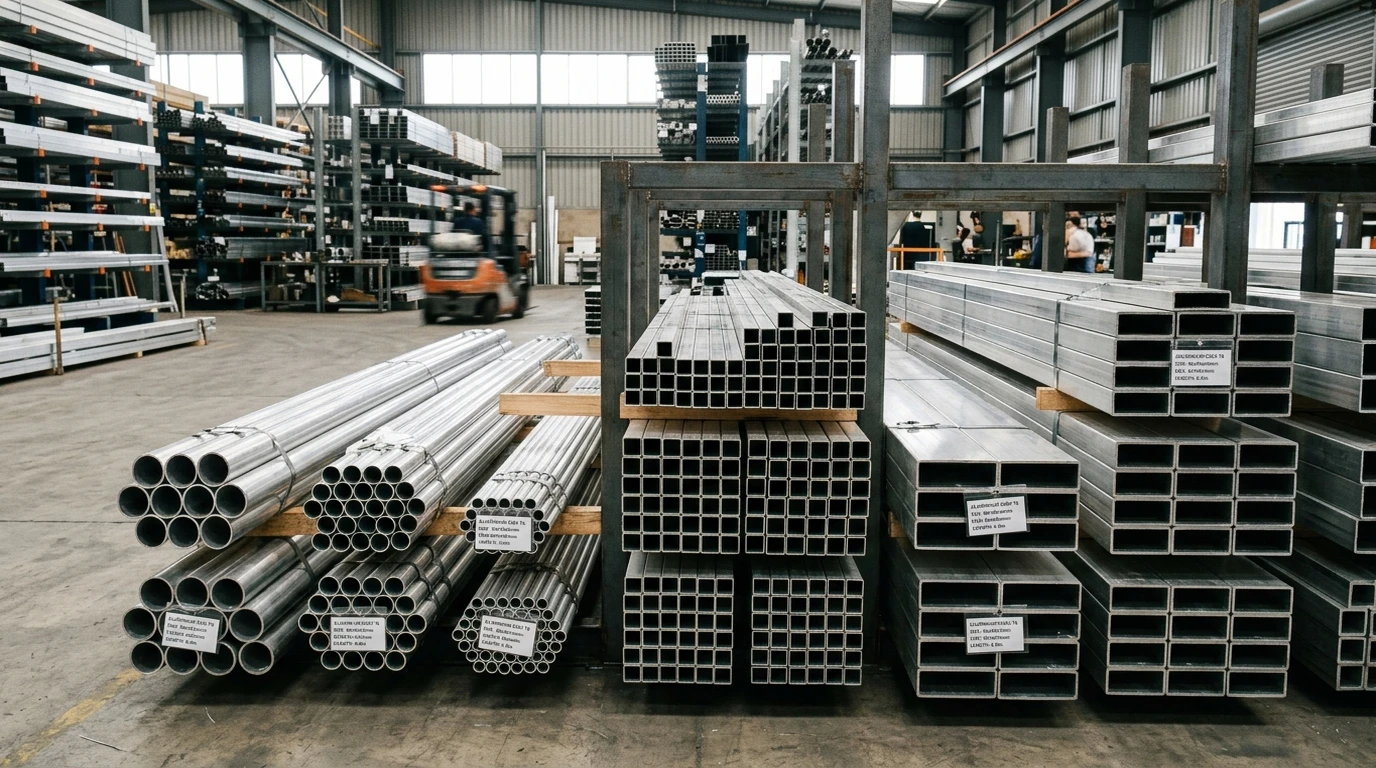
In industrial fabrication, structural engineering, and precision mechanical assembly, selecting between solid aluminium bars (Round, Square, and Hex Rods) and hollow extruded profiles (Square and Rectangle Tubes) is one of the most critical design decisions. While solid bars provide unmatched mass density, heavy shear strength, and superior thread engagement for CNC turned components, hollow structural extrusions deliver an extraordinary strength-to-weight ratio that slashes material costs and reduces structural dead loads by over 60%.
However, translating raw extruded aluminium stock into high-performance finished products requires an in-depth understanding of fabrication mechanics. Design engineers and workshop fabricators must navigate thread pull-out forces, evaluate the Heat-Affected Zone (HAZ) softening that occurs during TIG/MIG welding, select the correct welding filler alloy (ER4043 vs. ER5356), and optimize miter-cutting feeds to prevent profile burrs and blade galling.
Curated by the technical applications team at Premier Aluminium Traders—authorized distributor and stockist of Jindal Aluminium Limited in New Delhi since 1978—this comprehensive engineering guide provides fabricators and OEMs with a definitive decision matrix for solid vs. hollow sections, thread tapping standards, welding best practices, and single-source wholesale procurement.
1. Engineering Decision Matrix: Solid Rods vs. Hollow Tubes
To choose the optimal profile geometry for your project, evaluate how the component experiences mechanical stress during service:
                  STRUCTURAL FUNCTION & STRESS STATE
                                  |
         +------------------------+------------------------+
         |                                                 |
  [ SOLID PROFILES ]                               [ HOLLOW PROFILES ]
  (Round, Square, Hex Bar)                         (Square, Rectangle Tube)
  * Heavy shear and torsional torque               * Long-span bending moments (pergolas, beams)
  * Deep internal thread tapping                   * Vertical axial columns (racks, frames)
  * High-speed CNC turning & shafts                * Cleanroom conduits & fluid piping
  * Machining custom irregular contours            * Lightweight enclosures & facades
| Selection Criteria | Solid Profiles (Round / Square / Hex Rods) | Hollow Profiles (Square / Rectangle Tubes) | Engineering Rationale |
|---|---|---|---|
| Bending Strength-to-Weight | Moderate (Excess dead weight at center) | Superior (Concentrates metal at outer fibers) | Hollow tubes save $50% - 70%$ weight for equal bending resistance |
| Torsional Shear Resistance | High; solid mass resists continuous twist | Moderate; excellent for closed shapes, lower for open slots | Solid rods excel in drive shafts and motor couplings |
| Internal Threading Depth | Unlimited depth; can be bored and tapped fully | Limited to nominal wall thickness ($T = 1.2 - 3.5\text{ mm}$) | Hollow tubes require internal nut plates or rivet nuts |
| Material Cost per Meter | Higher ($1.0\text{ to }60.0+\text{ }kg/m$) | Economical ($0.2\text{ to }4.5\text{ }kg/m$) | Hollow profiles minimize project raw material expenditure |
| Assembly Speed | Requires multi-axis CNC milling or turning | Rapid bolt-together using internal corner cleats | Hollow tubes slash on-site fabrication labor |
| Primary Alloys Specified | 6082-T6 / 6061-T6 (High strength, crisp chips) | 6063-T6 / 6082-T6 (Architectural, smooth finish) | Matched to machining vs surface finish demands |
2. Mathematical Proof: The Hollow Tube Weight Advantage
Why do structural engineers specify hollow square or rectangular tubes for frameworks instead of solid bars? The answer lies in the Moment of Inertia ($I$):
  SOLID SQUARE BAR (50mm x 50mm)            HOLLOW SQUARE TUBE (50mm x 50mm x 3.0mm)
  +----------------------------+            +----------------------------+
  |                            |            | +------------------------+ |
  |   Metal at the center      |            | |  Empty Air at Center   | |
  |   contributes almost       |            | |  (Zero dead weight!)   | |
  |   NOTHING to bending!      |            | +------------------------+ |
  +----------------------------+            +----------------------------+
  Weight: ~6.75 kg/m (100%)                 Weight: ~1.52 kg/m (77% LIGHTER!)
  Moment of Inertia: 520,833 mm⁴            Moment of Inertia: 297,744 mm⁴ (57% as stiff!)
The Efficiency Index:
While the hollow tube carries $57%$ of the bending stiffness ($I$) of the solid bar, it weighs $77%$ less!
To match the exact stiffness of a $50\text{ mm}$ solid bar ($I = 520,833\text{ }mm^4$), an engineer simply selects a slightly deeper hollow tube—such as a $63\text{ mm} \times 38\text{ mm} \times 2.95\text{ mm}$ rectangular tube (Jindal Section No. 14005). It matches the bending strength of the solid bar, yet weighs only $1.516\text{ }kg/m$—achieving a massive $77.5%$ raw material cost reduction!
3. Precision Thread Tapping & Thread Engagement in Aluminium
Thread stripping is one of the most common fabrication failures when joining aluminium components. Because aluminium has a lower shear modulus than carbon steel, proper engineering practices must be observed:
       [ Stainless Steel Fastener Bolt (Grade A2-70) ]
                            |
       +--------------------+--------------------+
       |                                         |
  [ SOLID ROD / BAR ]                     [ HOLLOW TUBE WALL ]
  Minimum Thread Depth:                   Wall Thickness T < 3.0mm:
  * 1.5 x Bolt Diameter (6082-T6)         * Insufficient thread turns!
  * 2.0 x Bolt Diameter (6063-T6)         * MUST use Threaded Rivet Nut (Rivnut)
  Use Fluteless Cold-Forming Tap          or Internal Steel Nut Plate
1. The 1.5D to 2.0D Rule
When tapping threads into solid Jindal aluminium bars:
- For high-strength Alloy 6082-T6 / 6061-T6: The minimum threaded engagement depth must be at least $1.5 \times \text{nominal bolt diameter}$ (e.g., $15\text{ mm}$ depth for an M10 bolt).
- For softer architectural Alloy 6063-T6: The minimum engagement depth increases to $2.0 \times \text{diameter}$ ($20\text{ mm}$ for M10).
2. Fluteless Cold-Forming Taps vs. Cutting Taps
- Cutting Taps: Cut through the metal grain structure, leaving microscopic root tears where stress cracks can propagate under cyclical vibration.
- Roll-Forming (Fluteless) Taps: Displace the aluminium plastically without producing swarf chips. The continuous metal grain flow around the formed thread peaks increases thread shear pull-out strength by over $30%$ and eliminates swarf jamming in blind holes.
3. Fastening into Hollow Tube Walls
When the wall thickness of a square or rectangular tube is less than $3\text{ mm}$, tapping directly into the wall provides only 1 to 2 thread turns, resulting in stripped threads under light torque. Fabricators should utilize Threaded Rivet Nuts (Rivnuts / Blind Nuts) or insert internal steel backing plates to ensure strong, reliable mechanical joints.
4. Welding Aluminium Extrusions: TIG vs. MIG & Filler Metallurgy
Welding aluminium is fundamentally different from welding carbon steel due to aluminium’s high thermal conductivity (transfers heat 5x faster than steel), rapid oxidation, and sensitivity to thermal cracking.
       TIG (GTAW) WELDING                         MIG (GMAW) WELDING
       ------------------                         ------------------
  * AC High-Frequency Arc                    * Direct Current Electrode Positive (DCEP)
  * Arc cleans tough Al₂O₃ oxide layer        * High deposition rate for long seams
  * Unmatched precision for visible joints   * Production welding of heavy frames
  * Zero spatter, aesthetic architectural    * Requires push-pull wire feeder torch
The Filler Wire Dilemma: ER4043 vs. ER5356
Selecting the correct welding filler rod is critical to prevent joint cracking and guarantee strong structural welds:
| Practical Welding Parameter | ER4043 Filler Wire (Silicon-Alloyed) | ER5356 Filler Wire (Magnesium-Alloyed) |
|---|---|---|
| Filler Wire Characteristic | High-fluidity formulation (easy bead control) | High-strength formulation (maximum joint toughness) |
| Weld Pool Fluidity | Superior; flows easily into tight joints | Moderate; stiffer weld puddle |
| Hot Cracking Resistance | Extremely High (minimal cooling shrinkage) | Requires careful heat and speed control |
| Joint Shear Strength | Moderate ($\approx 160\text{ }MPa$) | High ($\approx 200\text{ }MPa$) |
| High Temperature Service | Safe up to $150^\circ C$ | Best below $65^\circ C$ |
| Post-Weld Anodizing Color | Turns Dark Grey / Black! (Unattractive) | Matches Base Metal (Clean Silver / Translucent) |
Practical Workshop Rule of Thumb:
- Choose ER4043: When welding general frameworks, furniture, and structures that will be painted or powder-coated, where crack resistance and easy bead control are paramount.
- Choose ER5356: When the welded assembly will undergo decorative clear anodizing (to avoid dark weld seams) or when maximum dynamic shear strength is required in structural transport applications.
Managing the Heat-Affected Zone (HAZ) Softening:
Aluminium extrusions derive their high strength from heat treatment (T6 artificial aging). When welding, the intense localized heat ($> 400^\circ C$) within $25\text{ mm}$ of the weld bead naturally anneals the metal back to an unhardened T4 or O-temper state, reducing local yield strength by up to $35% - 45%$. Structural fabricators compensate by placing welded joints away from maximum bending moment locations or reinforcing joints with internal gussets and corner cleats.
5. Precision Cold Saw Cutting & Miter Geometry
When fabricating frames from square and rectangular tubes, clean, burr-free cuts are essential for square corner fit-up:
  COLD CIRCULAR SAW PARAMETERS FOR ALUMINIUM:
  * Blade Type: Tungsten Carbide Tipped (TCT) with Triple Chip Grind (TCG)
  * Rake Angle: Negative rake (-5° to 0°) to prevent aggressive self-feeding
  * Rim Speed: 2,500 - 3,500 m/min (High-speed circular saw)
  * Lubrication: Micro-mist vegetable wax / alcohol spray (prevents chip welding)
By maintaining sharp carbide teeth and applying micro-lubrication, fabricators eliminate heavy edge burrs, ensuring $45^\circ$ miter joints close with zero visible gap before TIG welding or mechanical cleating.
6. Sourcing the Complete Jindal Shapes Portfolio at Premier Aluminium Traders
Premier Aluminium Traders eliminates the supply chain complexity of managing multiple vendors by stocking the entire Jindal Aluminium General Shapes catalog under one roof in Delhi:
- Solid Bar Shapes: Round Rods ($\varnothing 6\text{ mm}$ to $200\text{ mm}$), Square Bars ($6\text{ mm}$ to $152.4\text{ mm}$ with sharp/radiused corners), and Hexagonal Bars ($10\text{ mm}$ to $65\text{ mm}$).
- Hollow Tube Profiles: Square Hollow Sections ($12.7\text{ mm}$ to $125\text{ mm}$) and Rectangular Hollow Sections ($20 \times 10\text{ mm}$ to $150 \times 50\text{ mm}$) across all standard wall thicknesses.
- Structural Alloys: 6063-T6, 6061-T6, 6082-T6, 6101-T6, and 2014-T6.
- Certified Traceability: 100% Jindal factory Mill Test Certificates verifying certified alloy grade and mechanical hardness.
- Value-Added Processing: Precision bundle cutting, CNC miter sawing, punching, anodizing ($15 - 25\text{ }\mu m$), and Qualicoat powder coating.
Explore our full inventory:
- Jindal Aluminium Rods & Bars
- Jindal Aluminium Flat Bars
- Jindal Aluminium Pipes & Tubes
- Jindal Complete Extrusions Catalog
Frequently Asked Questions (FAQs)
Which aluminium alloy is best when an assembly must be both welded and CNC machined?
Alloy 6082-T6 is the ideal all-around engineering alloy. It possesses high manganese content for clean CNC chip breaking, provides a minimum tensile yield strength of $250\text{ }MPa$, and welds smoothly using ER4043 or ER5356 filler without hot cracking.
Why do TIG welds on 6063 aluminium turn black after anodizing?
This discoloration occurs when an ER4043 filler rod (containing 5% Silicon) is used. During the anodizing acid bath, the silicon particles in the weld pool turn dark soot-grey. To maintain a uniform, seamless silver color match after anodizing, fabricators must always use ER5356 filler rod (containing 5% Magnesium).
How do I join two hollow aluminium tubes without welding?
Hollow square and rectangular tubes can be joined using internal corner cleats (L-brackets), expandable internal friction plugs, or concealed screw ports. This produces 100% rigid, vibration-resistant frames that require zero field welding and preserve pristine factory powder-coated finishes.
What is the maximum bending angle for solid aluminium square bars?
Cold-bending a solid T6-temper square bar to $90^\circ$ can induce surface micro-cracking unless a generous bend radius ($R \ge 2.5 \times \text{bar thickness}$) is maintained. For sharp tight-radius architectural bends, specify Alloy 6063 in T4 temper or O-temper (annealed), followed by post-forming artificial aging.
Request Wholesale Project Quotations & Engineering Support
Planning a complex fabrication assembly, architectural framework, or high-volume turned parts production? Contact the engineering sales division at Premier Aluminium Traders for immediate volume schedules, mill test certificates, and custom length deliveries.
- Address: 5233, G.B. Road, Near Ajmeri Gate, New Delhi - 110006
- Phone: +91 98111 98926 / 011-23212885
- Email: sales@premieraluminium.com
- Web Inquiry: Contact Premier Aluminium Traders