Blog
Aluminium Sheets (1050, 3003, 5052, 6061): Gauge-to-MM Thickness & Weight Chart Guide
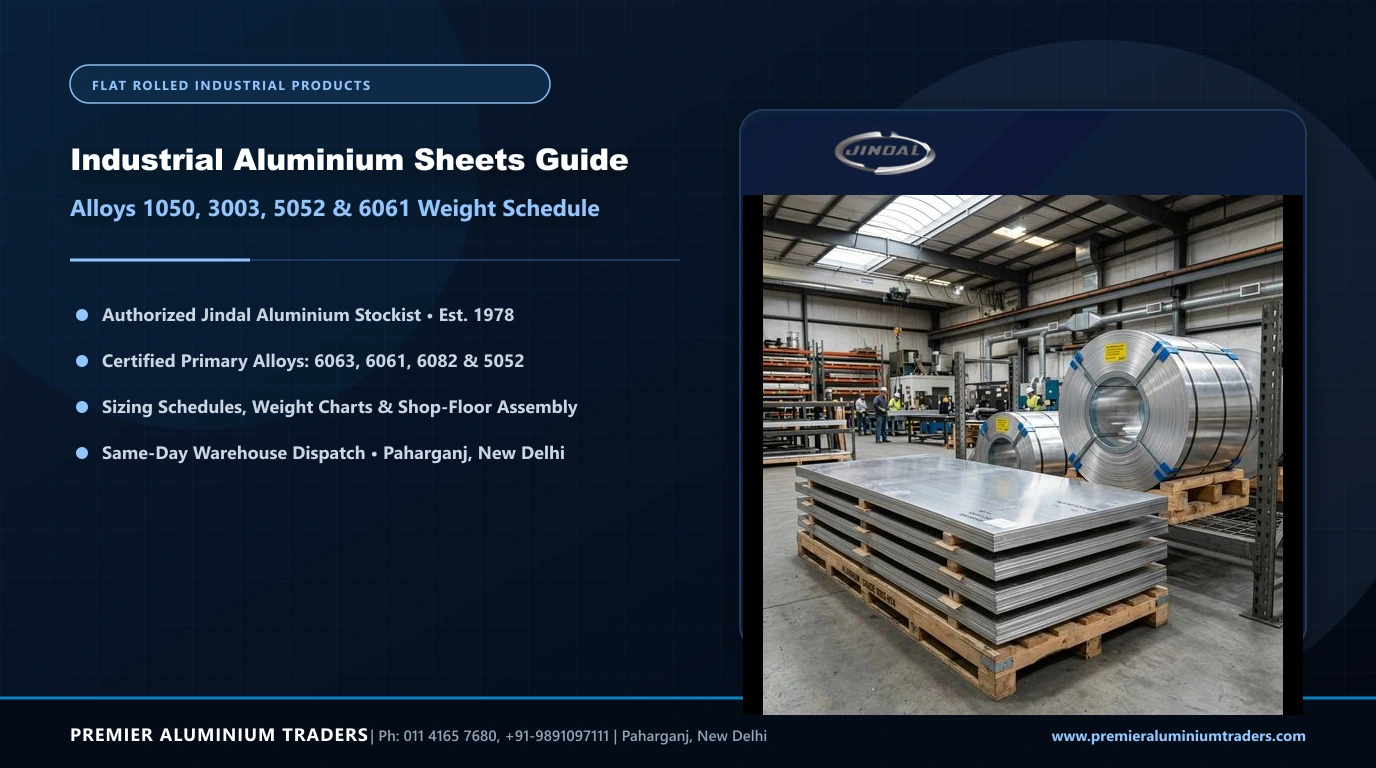
Plain aluminium sheets and industrial plates form the foundational raw material for modern engineering, commercial transport bodybuilding, HVAC air ducting, electrical control panels, chemical storage tanks, cold room insulated panel skins, and high-end architectural facade cladding. Because aluminium delivers an exceptional strength-to-weight ratio (one-third the weight of mild steel or brass) alongside permanent atmospheric corrosion resistance, it is the primary choice for weight-critical fabrication across Delhi NCR and India.
However, selecting the correct sheet specification involves more than just selecting a thickness. Sourcing the wrong alloy grade or temper can lead to catastrophic cracking along press-brake bend lines, poor weld puddle control during TIG/MIG welding, or excessive structural deflection under hydraulic or aerodynamic pressure.
Prepared by the metal distribution team at Premier Aluminium Traders—authorized distributor and stockist of Jindal Aluminium Limited and prime flat-rolled products in Paharganj, New Delhi since 1978—this definitive commercial reference provides a comprehensive standard gauge-to-millimeter conversion table, sheet weight calculation formulas, commercial alloy selection guides, and sheet metal fabrication rules.
1. Why High-Purity Primary Aluminium Sheets Outperform Galvanized Iron (GI) & Stainless Steel
Fabricators and design engineers regularly compare aluminium sheets against Galvanized Iron (GI) and Stainless Steel (SS 304):
| Property Metric | Prime Industrial Aluminium Sheet | Galvanized Iron (GI) Sheet | Stainless Steel (SS 304) Sheet |
|---|---|---|---|
| Specific Gravity (Density) | $2.71\text{ }g/cm^3$ (Ultra-Lightweight) | $7.85\text{ }g/cm^3$ (2.9x Heavier) | $7.93\text{ }g/cm^3$ (2.9x Heavier) |
| Corrosion Protection Mechanism | Self-healing native aluminium oxide ($Al_2O_3$) | Sacrificial zinc layer; rusts once scratched | Passive chromium oxide layer |
| Cut-Edge Rust Vulnerability | 100% Rust-Proof at sheared cut edges | Sheared raw edges rust relentlessly | Rust-resistant but prone to pitting |
| Electrical & Thermal Conductivity | High (55% to 62% IACS); superior heat transfer | Low (~15% IACS); poor thermal dissipation | Very Low (~3% IACS); hot spots develop |
| Formability & Deep Drawing | Exceptional elongation in annealed tempers | Moderate formability; zinc flaking risk | High work-hardening; requires heavy tooling |
| Dead Weight Savings on Vehicles | Saves 60% payload tare weight | Heavy; increases fuel consumption | Heavy; increases axle wear |
2. Universal Mathematical Formulas for Aluminium Sheet Weight
Calculating the exact theoretical weight of an aluminium sheet is essential for procurement budgeting, freight estimation, and structural load calculations.
Formula 1: Weight of an Individual Sheet
$$\text{Weight } (\text{kg}) = \text{Length } (\text{m}) \times \text{Width } (\text{m}) \times \text{Thickness } (\text{mm}) \times 2.71$$
Formula 2: Weight per Square Meter ($kg/m^2$)
$$\text{Weight per } m^2 (\text{kg}) = \text{Thickness } (\text{mm}) \times 2.71$$
Example: For a standard $8\text{ ft} \times 4\text{ ft}$ ($2.438\text{ m} \times 1.219\text{ m}$) sheet with a thickness of $2.00\text{ mm}$: $$\text{Surface Area} = 2.438 \times 1.219 = 2.972\text{ }m^2$$ $$\text{Weight} = 2.972 \times 2.00 \times 2.71 = \mathbf{16.11\text{ kg}}$$
3. Standard Gauge (SWG) to MM Thickness & Weight Schedule
The following reference table covers the most high-demand commercial sheet thicknesses and sheet sizes stocked in our Delhi central warehouse:
| Standard Wire Gauge (SWG) | Nominal Thickness ($\text{mm}$) | Weight per Sq. Meter ($\text{kg/m}^2$) | Weight of $8\text{ ft} \times 4\text{ ft}$ ($2440 \times 1220\text{ mm}$) Sheet | Weight of $10\text{ ft} \times 4\text{ ft}$ ($3050 \times 1220\text{ mm}$) Sheet | Typical Industrial Application |
|---|---|---|---|---|---|
| 24 SWG | $0.56$ | $1.52$ | $4.52\text{ kg}$ | $5.65\text{ kg}$ | HVAC duct wrap, thermal pipe lagging |
| 22 SWG | $0.71$ | $1.92$ | $5.72\text{ kg}$ | $7.15\text{ kg}$ | Signage backing, false ceiling tiles |
| 20 SWG | $0.91$ | $2.47$ | $7.35\text{ kg}$ | $9.19\text{ kg}$ | PUF cold room skin, kitchen splashbacks |
| 18 SWG | $1.22$ | $3.31$ | $9.85\text{ kg}$ | $12.31\text{ kg}$ | Commercial vehicle interior paneling |
| 16 SWG | $1.63$ | $4.42$ | $13.15\text{ kg}$ | $16.44\text{ kg}$ | Electrical enclosures, machinery covers |
| 14 SWG | $2.03$ | $5.50$ | $16.38\text{ kg}$ | $20.47\text{ kg}$ | Architectural cladding, fuel tanks |
| 12 SWG | $2.64$ | $7.15$ | $21.30\text{ kg}$ | $26.62\text{ kg}$ | Heavy tool boxes, bus body outer skin |
| 10 SWG | $3.25$ | $8.81$ | $26.22\text{ kg}$ | $32.78\text{ kg}$ | Structural brackets, transport floors |
| Plate 4mm | $4.00$ | $10.84$ | $32.27\text{ kg}$ | $40.34\text{ kg}$ | Machine base plates, marine decks |
| Plate 5mm | $5.00$ | $13.55$ | $40.34\text{ kg}$ | $50.42\text{ kg}$ | Heavy robotic fixtures, industrial beds |
| Plate 6mm | $6.00$ | $16.26$ | $48.40\text{ kg}$ | $60.50\text{ kg}$ | CNC tooling plates, heavy structural panels |
4. Commercial Alloy Grade Guide: Selecting for Formability, Marine or Strength
Aluminium sheets are categorized by their primary alloying elements to serve specific industrial requirements:
                         [ COMMERCIAL ALUMINIUM SHEET GRADES ]
                                          |
            +--------------------+--------+--------+--------------------+
            |                    |                 |                    |
            v                    v                 v                    v
      [ ALLOY 1050/1100 ]  [ ALLOY 3003 ]    [ ALLOY 5052-H32 ]   [ ALLOY 6061-T6 ]
      High-Purity Primary  Manganese-Alloyed Marine-Grade Mg      Heat-Treated Structural
      High Conductivity    High Workability  High Fatigue/Corrosion Heavy CNC Machining
1. Alloy 1050 / 1100 ($>99.5%$ Pure Primary Aluminium)
- Mechanical Characteristics: Soft, highly ductile, with maximum electrical conductivity ($\ge 61%\text{ IACS}$) and thermal conductivity ($220\text{ W/m}\cdot\text{K}$).
- Primary Uses: Deep drawing, spun reflective lighting louvers, transformer electrical windings, chemical process vessels, and thin condenser fins.
2. Alloy 3003-H14 (Manganese-Alloyed Workhorse)
- Mechanical Characteristics: Approximately $20%$ stronger than pure 1100 alloy while maintaining superb cold formability, smooth brake-press bending, and excellent weldability.
- Primary Uses: Commercial HVAC ducting, cold storage insulated sandwich panel skins, architectural flashings, and roofing sheets.
3. Alloy 5052-H32 (The Marine & Transport Benchmark)
- Mechanical Characteristics: Alloyed with magnesium, delivering high tensile strength ($210-260\text{ MPa}$), superior fatigue resistance, and absolute immunity to aggressive saltwater salt spray and chemical atmospheric attack.
- Primary Uses: Bus and truck bodybuilding (Tata, Ashok Leyland, Eicher specs), boat hulls, hydraulic fluid tanks, and outdoor coastal electrical kiosks.
4. Alloy 6061-T6 (Structural Heat-Treated Heavy Plate)
- Mechanical Characteristics: Precipitation-hardened structural plate with yield strength exceeding $240\text{ MPa}$. Excellent machinability on CNC routers with zero gumming.
- Primary Uses: Precision tooling jigs, machine table beds, structural mounting brackets, and aerospace components.
5. Sheet Metal Fabrication Best Practices (Bending & Shearing)
To avoid cracking, orange-peeling, and scrap losses on your shop floor, follow these proven fabrication rules:
              [ SHEET BENDING BEST PRACTICE: GRAIN ORIENTATION ]

              INCORRECT (Cracking Risk):         CORRECT (Maximum Bend Strength):

              ===========================        ===========================
              Rolling Grain Direction ===>        Rolling Grain Direction ===>
              ===========================        ===========================
                   | Bend Line (Parallel)              |
                   v                                   +-------+
              [ Bends along grain crack ]                      | Bend Line (Perpendicular)
                                                               v
                                                      [ Clean 90° crack-free bend ]
- Bend Across (Perpendicular to) the Rolling Grain: Aluminium sheets have a directional grain created during cold rolling. Always orient sharp 90° bend lines perpendicular or at 45° to the rolling grain direction to prevent microscopic surface tearing.
- Minimum Inside Bend Radius ($R$):
- For soft tempers (1050-O, 3003-O): Inside bend radius can equal $0.5t$ to $1.0t$ ($t = \text{thickness}$).
- For strain-hardened alloys (5052-H32): Maintain a minimum inside bend radius of $1.5t$ to $2.0t$.
- For structural plates (6061-T6): Use generous bend radii of $2.5t$ to $3.5t$; sharp tool radii will crack high-strength plates.
- Guillotine Shearing Blade Clearance: Set shear blade clearance to approximately $6%$ to $8%$ of sheet thickness. Setting clearances too tight dulls the blade; setting clearances too wide creates heavy burrs and edge rollover.
6. Surface Finishes & Protective Peel-Off PVC Films
Premier Aluminium Traders supplies sheets ready for immediate scratch-free processing:
- Protective Laser-Grade / Standard Blue PVC Film: Applied on one or both sides to safeguard the mirror-smooth mill finish during transit, CNC laser cutting, and turret punching.
- Class 1 Natural Anodized Sheets: Pre-anodized with a uniform $15-20\text{ }\mu m$ clear satin finish for architectural column cladding, elevator interiors, and premium nameplates.
- Prepainted Exterior Coated Sheets: Continuous coil-coated with super-durable exterior PVDF or polyester paint for outdoor signage and architectural elevation cladding.
7. Wholesale Commercial Supply at Premier Aluminium Traders
As one of North India's oldest and most respected metal stockists in Paharganj, New Delhi, Premier Aluminium Traders maintains thousands of tonnes of certified prime sheets and coils.
Why Choose Premier Aluminium Traders for Sheet Metal?
- Certified High-Purity Primary Billets & Coils: Sourced strictly from premier primary producers with full manufacturer Mill Test Certificates (MTC) confirming chemical composition, tensile strength, and gauge tolerances.
- Massive Range of Ready Sizes: Standard $8\text{ ft} \times 4\text{ ft}$ ($2440 \times 1220\text{ mm}$), $2500 \times 1250\text{ mm}$, and $10\text{ ft} \times 4\text{ ft}$ ($3050 \times 1220\text{ mm}$) sheets ready in gauges from 24 SWG to heavy 25mm plates.
- Custom Shearing & Cut-to-Size Blanks: In-house precision shearing machines provide custom pre-cut blanks, minimizing edge scrap for your stamping and fabrication runs.
- Immediate Pan-India & Delhi NCR Dispatch: Centrally located in Paharganj, New Delhi, enabling fast regional trucking across Delhi, Haryana, Rajasthan, Punjab, and Uttar Pradesh.
Related Products & Technical Guides:
- Aluminium Plain Sheets Product Page
- Aluminium Chequered & Tread Plates Guide
- Jindal Aluminium Extrusions Catalog
- Download Complete Product Catalog
8. Frequently Asked Questions (FAQs)
Q1: What is the best aluminium alloy sheet for sheet metal bending without cracking?
Alloy 5052-H32 and Alloy 3003-H14 are the industry standards for sheet metal enclosures, brackets, and vehicle bodies. They provide an outstanding balance of yield strength and ductility, allowing clean 90° brake-press bends without cracking when using appropriate bend radii.
Q2: What is the weight difference between an aluminium sheet and a mild steel sheet of identical size?
Aluminium is approximately $65%$ lighter than steel. A standard $8\text{ ft} \times 4\text{ ft} \times 2.0\text{ mm}$ steel sheet weighs approximately $46.7\text{ kg}$, whereas the identical aluminium sheet weighs only $16.1\text{ kg}$, generating massive tare weight savings for transport vehicles and reducing building dead-load.
Q3: Can Premier Aluminium Traders provide cut-to-size sheet metal blanks?
Yes. Our Central Delhi warehouse facility houses heavy guillotine shearing machines capable of cutting prime sheets into custom length and width blanks based on your production schedule, saving you labor time and scrap disposal costs.
Looking for certified prime aluminium sheets at competitive wholesale prices in Delhi NCR?
Contact the sales desk at Premier Aluminium Traders at 011 4165 7680 / +91-9891097111 or email premieraluminiumtraders@gmail.com for immediate stock availability and bulk pricing.