Blog
Thermally Broken Aluminium Windows: Polyamide Strut Technology, U-Values & ECBC Compliance in India
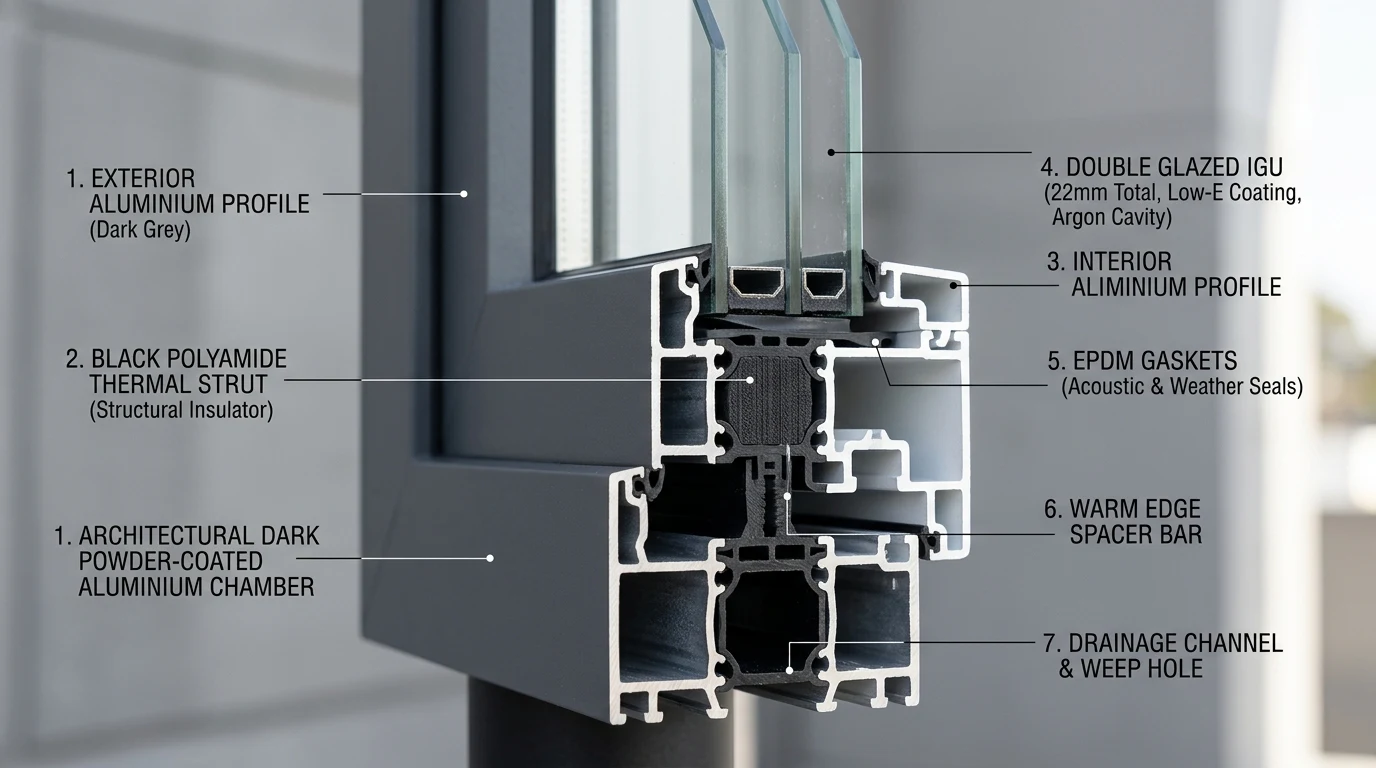
In India’s rapidly evolving real estate and commercial construction sectors, energy efficiency is no longer an optional green luxury—it is a statutory mandate. With the nationwide enforcement of the Energy Conservation Building Code (ECBC) and stringent rating frameworks such as GRIHA and LEED, building envelopes must drastically reduce solar heat gain and artificial HVAC cooling loads.
Standard single-wall aluminium window frames possess outstanding structural strength, fire safety, and sleek slim sightlines. However, aluminium is naturally an excellent conductor of heat ($k \approx 160 - 200\text{ }W/m\cdot K$). In regions like Delhi NCR, Punjab, and Rajasthan, where summer outdoor ambient temperatures consistently exceed $45^\circ C$, standard aluminium frames act as continuous "thermal bridges," radiating scorching heat directly into air-conditioned interior living spaces.
The engineering breakthrough that resolves this thermal conduction dilemma is the Thermally Broken Aluminium Window System. Utilizing precision-crimped, glass-fiber reinforced polyamide structural insulation strips, thermal break extrusions manufactured by Jindal Aluminium Limited decouple the exterior and interior aluminium profiles. This technology delivers world-class thermal insulation ($U$-values below $2.0\text{ }W/m^2\cdot K$), prevents interior condensation, and slashes building HVAC electricity bills by up to 35%.
Curated by the fenestration engineering desk at Premier Aluminium Traders—authorized distributor of Jindal Aluminium Limited in New Delhi since 1978—this technical guide explains polyamide thermal barrier mechanics, U-value thermodynamics, ECBC compliance metrics, and system procurement.
1. The Physics of Thermal Bridging in Window Frames
To understand why thermal breaks are mandatory for modern high-performance architecture, consider how heat flows through a building envelope:
  OUTSIDE SUMMER HEAT (45°C)                  AIR-CONDITIONED INTERIOR (24°C)
  ==========================                  ===============================
              |                                              |
      [ Exterior Aluminium ]                                 |
              |                                              |
              +=================== [ THERMAL BRIDGE ] =======+
              |           (Continuous Metal Conduction)      |
              v                                              v
      HEAT TRANSFERS RAPIDLY! --------------> Interior frame heats up to 41°C!
                                              HVAC compressor runs non-stop!
In a non-thermal break window:
- Aluminium conducts heat over 1,000 times faster than insulating glass and over 500 times faster than polyamide plastic.
- Even if high-performance double-glazed Low-E glass ($U_g \approx 1.4\text{ }W/m^2\cdot K$) is installed, the non-insulated aluminium frame ($U_f \approx 5.8 - 7.0\text{ }W/m^2\cdot K$) acts as an uninhibited thermal bridge, short-circuiting the thermal performance of the entire facade.
- In winter, the cold exterior metal chills the interior frame surface below the dew point of indoor air, creating unsightly water droplets, mildew, and plaster peeling along window sills.
2. Polyamide Thermal Barrier Technology: How It Works
A thermally broken aluminium extrusion is a composite structural section consisting of three distinct elements:
- An exterior extruded aluminium profile exposed to the outdoor climate.
- An interior extruded aluminium profile facing the air-conditioned room.
- Two parallel strips of Polyamide 6.6 reinforced with 25% glass fiber ($PA66\text{ }GF25$) mechanically crimped between them.
       EXTERIOR (45°C)                                INTERIOR (24°C)
  +-----------------------+                      +-----------------------+
  | Exterior 6063-T6      |                      | Interior 6063-T6      |
  | Aluminium Profile     |                      | Aluminium Profile     |
  |     +===========+     |                      |     +===========+     |
  |     | Gasket Slot|     |                      |     | Glazing Slot | |
  +-----+-----------+-----+                      +-----+-----------+-----+
        |  Crimp    |                                  |  Crimp    |
        |  Knurl    |                                  |  Knurl    |
        +-----+-----+                                  +-----+-----+
              |                                              |
              +====== [ POLYAMIDE STRIP (PA66 GF25) ] =======+
              |        Thermal Conductivity: ~0.30 W/m·K      |
              |        (530x LOWER heat conduction!)          |
              +====== [ POLYAMIDE STRIP (PA66 GF25) ] =======+
Why Polyamide 6.6 with 25% Glass Fiber ($PA66\text{ }GF25$)?
The choice of material for the insulating thermal strut is crucial. Ordinary PVC or nylon cannot be used because:
- Matched Coefficient of Thermal Expansion: $PA66\text{ }GF25$ has a thermal expansion coefficient ($\alpha \approx 23 \times 10^{-6}/^\circ C$) that virtually mirrors aluminium ($23.5 \times 10^{-6}/^\circ C$). When exposed to cyclical sun exposure, both materials expand and contract in perfect unison, preventing profile warping, shear failure, or seal debonding.
- High Heat Deflection Temperature: Polyamide can withstand temperatures exceeding $200^\circ C$, enabling the composite assembled profiles to pass directly through industrial powder coating baking ovens without melting.
- Structural Shear Strength: The glass-fiber reinforcement provides massive transverse tensile strength ($\ge 80\text{ }N/mm$), allowing the composite profile to resist heavy wind suction loads on 40-story towers.
The Precision Assembly Process:
- Knurling: Specialized rotating carbide wheels roll teeth into the reception grooves of the aluminium extrusions to form microscopic mechanical locking ridges.
- Strip Insertion: The polyamide struts are fed continuously into the grooves.
- Crimping / Rolling: Heavy steel pressure rollers deform the aluminium gripping flanges tightly around the polyamide strip, creating a permanent, unified structural composite member.
3. Thermal Performance Comparison & ECBC Compliance
India’s Energy Conservation Building Code (ECBC) sets stringent maximum allowable U-factors ($W/m^2\cdot K$) and Solar Heat Gain Coefficients (SHGC) for commercial building fenestration based on climatic zones (Composite, Hot-Dry, Warm-Humid, Moderate, Cold).
| Fenestration System Configuration | Frame U-Value ($U_f$) | Glass U-Value ($U_g$) | Overall Window U-Value ($U_w$) | ECBC Compliance Status | Condensation Risk (Winter) | HVAC Energy Reduction |
|---|---|---|---|---|---|---|
| Standard Single Aluminium + Single 6mm Glass | $6.8\text{ }W/m^2K$ | $5.7\text{ }W/m^2K$ | $5.9\text{ }W/m^2K$ | FAILS ECBC | Severe | Baseline (0%) |
| Standard Non-Thermal Break + DGU (6+12A+6mm) | $6.2\text{ }W/m^2K$ | $2.8\text{ }W/m^2K$ | $3.5\text{ }W/m^2K$ | Marginal (Fails SuperECBC) | Moderate | 12% - 15% |
| Jindal Thermal Break (14mm Strip) + DGU | $2.6\text{ }W/m^2K$ | $2.6\text{ }W/m^2K$ | $2.4\text{ }W/m^2K$ | Fully ECBC Compliant | Very Low | 22% - 28% |
| Jindal Thermal Break (24mm Strip) + Low-E DGU + Argon | $1.8\text{ }W/m^2K$ | $1.4\text{ }W/m^2K$ | $1.6\text{ }W/m^2K$ | Exceeds ECBC+ & SuperECBC | Zero Condensation | Up to 35% Savings |
What is the Window U-Value ($U_w$)?
The overall window thermal transmittance ($U_w$) is calculated per ISO 10077-1:
$$U_w = \frac{A_g U_g + A_f U_f + l_g \Psi_g}{A_g + A_f}$$
Where:
- $A_g, A_f$ = Areas of glass and frame respectively
- $U_g, U_f$ = Thermal transmittance of glass and frame
- $l_g$ = Perimeter perimeter length of glass edge
- $\Psi_g$ = Linear thermal transmittance of the spacer bar
By reducing the frame U-value ($U_f$) from $6.8$ down to $1.8\text{ }W/m^2\cdot K$, the overall heat entering the building through fenestration drops by over 60%, allowing MEP consultants to downsize central HVAC chiller capacity significantly.
4. Acoustic Insulation: The Dual-Benefit of Thermal Breaks
Beyond thermal insulation, the polyamide barrier acts as a physical acoustic dampener. In conventional hollow aluminium windows, mechanical sound vibrations (honking, road traffic, aircraft noise) resonate effortlessly through the continuous metal frame.
In a thermally broken system, the elastomeric nature of the glass-filled polyamide strip interrupts sound waves, breaking the acoustic bridge. When paired with acoustic acoustic laminated double-glazing ($6\text{ }mm\text{ Toughened} + 0.76\text{ }mm\text{ Acoustic PVB} + 6\text{ }mm\text{ Glass}$), Jindal thermally broken window systems achieve an acoustic sound transmission class rating of $Rw \ge 38 - 42\text{ }dB$, ensuring pin-drop silence inside urban apartments adjacent to bustling flyovers and metro lines.
5. Architectural Flexibility: Dual-Color Surface Finishes
A major architectural advantage of three-piece thermally broken composite extrusions is the ability to apply two completely different surface finishes on the interior and exterior sides:
  EXTERIOR FACADE VIEW                         INTERIOR ROOM VIEW
  -------------------                          ------------------
  Matches Exterior Facade:                     Matches Interior Decor:
  * Architectural Matt Charcoal Grey           * Sublimation Warm Teak Wood Grain
  * High-Performance PVDF Metallic Bronze      * Pristine Pure Architectural White
  * Weather-Resistant Qualicoat Class 2        * Champagne Gold Anodized Luxury
Because the interior and exterior aluminium profiles are powder-coated or anodized before being crimped onto the polyamide strip, architects can freely customize interior window frames to match wooden interior flooring, modular kitchen aesthetics, or luxury wall panels without compromising the unified uniform appearance of the building's exterior curtain wall.
6. Sourcing Jindal Thermal Break Profiles at Premier Aluminium Traders
As an authorized distributor and stockist of Jindal Aluminium Limited, Premier Aluminium Traders supplies specialized thermal break profiles, polyamide barrier components, and accessories to leading facade fabricators across India:
- Proprietary Jindal Thermal Break Dies: Premium casement windows, tilt-and-turn systems, heavy lift-and-slide patio doors, and thermally insulated curtain wall mullions.
- Polyamide Strut Widths: Available in $14.8\text{ }mm$, $20\text{ }mm$, $24\text{ }mm$, and $34\text{ }mm$ thermal barrier depths to achieve specific targeted U-values.
- EPDM Gaskets & Multi-Point Hardware: Co-extruded EPDM central weather-strips and European standard 16mm groove multi-point locking mechanisms.
- Factory Certification: Full Jindal factory batch test certificates verifying tensile crimp shear strength and alloy composition (IS 733 / ASTM B221).
Explore related high-performance fenestration products:
- Jindal Aluminium Window Sections
- Jindal Domal Window & Door Systems
- Structural Glazing & Curtain Wall Mullions
- Jindal Extrusions Complete Catalog
Frequently Asked Questions (FAQs)
What is the typical cost premium for thermally broken aluminium windows?
A thermally broken aluminium window system typically costs $25%\text{ }to\text{ }40%$ more than a conventional non-thermal break aluminium system with single glazing. However, this upfront investment is rapidly recouped within $3\text{ }to\text{ }5\text{ }years$ through recurring monthly electricity savings from slashed HVAC cooling and heating demands.
Can thermally broken windows handle large glass spans and heavy wind loads?
Yes. Jindal thermally broken profiles feature high-tensile 6063-T6 aluminium with structural wall thicknesses up to $2.2\text{ }mm$. When crimped with $25%$ glass-fiber polyamide struts, the composite member exhibits exceptional structural inertia ($I_{xx}$ and $I_{yy}$), easily supporting triple-glazed acoustic panels weighing upwards of $250\text{ }kg$ per sash on high-rise buildings.
Do thermally broken aluminium windows require special maintenance?
No. Thermally broken systems require the exact same low-maintenance care as standard aluminium windows. The polyamide composite strips are chemically inert, resistant to UV degradation, ozone, and acid rain, and are engineered to last the full 40+ year structural lifetime of the building envelope.
How does thermally broken aluminium compare to uPVC windows?
While uPVC also provides low thermal conductivity, aluminium is structurally superior. Thermally broken aluminium delivers 3 times higher tensile yield strength, allows ultra-slim sightlines, can support glass panels up to twice the height and weight of uPVC, is completely fireproof (Class A non-combustible), and does not turn brittle, yellow, or warp under prolonged $45^\circ C+$ Indian summer UV radiation.
Request Wholesale Quotations & Architectural Specification Sheets
Designing an ECBC-compliant commercial facade or fabricating luxury villa fenestration? Contact the engineering sales division at Premier Aluminium Traders for immediate thermal performance simulations, sample profile mockups, and wholesale project allocations.
- Address: 5233, G.B. Road, Near Ajmeri Gate, New Delhi - 110006
- Phone: +91 98111 98926 / 011-23212885
- Email: sales@premieraluminium.com
- Web Inquiry: Contact Premier Aluminium Traders