Blog
Jindal Aluminium Clips, Glazing Beads & Corner Cleats: Precision Assembly Guide
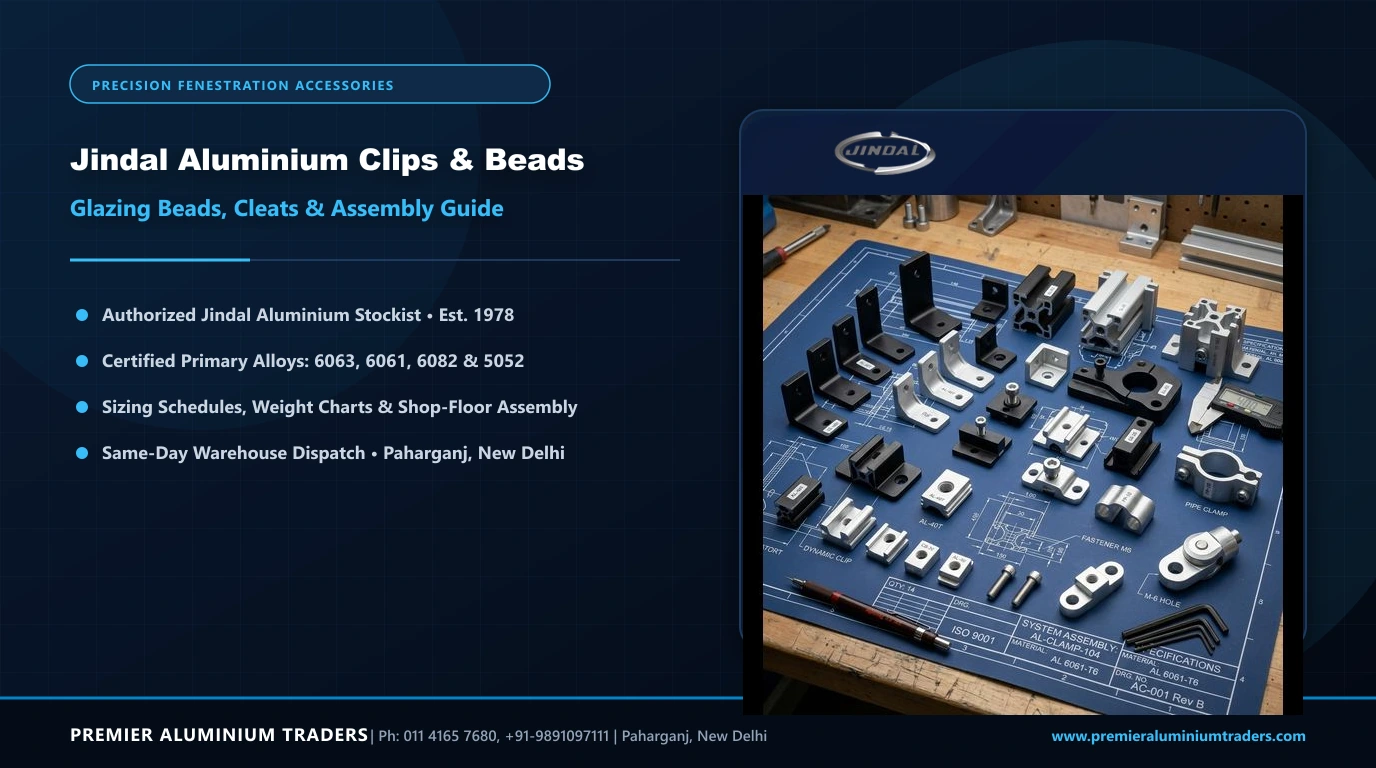
In architectural fenestration, structural curtain glazing, and high-performance commercial interior partitions, major structural profiles—such as outer frames, transoms, and mullions—receive the vast majority of architectural attention. Yet on the factory fabrication floor and during high-wind monsoon storms, the ultimate structural integrity, weather sealing, and acoustic performance of every window, door, and curtain wall depend directly on auxiliary extruded profiles: snap-on glazing beads, structural corner cleats, and retention clips.
A miscalculated corner cleat can cause a heavy glass shutter to sag out of square over time, leading to air leaks and lock binding. Similarly, an inferior glazing bead lacking precision snap-fit retention can pop out under cyclic negative wind suction on high-rise facades, causing disastrous glass blowout accidents.
Manufactured from high-purity primary alloy billets under strict metallurgical tolerances, Jindal Aluminium clips, beads, and cleats provide the exact dimensional consistency, elastic snap recovery, and mechanical shear strength needed for mission-critical assemblies.
Authored by the technical tooling specialists at Premier Aluminium Traders—authorized dealer and stockist of Jindal Aluminium Limited in Paharganj, New Delhi since 1978—this practical guide examines auxiliary profile classifications, snap-action mechanics, glass bite rules, corner crimping guidelines, and wholesale sourcing for fabricators across North India.
1. The Critical Role of Auxiliary Hardware Extrusions
Auxiliary profiles perform three essential mechanical functions that make modern modular aluminium framing possible:
            +-------------------------------------------------------------+
            |        THE 3 CORE MECHANICAL FUNCTIONS OF AUXILIARY EXTRUSIONS|
            +-------------------------------------------------------------+
            |                                                             |
            |   1. CORNER CLEATS: Structural corner rigidity & shear load |
            |      transfer at 90° mitered and butt-joined frame corners. |
            |                                                             |
            |   2. GLAZING BEADS: Secure glass retention & controlled     |
            |      EPDM gasket compression against wind pressure/suction. |
            |                                                             |
            |   3. PRESSURE CLIPS: Uniform thermal isolation & clamp      |
            |      holding across continuous structural curtain walls.    |
            |                                                             |
            +-------------------------------------------------------------+
| Component Category | Primary Mechanical Function | Alloy & Temper | Critical Failure If Low Quality Sourced |
|---|---|---|---|
| Snap-On Glazing Beads | Locks glass into frame rebate; compresses EPDM | 6063-T6 (High spring recovery) | Bead dislodges under wind suction; glass falls |
| Structural Corner Cleats | Joins mitered corners; resists frame diagonal shear | 6082-T6 / 6061-T6 (High yield) | Corner opens up; water leaks; shutter sags |
| Curtain Wall Clips | Secures pressure plates to heavy mullion stems | 6063-T6 / 6082-T6 | Uneven glass clamp force; air/water penetration |
| Partition Snap Trims | Conceals screw channels in modular office walls | 6063-T5 / T6 (Crisp finish) | Loose fit; rattles and vibrates in HVAC air flow |
2. Anatomy of Precision Snap-On Glazing Beads (Beading)
Glazing beads are slender extruded profiles engineered with a flexible snap-leg that engages into a mating groove in the window or door sash:
                  [ SNAP-ON GLAZING BEAD MECHANICAL DETAIL ]

               +-----------------------------+
               |   Exposed Bevel / Square    |  <--- Visible Decorative Face
               |   Architectural Trim Face   |       (Mill / Anodized / Powder Coated)
               +----+------------------------+
                    |                 |
                    v                 v
            [ EPDM Gasket Lip ]   [ Hollow Weight Relief Chamber ]
            (Continuous Slot)                 |
                    |                         |
                    +-------------------------+
                                 |
                                 v
                 [ Flexible Barbed Snap-Leg ] <--- Must flex past entry lip,
                                 |                 then spring outward to lock
                                 v
        ===================================================================
                 MATING GROOVE IN OUTER WINDOW / DOOR PROFILE
        ===================================================================
1. Square vs. Sloped (Chamfered) Beads
- Sloped (Beveled) Beads: Feature an outer face sloping at $10^\circ$ to $15^\circ$ downward. Primarily used on exterior-facing windows and doors to shed condensation and rainwater outward away from the glass seal.
- Square (Minimalist) Beads: Highly favored in contemporary interior architecture, office partitions, and minimalist luxury villa sliding doors for crisp rectilinear shadow lines.
2. Single Glass vs. Insulated Glazing Unit (DGU) Beads
By changing only the depth of the snap-on glazing bead, fabricators can glaze the exact same window frame profile with different glass thicknesses without altering the expensive outer frame extrusions:
- Deep Beads ($20\text{ mm}-25\text{ mm}$ width): Used for thin single glass ($5\text{ mm}$ or $6\text{ mm}$).
- Slim/Flat Beads ($8\text{ mm}-12\text{ mm}$ width): Used for thick Double Glazed Units ($20\text{ mm}-24\text{ mm}$ DGU) or laminated acoustic glass.
3. Structural Corner Cleats (Corner Keys): Crimping vs. Screw Assembly
A 45° mitered corner has zero inherent mechanical strength on its own; all tensile and shear loads must be absorbed by the hidden internal corner cleat:
                  [ 45-DEGREE CORNER JOINT ASSEMBLY ]

                       Frame Profile Stile
                           |     |
                           |     |
                 +---------+     +---------+
                 | \                     / |
                 |   \   CORNER CLEAT  /   |  <--- Thick-Wall 6082-T6 Extrusion
                 |     \   [========] /    |       (Pneumatically Crimped
                 |       \ [========]/     |        into Profile Wall Dimples)
                 +---------+---+---+-------+
                               |   |
                               |   |
                      Frame Profile Rail
1. Pneumatic Corner Crimping (The Commercial Gold Standard)
- Heavy extruded corner cleats featuring deep lateral gripping grooves are inserted into the hollow chambers of the mitered stiles.
- The corner is clamped inside a pneumatic or hydraulic corner-crimping machine. Hardened steel punch blades press into the profile's outer wall, plastically deforming the aluminium into the cleat's locking grooves.
- When paired with polyurethane corner assembly adhesive, crimped corners achieve permanent structural rigidity that will never loosen over decades of window opening and slamming.
2. Mechanical Expansion Screw Cleats
- Popular for on-site knockdown assembly where pre-crimped frames cannot be transported up narrow stairwells.
- As the stainless steel Allen screw is tightened, the split wedge of the cleat expands outward against the internal profile walls, generating high friction clamping force.
4. Standard Sizing Schedule for Jindal Hardware & Auxiliary Extrusions
| Component Type | Section / Die Series | Typical Sizing Dimensions ($\text{mm}$) | Flange Thickness ($\text{mm}$) | Weight per 16-Foot Length ($\text{kg}$) | Primary Application |
|---|---|---|---|---|---|
| Snap Glazing Bead | Jindal 14000 Series | $18.0 \times 15.0$ | $1.20 - 1.40$ | $1.15 - 1.35$ | Casement & sliding $6\text{mm}$ glass beading |
| DGU Slim Glazing Bead | Jindal 14000 Series | $10.0 \times 15.0$ | $1.20 - 1.40$ | $0.85 - 1.05$ | Double glass ($24\text{mm}$) slim retainer |
| Heavy Corner Cleat Bar | Jindal 18000 Series | $38.0 \times 18.0$ (Solid/Hollow) | $3.50 - 5.00$ | $4.20 - 5.80$ | Pre-punched 90° crimping cleat stock |
| Large Door Cleat Bar | Jindal 18000 Series | $52.0 \times 24.0$ (Thick Wall) | $4.50 - 6.00$ | $6.50 - 8.20$ | Heavy commercial entrance door corners |
| Curtain Wall Clip | Jindal 16000 Series | $50.0 \times 25.0$ | $2.50 - 3.20$ | $2.80 - 3.40$ | Pressure plate retaining clip for mullions |
| Partition Trim Bead | Jindal General Trim | $45.0 \times 12.0$ | $1.30 - 1.50$ | $1.45 - 1.70$ | Snap-on cover for modular office walls |
5. Shop-Floor Glass Bite & Gasket Compression Rules
Improper glass bite is the leading cause of cracked glass edges and water leakage:
- Minimum Edge Bite Depth: Ensure glass extends at least $12\text{ mm}$ to $15\text{ mm}$ into the glazing pocket. Inadequate bite depth allows the glass to pull out of the rebate under negative wind deflection.
- Setting Block Placement: Never let glass rest directly on aluminium. Support the bottom edge with high-density EPDM setting blocks ($80-100\text{ mm}$ long) placed at quarter points ($L/4$) from the bottom corners to allow free rainwater drainage beneath the glass.
- Controlled Gasket Compression: Select glazing beads and wedge gaskets that achieve $25%$ to $35%$ nominal gasket compression. Over-compression deforms the bead and causes glass edge-pinching fractures; under-compression causes whistling wind noise and water leaks.
6. Sourcing Auxiliary Profiles at Premier Aluminium Traders
Premier Aluminium Traders maintains full inventory compatibility across all major architectural window and door suites in North India:
Why Source Clips and Cleats from Premier Aluminium Traders?
- Die-Matched Compatibility: Every corner cleat and glazing bead in our warehouse is engineered to mate with millimeter tolerance into Jindal outer frames and sliding stiles.
- Prime Alloy Metallurgy: Cleats extruded from Alloy 6082-T6 and 6061-T6 to prevent thread stripping under torque; beads extruded from Alloy 6063-T6 for superior spring elasticity.
- Bulk Cleat Cutting & Punching Services: We supply cleats pre-cut to exact internal profile dimensions and pre-punched with screw holes, saving fabricators hundreds of hours of manual shop-floor prep time.
Related Products & Catalogs:
- Jindal Aluminium Clips & Hardware Extrusions
- Jindal Aluminium Door Sections
- Jindal Aluminium Window Sections
- Download Complete Jindal Architectural Extrusions Catalog
- Explore 20+ Ready Aluminium Extrusion Sections
7. Frequently Asked Questions (FAQs)
Q1: Can I reuse snap-on glazing beads if I need to replace a broken glass pane?
Yes, provided the beads were extruded from high-purity Alloy 6063-T6 with proper elastic memory. To remove, use a nylon or brass glazing shovel to release the barbed snap-leg at one end, then work along the length. Inferior scrap-recycled beads will fracture or permanently bend during removal.
Q2: What is the benefit of extruded corner cleats over cast aluminium corner keys?
Extruded aluminium cleats (Alloy 6082-T6) offer significantly higher tensile strength ($>290\text{ MPa}$) and high ductility, meaning they will not snap or shatter under dynamic hurricane wind loads or aggressive corner crimping. Porous cast-zinc or cheap cast-aluminium keys are brittle and frequently crack during assembly.
Q3: How do I order custom pre-cut corner cleats from Premier Aluminium Traders?
Simply provide your window or door profile die number and order quantity. Our Paharganj processing facility will precision-saw the cleat bar stock into exact lengths with clean deburred edges ready for immediate insertion on your assembly line.
Need certified Jindal glazing beads, corner cleats, or hardware clips in Delhi NCR?
Call the technical desk at Premier Aluminium Traders at 011 4165 7680 / +91-9891097111 or email premieraluminiumtraders@gmail.com for immediate dispatch and wholesale volume rates.