Blog
Industrial Aluminium T-Slot Profiles & Modular Automation Framing: Sizing, Load Deflection & Assembly Guide
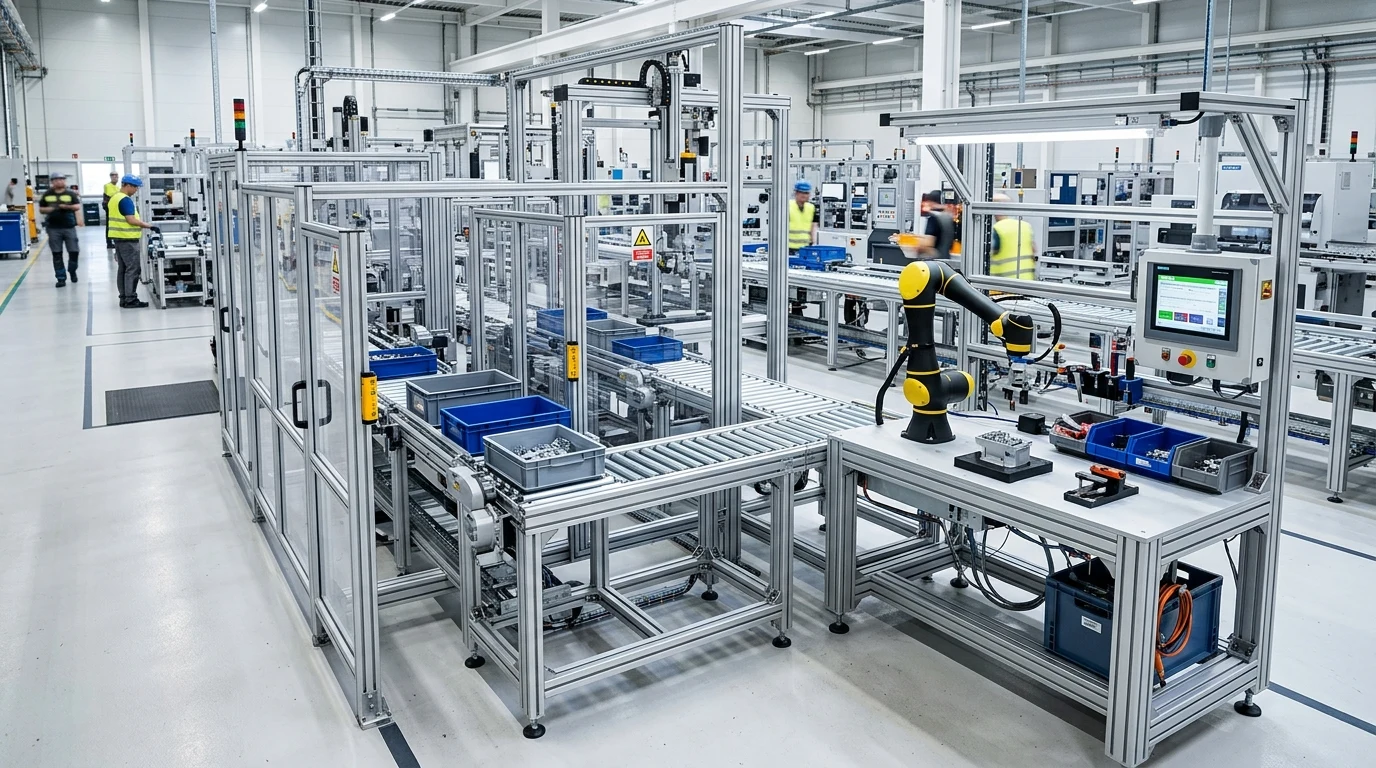
In modern manufacturing, warehousing automation, robotics, and cleanroom packaging environments, speed, modularity, and rapid reconfigurability define operational success. For decades, building machinery frames, assembly workstations, conveyor lines, and safety enclosures required structural mild steel (MS) fabrication—a tedious, labor-intensive process involving cutting, manual arc welding, weld grinding, degreasing, primer application, final painting, and permanent anchoring.
Whenever production layouts changed or new automation stations were added, welded steel structures had to be destroyed with gas torches or scraped at high capital loss.
Today, industrial manufacturing plants across Delhi NCR, Haryana, Rajasthan, and Uttar Pradesh have decisively migrated to modular extruded aluminium T-slot structural framing systems and conveyor sections. Manufactured to ultra-tight mechanical tolerances by Jindal Aluminium Limited, extruded T-slot profiles act as a heavy-duty industrial "Meccano" set—allowing mechanical engineers to build rigid, load-bearing frameworks in hours using simple hand tools, with zero welding, zero painting, and infinite reconfigurability.
Curated by the industrial automation engineering desk at Premier Aluminium Traders (authorized stockist and distributor for Jindal Aluminium Limited in Paharganj, New Delhi since 1978), this technical handbook breaks down T-slot profile series, dimensional standards (2020 to 8080), moment of inertia calculations, beam deflection formulas under point loads, fastening mechanics, and procurement in North India.
1. T-Slot Aluminium vs. Welded Mild Steel: The Engineering Paradigm Shift
Mechanical engineers frequently evaluate whether to fabricate machine frames from welded steel tubing or specify modular extruded aluminium profiles. The table below illustrates why modern automation facilities overwhelmingly choose aluminium:
| Engineering Factor | Modular Aluminium T-Slot Systems (6063-T6) | Welded Mild Steel (MS) Structural Tubing |
|---|---|---|
| Assembly Workflow | Bolt-together with T-nuts & hex keys; No welding | Requires certified welders, cutting torches, grinding |
| Assembly Time | Up to 70% faster; Immediate bolt-together assembly | Multi-day process (cut, tack, weld, grind, paint) |
| Surface Finish & Maintenance | 15µ Clear Anodized; Scratch & rust-proof forever | Requires periodic sanding, primer, and enamel painting |
| Reconfigurability & Flexibility | 100% Modular; Loosen bolts, adjust, retighten | Permanent; Requires torch cutting and re-welding |
| Weight-to-Strength Ratio | High (Aluminium density $\approx 2.70\text{ }g/cm^3$) | Heavy (Steel density $\approx 7.85\text{ }g/cm^3$, 2.9x heavier) |
| Vibration Damping | High internal damping; Resists harmonic fatigue | Rigid; Transmits mechanical vibrations directly |
| Cleanroom & Food Suitability | Non-toxic, non-shedding, ISO Cleanroom compliant | Flakes paint, oxidizes, unhygienic for food/pharma |
| Total Cost of Ownership (TCO) | Significantly lower when factoring labor & downtime | Higher overall project cost due to skilled labor & delays |
2. Standard T-Slot Series Breakdown & Dimensional Standards
T-slot aluminium extrusions are organized by their nominal square cross-section metric dimensions (in millimeters) and slot width (typically 6mm, 8mm, or 10mm):
       +---------------------------------------------+
       |   +---+                     +---+           |
       |   |   |        T-SLOT       |   |           |  Slot Opening (e.g., 8mm)
       |   |   +---------------------+   |           |
       |   |                             |           |
       |   |         CENTRAL BORE        |           |  Center Bore for M8 Tapping
       |   |                             |           |
       |   |   +---------------------+   |           |
       |   |   |                     |   |           |
       |   +---+                     +---+           |
       +---------------------------------------------+
1. The 20-Series (Slot 6mm - e.g., 20x20, 20x40)
- Profile Cross Section: $20\text{ }mm \times 20\text{ }mm$ or $20\text{ }mm \times 40\text{ }mm$.
- Slot Width: 6 mm (Takes M4 / M5 T-nuts).
- Core Bore Diameter: $\varnothing 5.0\text{ }mm$ (Threaded for M5/M6 tap).
- Primary Applications: 3D printer chassis, small laser engraver frames, lightweight safety shields, camera inspection mounts, sensor brackets, and laboratory fixtures.
2. The 30-Series (Slot 8mm - e.g., 30x30, 30x60)
- Profile Cross Section: $30\text{ }mm \times 30\text{ }mm$ or $30\text{ }mm \times 60\text{ }mm$.
- Slot Width: 8 mm (Takes M6 T-nuts).
- Core Bore Diameter: $\varnothing 6.8\text{ }mm$ (Threaded for M8 tap).
- Primary Applications: Medium-duty ergonomic assembly benches, electronics test racks, visual inspection stations, and lightweight motorized linear slides.
3. The 40-Series (Slot 8mm - e.g., 40x40, 40x80, 80x80) - The Industrial Standard
- Profile Cross Section: $40\text{ }mm \times 40\text{ }mm$, $40\text{ }mm \times 80\text{ }mm$, or $80\text{ }mm \times 80\text{ }mm$.
- Slot Width: 8 mm (Takes M6 / M8 T-nuts).
- Core Bore Diameter: $\varnothing 6.8\text{ }mm$ to $\varnothing 7.3\text{ }mm$ (Precision bored for M8 tapping).
- Primary Applications: Heavy-duty automation frameworks, robotic cell safety enclosures, machine tool bases, automated assembly lines, belt and roller conveyor side beams, and high-load industrial workstations.
4. The 45-Series & 50-Series (Slot 10mm - e.g., 45x45, 45x90)
- Profile Cross Section: $45\text{ }mm \times 45\text{ }mm$ or $45\text{ }mm \times 90\text{ }mm$ (European / German automotive standard).
- Slot Width: 10 mm (Takes heavy M8 / M10 T-bolts).
- Primary Applications: High-stress CNC gantry beams, automotive assembly jigs, aerospace tooling fixtures, and dynamic multi-axis pick-and-place robots.
3. Engineering Mechanics: Load Deflection Calculations for Industrial Framing
When designing horizontal structural beams, conveyor support frames, or crane gantries, engineers must ensure the structural deflection does not exceed allowable machine tolerances.
Beam Deflection Formula (Center Point Load):
For a simply supported aluminium extrusion beam under a concentrated center load:
$$\delta_{max} = \frac{F \cdot L^3}{48 \cdot E \cdot I}$$
Where:
- $\delta_{max}$ = Maximum deflection at the center ($mm$)
- $F$ = Applied concentrated force in Newtons ($N$, where $1\text{ }kg \approx 9.81\text{ }N$)
- $L$ = Unsupported span length between pillars ($mm$)
- $E$ = Modulus of Elasticity of Aluminium ($70,000\text{ }N/mm^2$ or $70\text{ }GPa$)
- $I$ = Area Moment of Inertia of the profile along the bending axis ($cm^4$ or $mm^4$)
Section Properties & Moment of Inertia Matrix for Jindal Profiles:
| Profile Description | Dimensions ($mm$) | Weight ($kg/m$) | Moment of Inertia $I_x$ ($cm^4$) | Moment of Inertia $I_y$ ($cm^4$) | Allowable Point Load ($L=1000mm$, $\delta \le 1mm$) |
|---|---|---|---|---|---|
| 2020 Standard | 20 x 20 | ~0.55 | 0.72 | 0.72 | ~24 kg (~235 N) |
| 3030 Standard | 30 x 30 | ~0.95 | 3.20 | 3.20 | ~107 kg (~1,050 N) |
| 4040 Standard | 40 x 40 | ~1.45 | 9.80 | 9.80 | ~328 kg (~3,220 N) |
| 4040 Heavy Duty | 40 x 40 | ~1.85 | 13.50 | 13.50 | ~452 kg (~4,430 N) |
| 4080 Heavy Beam | 40 x 80 | ~2.90 | 78.40 (Major) | 21.20 (Minor) | ~2,630 kg (~25,800 N) |
| 8080 Pillar Beam | 80 x 80 | ~4.80 | 145.20 | 145.20 | ~4,870 kg (~47,800 N) |
Rule of Thumb for Workstations: For standard manual assembly tables carrying up to 300 kg distributed load across a 1.5-meter span, a 4040 Heavy Duty profile or 4080 section easily satisfies the deflection threshold without noticeable flexing.
4. Hardware Ecosystem: T-Nuts, Brackets & Fastening Mechanics
The strength of a modular aluminium framework is entirely dependent on using the correct fastening hardware:
              [ Hex Socket Head Cap Screw ]
                         |
                         v
              [ Cast Aluminium Corner Gusset ]
                         |
                         v
  ================== [ Profile T-Slot ] ==================
                         ^
                         |
       [ Roll-in T-Nut with Spring-Loaded Ball Detent ]
Essential Fastening Hardware:
- Roll-In Spring T-Nuts (Drop-In Nuts): Equipped with a small spring-loaded stainless steel ball that holds the nut in place vertically within the T-slot channel without sliding down, allowing effortless single-handed assembly.
- Hammer-Head T-Bolts: Drop into the slot anywhere along the profile length and automatically rotate 90° when tightened, locking securely against the internal extrusion lip.
- Die-Cast Aluminium Corner Gussets (Corner Brackets): Heavy-duty triangular 90° brackets with alignment tabs that sit directly inside the T-slot to prevent twisting.
- Internal Concealed Corner Connectors: Hidden inside the extrusion slots, allowing flush, unhindered exterior surfaces for mounting panels or acrylic safety glass.
- Articulated Swivel Leveling Feet & Heavy-Duty Casters: Screwed directly into the tapped M8 or M12 center bore, allowing floor leveling and mobile portability on factory shop floors.
5. Jindal Conveyor Extrusions: Profiles for Automated Material Handling
In addition to standard square T-slot framing, Premier Aluminium Traders stocks specialized Jindal Aluminium Conveyor Profiles:
- Conveyor Side Side Frames: Extruded beams featuring dedicated upper guide channels for low-friction UHMW-PE wear strips, roller return tracks, and side T-slots for mounting photo-electric sensors, pneumatic cylinders, and motor drives.
- Conveyor Guide Rails & Brackets: Anodized aluminium track sections holding nylon or stainless steel side guide rails to channel bottles, cartons, or automotive parts smoothly.
- Pallet Transfer Profiles: Rigid profiles engineered with precision tolerances for automated roller chains and modular flat-top belt conveyor lines.
6. Sourcing Genuine Jindal T-Slot & Conveyor Profiles at Premier Aluminium Traders
For automation contractors and machine builders, profile straightness, die consistency, and alloy hardness are non-negotiable. Sub-standard extrusions warp along the length, causing conveyor belts to drift and linear guide bearings to bind.
At Premier Aluminium Traders (Paharganj, New Delhi), we deliver:
- 100% Genuine Jindal Extrusions: Sourced from primary billet Alloy 6063-T6, delivering Webster hardness $\ge 12\text{ }HW$ and perfect profile straightness ($< 0.5\text{ }mm$ per meter).
- Complete Metric Series Inventory: 2020, 2040, 3030, 3060, 4040 (Standard and Heavy), 4080, and 8080 profiles in ready physical stock in 3.0-meter, 4.0-meter, and 6.0-meter lengths.
- Comprehensive Hardware Stocks: Immediate availability of T-nuts, angle gussets, end caps, hinges, leveling pads, and T-bolts.
- In-House CNC Cutting & Center Bore Tapping: Cut to exact millimetric tolerances and pre-tapped to your mechanical drawings, saving valuable machine shop preparation time.
7. Frequently Asked Questions (FAQs)
1. How much weight can a single 4040 aluminium profile support vertically as a column?
When used as a vertical column (pillar) under compressive axial loading with an unsupported height of 2.0 meters, a high-quality Jindal 4040 Heavy-Duty profile can safely support up to 1,200 kg to 1,500 kg (12 to 15 kN) before reaching elastic Euler buckling limits.
2. Can the center bore of a 4040 T-slot profile be threaded?
Yes. The center bore of standard Jindal 4040 profiles is extruded with an accurate core diameter of approximately 6.8mm to 7.2mm, which is the exact pilot drill size required to cut standard M8 metric internal screw threads using a standard machine hand tap.
3. What is the difference between standard and heavy-duty 4040 profiles?
A standard 4040 profile features a wall thickness of approximately 1.2mm to 1.5mm and weighs around $1.45\text{ }kg/m$. A heavy-duty 4040 profile has reinforced interior webbing with wall thicknesses up to 2.0mm to 2.2mm, weighing upwards of $1.85\text{ }kg/m$, providing ~38% higher bending rigidity ($I_x$).
4. How are acrylic safety panels or wire mesh mounted inside T-slot frames?
Acrylic panels, polycarbonate safety sheets (4mm–6mm), or wire mesh screens can be inserted directly into the T-slot channel during frame assembly using snap-in PVC panel clamping strips or U-shaped rubber gaskets, creating seamless, rattle-free machine enclosures.
5. Where can I buy wholesale T-slot aluminium extrusions in Delhi NCR?
Ready inventory of certified Jindal T-slot structural extrusions and conveyor profiles is available directly at Premier Aluminium Traders, situated at 3/8, D.B. Gupta Road, Paharganj, New Delhi - 110055 (Phone: +91-9891097111). We supply industrial automation plants, machine tool OEMs, and research institutes across India.
8. Industrial Automation Framing & Sourcing Desk
Building an automated assembly conveyor, robotic welding enclosure, cleanroom workstation, or CNC machine frame? Eliminate welding delays and ensure structural rigidity with genuine Jindal Aluminium industrial profiles.
Partner with Premier Aluminium Traders:
- Authorized Stockist Since 1978: Guaranteed primary metal purity and verified mechanical yield strength.
- Immediate Warehouse Availability: Full metric series from 2020 up to 8080 in stock for fast dispatch.
- In-House Processing: Precision miter saws, bore tapping, and custom length kitting.
- Rapid Industrial Dispatch: Same-day loading for manufacturing clusters in Delhi NCR, Gurgaon, Manesar, Faridabad, Ghaziabad, Greater Noida, Neemrana, and pan-India.
Connect with Our Industrial Metals Engineering Team:
- Central Facility: Premier Aluminium Traders, 3/8, D.B. Gupta Road, Paharganj, New Delhi - 110055
- Direct Phone / WhatsApp: +91-9891097111 / 011-41657680
- Email: premieraluminiumtraders@gmail.com
- Product Information: Explore Jindal Conveyor & Industrial Sections
- Submit Your Framing Drawings & BOQ: Request an Instant Industrial Quotation