Blog
Extruded Aluminium Heat Sinks: Design, Thermal Conductivity, Alloy 6063 vs 6101 & Sourcing Guide
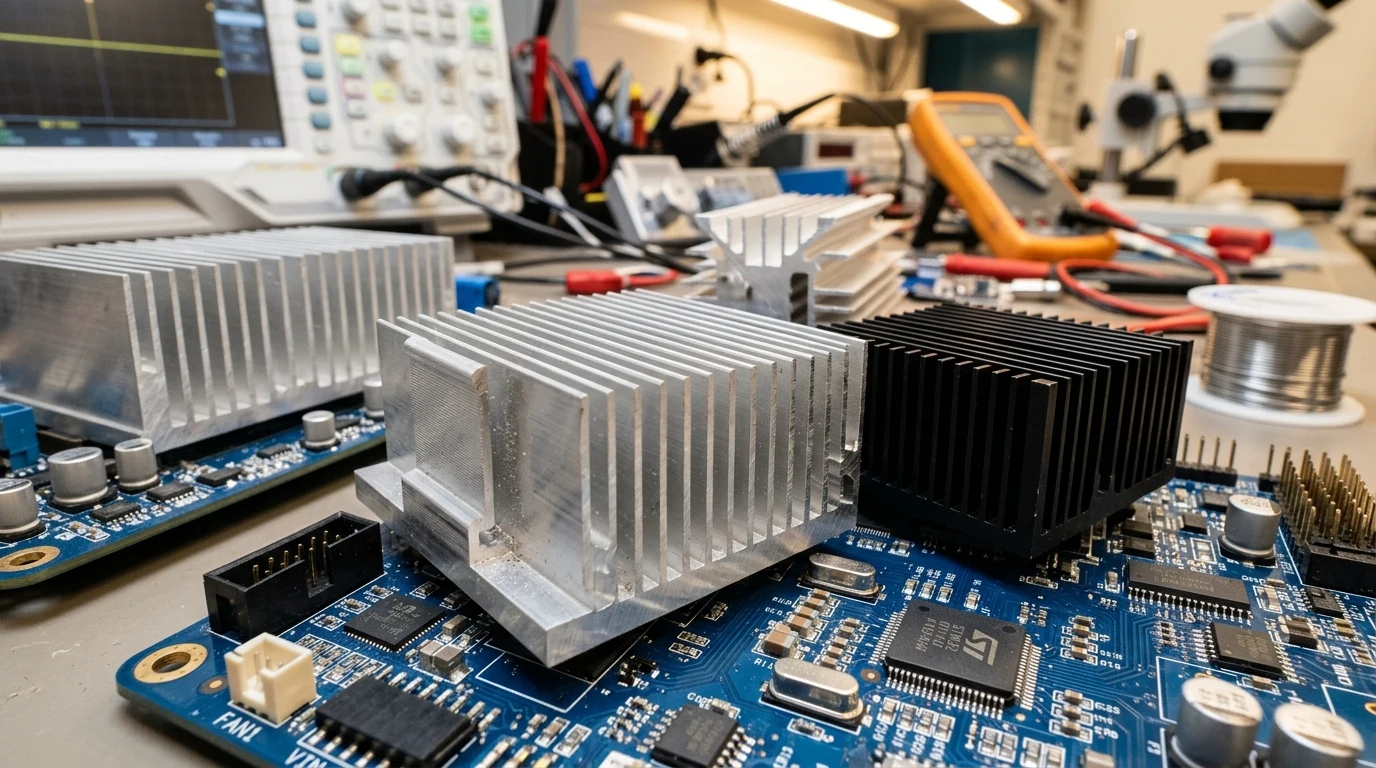
In power electronics, telecommunications infrastructure, high-output LED lighting, solar inverters, and electric vehicle (EV) motor controllers, heat is the ultimate enemy of component longevity and operational reliability. For every 10°C rise in the junction temperature ($T_j$) of a semiconductor power transistor (MOSFET / IGBT) beyond its operational limit, its mean time between failures (MTBF) is slashed by approximately 50% (Arrhenius equation of thermal aging).
To effectively transfer and dissipate massive thermal heat flux from solid-state silicon dies into the surrounding air, mechanical engineers rely overwhelmingly on extruded aluminium heat sinks. Combining exceptional thermal conductivity, lightweight form factor, design flexibility, and cost efficiency, extruded aluminium remains the undisputed thermal management backbone of modern electronics.
Manufactured using high-tonnage computerized extrusion presses, Jindal Aluminium heat sink profiles set the Indian industry benchmark for metal purity, tight fin tolerances, and high aspect ratios.
Curated by the engineering and industrial metals desk at Premier Aluminium Traders (authorized distributor for Jindal Aluminium Limited in Paharganj, New Delhi since 1978), this technical handbook examines heat sink extrusion design, thermodynamic principles, alloy conductivity comparisons (6063 vs. 6101 vs. 6061), fin aspect ratio constraints, surface radiation via black anodizing, and procurement strategies.
1. Thermodynamic Fundamentals: Why Extruded Aluminium Dominates Heat Dissipation
A heat sink operates by conducting heat away from an electronic device via direct conduction and rejecting it to the surrounding fluid (air) through convection and radiation:
$$Q = \frac{\Delta T}{\theta_{total}} = \frac{T_j - T_a}{\theta_{jc} + \theta_{cs} + \theta_{sa}}$$
Where:
- $Q$ is dissipated thermal power in Watts ($W$).
- $T_j, T_a$ are semiconductor junction and ambient temperatures (°C).
- $\theta_{sa}$ is the thermal resistance of the heat sink to ambient air (°C/W or K/W).
To achieve the lowest possible thermal resistance ($\theta_{sa}$), an engineering material must possess three physical attributes:
- High Bulk Thermal Conductivity ($k$): Allows rapid heat spreading from the localized heat source across the entire base plate without choking.
- High Surface-Area-to-Volume Ratio: Maximizes convective air contact area through tightly spaced, thin vertical cooling fins.
- High Surface Emissivity ($\epsilon$): Enables radiant cooling in still-air environments.
Material Thermal Comparison: Aluminium vs. Copper vs. Steel
| Engineering Material | Thermal Conductivity ($k$, $W/m\cdot K$) | Density ($\rho$, $g/cm^3$) | Cost per kg Relative Factor | Extrudability into Complex Fins |
|---|---|---|---|---|
| Pure Copper (C11000) | 390 – 400 | 8.96 (Extremely Heavy) | ~4.5x – 5.5x higher | Poor (Very difficult to extrude thin fins) |
| Aluminium 6063-T6 | 200 – 210 | 2.70 (Lightweight) | Standard Benchmark (1.0x) | Exceptional (Fin aspect ratios up to 16:1) |
| Aluminium 6101-T6 (Electrical) | 215 – 220 | 2.70 (Lightweight) | 1.1x | Very High |
| Structural Mild Steel | 45 – 50 | 7.85 (Heavy) | Low | Low (Requires welded plates) |
| Stainless Steel (SS 304) | 16 | 8.00 | High | Extremely Poor (Thermal insulator) |
While copper delivers roughly double the thermal conductivity of aluminium, it is over three times heavier and more than four times more expensive. More importantly, copper cannot be easily extruded into intricate, high-density fin geometries. Extruded aluminium offers an unbeatable thermal-conductivity-to-weight and thermal-conductivity-to-cost ratio.
2. Alloy Selection: 6063-T6 vs. 6101-T6 vs. 6061-T6 for Thermal Applications
Selecting the correct extrusion alloy involves balancing thermal conductivity, mechanical rigidity for tapping screws, and extrusion precision:
| Metallurgical Parameter | Alloy 6063-T6 | Alloy 6101-T6 | Alloy 6061-T6 |
|---|---|---|---|
| Primary Industry Role | The Global Standard for Electronics & LED Heat Sinks | High-Conductivity Electrical Busbars & High-Power Heat Sinks | Structural Brackets & Machined Mechanical Enclosures |
| Thermal Conductivity ($k$) | $201 - 209\text{ }W/m\cdot K$ | $218 - 225\text{ }W/m\cdot K$ | $167 - 180\text{ }W/m\cdot K$ |
| Electrical Conductivity (% IACS) | 53% – 55% | 57% – 60% | 40% – 45% |
| Yield Strength (0.2% Proof Stress) | $\ge 170\text{ }MPa$ | $\ge 150\text{ }MPa$ | $\ge 240\text{ }MPa$ |
| Webster Hardness | 12 – 14 HW | 11 – 13 HW | 15 – 17 HW |
| Extrusion Die Precision | Superior (Extremely thin fin tips) | High | Moderate (Higher die wear) |
Engineering Recommendation:
- Alloy 6063-T6 is the universal recommendation for 90% of heat sink applications (LED luminaires, SMPS power supplies, amplifier chassis, and industrial drives). It provides the optimum sweet spot between excellent thermal conduction ($~205\text{ }W/m\cdot K$) and tight extrusion tolerances.
- Alloy 6101-T6 is specified for ultra-high-efficiency power distribution systems, high-voltage substations, and mega-watt solar central inverters where maximizing electrical and thermal throughput is paramount.
- Alloy 6061-T6 should generally be avoided for pure heat dissipation profiles because its higher copper/chromium content reduces thermal conductivity down to $167\text{ }W/m\cdot K$ (~20% drop compared to 6063).
3. Extrusion Fin Geometry: Aspect Ratios, Base Thickness & Fluid Dynamics
The thermal resistance of an extruded heat sink is dictated by its physical geometry. However, mechanical extrusion processes are governed by hydraulic die limits.
       |<-- Fin Thickness (t_f) -->|
       +---+                       +---+       ^
       |   |                       |   |       |
       |   |                       |   |       | Fin Height (H)
       |   |<---- Fin Gap (S) ---->|   |       |
       |   |                       |   |       v
  ===================================================  ^ Base Thickness (t_b)
  //////////////// Base Plate ///////////////////////  v
  ===================================================
               ^ Heat Source (IGBT/LED)
Critical Design Parameters:
- Fin Aspect Ratio ($H : S$): The ratio of fin height ($H$) to the gap between fins ($S$).
- Standard commercial dies: Up to 8:1 to 10:1.
- Advanced high-tonnage Jindal extrusion presses: Capable of precision high-density fin aspect ratios reaching 14:1 to 16:1.
- Fin Taper Angle: To facilitate extraction from the extrusion steel die without tearing, fins must have a slight manufacturing draft angle ($0.5^\circ$ to $1.5^\circ$). This creates fins that are slightly thicker at the root and narrower at the tip, which thermodynamically matches the natural conductive heat-flux decay along the fin height!
- Base Plate Thickness ($t_b$): If the base plate is too thin, heat cannot spread laterally across the outer fins, creating an intense localized hot spot above the semiconductor. As a rule of thumb:
- For small discrete TO-220 devices: Base thickness $\ge 3.0\text{ }mm$.
- For high-power IGBT modules / EV drive controllers: Base thickness $\ge 8.0\text{ }mm - 16.0\text{ }mm$.
- Natural Convection vs. Forced Air:
- Natural Convection (Fanless): Air moves solely by buoyancy. Fin gaps must be wide ($6.0\text{ }mm - 12.0\text{ }mm$) to prevent boundary layer interference and air stagnation.
- Forced Convection (Fan-Cooled): High-velocity airflow overcomes narrow resistance. Fin gaps can be compressed down to $1.5\text{ }mm - 3.0\text{ }mm$ to maximize convective heat transfer area.
4. The Critical Role of Black Anodizing in Radiant Heat Dissipation
Many electrical designers overlook the radiative component of thermal rejection:
$$Q_{radiation} = \epsilon \cdot \sigma \cdot A \cdot (T_{sink}^4 - T_{ambient}^4)$$
Where $\epsilon$ is surface emissivity and $\sigma$ is the Stefan-Boltzmann constant ($5.67 \times 10^{-8}\text{ }W/m^2K^4$).
- Raw Mill Finish Aluminium: Features a low, mirror-like emissivity of only $\epsilon \approx 0.04 - 0.08$. It reflects thermal radiation back and radiates almost zero heat.
- Black Anodized Aluminium (10 – 15 microns): Transforms the microscopic surface into a dense, non-reflective porous oxide matrix dyed jet black, raising surface emissivity to $\epsilon \approx 0.85 - 0.90$.
Practical Impact:
In natural convection (fanless) enclosures such as audio power amplifiers, outdoor LED streetlights, and sealed telecom base stations, black anodizing increases overall heat dissipation efficiency by 15% to 25% compared to identical raw mill finish profiles!
5. Popular Heat Sink Extrusion Profiles in the Jindal Catalog
Jindal Aluminium Limited offers over 500+ specialized heat sink dies. Premier Aluminium Traders maintains standard and high-density ready profiles in stock:
| Profile Category | Base Width ($mm$) | Fin Height ($mm$) | Fin Count | Typical Application |
|---|---|---|---|---|
| Comb-Type Heat Sink (Light) | 50 – 100 mm | 15 – 25 mm | 8 – 14 fins | Linear power supplies, PCB regulators |
| High-Density Comb (Heavy) | 120 – 250 mm | 35 – 65 mm | 18 – 36 fins | Industrial inverters, solar drives, VFDs |
| Radial / Pin-Fin Profiles | $\varnothing 60 - \varnothing 180\text{ }mm$ | High-Radial | Circumferential | High-bay LED luminaires, floodlights |
| Enclosure-Integrated Profiles | 100 – 300 mm | 20 – 40 mm | Integrated side slots | Sealed telecom repeaters, EV charging piles |
6. Sourcing & Custom Fabrication at Premier Aluminium Traders
Electronic OEMs often require more than raw extrusions. Premier Aluminium Traders provides an integrated fabrication workflow in New Delhi:
- Precision Cut-to-Length: Automated high-speed miter and circular saws delivering clean burr-free cuts with tolerances within $\pm 0.2\text{ }mm$.
- CNC Drilling & Tapping: Precision-machined mounting holes, thermal interface counter-bores, and M3/M4/M5 threaded screw holes for direct semiconductor clamping.
- Controlled Surface Fly-Cutting / Milling: Providing an ultra-flat mounting base ($R_a \le 0.8\text{ }\mu m$) to minimize thermal interface material (TIM) resistance.
- Certified Matte Black Anodizing: Type II sulfuric acid anodized coating verified for dielectric breakdown resistance and uniform thermal emissivity.
7. Frequently Asked Questions (FAQs)
1. Does the color of the heat sink affect thermal performance?
Yes, but primarily in natural convection (passive) setups. Black anodized heat sinks have an emissivity of ~0.88 compared to ~0.05 for shiny raw aluminium, radiating 15% to 25% more heat. In forced convection systems with high-speed fans, air convection accounts for over 90% of cooling, making surface color far less influential.
2. Can I use Alloy 6082 or 6061 for heat sinks?
While 6082 and 6061 offer higher structural yield strength, their thermal conductivity is 15% to 20% lower than Alloy 6063-T6. Unless the heat sink acts as a heavy load-bearing chassis or vehicle suspension mount, 6063-T6 remains the superior thermal choice.
3. What is the typical thermal resistance ($\theta_{sa}$) of an extruded aluminium heat sink?
Thermal resistance depends on profile length, fin surface area, and air velocity. A medium-sized comb heat sink (150mm wide x 40mm fin height x 100mm length) typically exhibits a passive thermal resistance of $0.8 - 1.4\text{ }^\circ C/W$ in natural air, dropping to $0.2 - 0.35\text{ }^\circ C/W$ under forced airflow (3 m/s).
4. How flat must the mounting surface of a heat sink be?
For discrete components (TO-247, TO-220), a surface flatness of 0.05 mm per 100 mm is recommended. For large multi-die IGBT power modules, base flatness must be within 0.02 mm to prevent air gaps that cause localized thermal runaway.
5. How can I get a copy of the Jindal Heat Sink catalog and pricing?
You can request the official Jindal Aluminium heat sink extrusion catalog and live pricing per kg directly from Premier Aluminium Traders by calling +91-9891097111 or submitting your engineering drawings online.
8. Technical Consultation & OEM Supply Desk
Designing a custom power supply, LED fixture, or EV controller? Sourcing certified high-purity aluminium heat sink sections directly from the authorized stockist eliminates thermal failures and guarantees consistent thermal conductivity batch after batch.
Why Specify Jindal Profiles from Premier Aluminium Traders?
- Certified Primary Aluminium Billets: 100% genuine primary alloy with guaranteed thermal conductivity ($> 200\text{ }W/m\cdot K$).
- Extensive Die Library: Ready availability of hundreds of standard and custom heat sink profiles.
- In-House Value Addition: High-precision cutting, hole drilling, and matte black anodizing.
- Rapid B2B Fulfillment: Daily supply to electronics manufacturing clusters in Delhi NCR, Noida, Greater Noida, Gurgaon, Manesar, and pan-India.
Connect with Our Thermal Engineering Specialists:
- Central Facility: Premier Aluminium Traders, 3/8, D.B. Gupta Road, Paharganj, New Delhi - 110055
- Phone / WhatsApp: +91-9891097111 / 011-41657680
- Email: premieraluminiumtraders@gmail.com
- Explore Heat Sink Products: Jindal Aluminium Heat Sinks
- Submit Your CAD / BOQ: Request an Instant Engineering Quotation