Blog
Anodizing vs Powder Coating vs PVDF vs Wood Finish: The Ultimate Surface Finishing Guide for Aluminium Extrusions
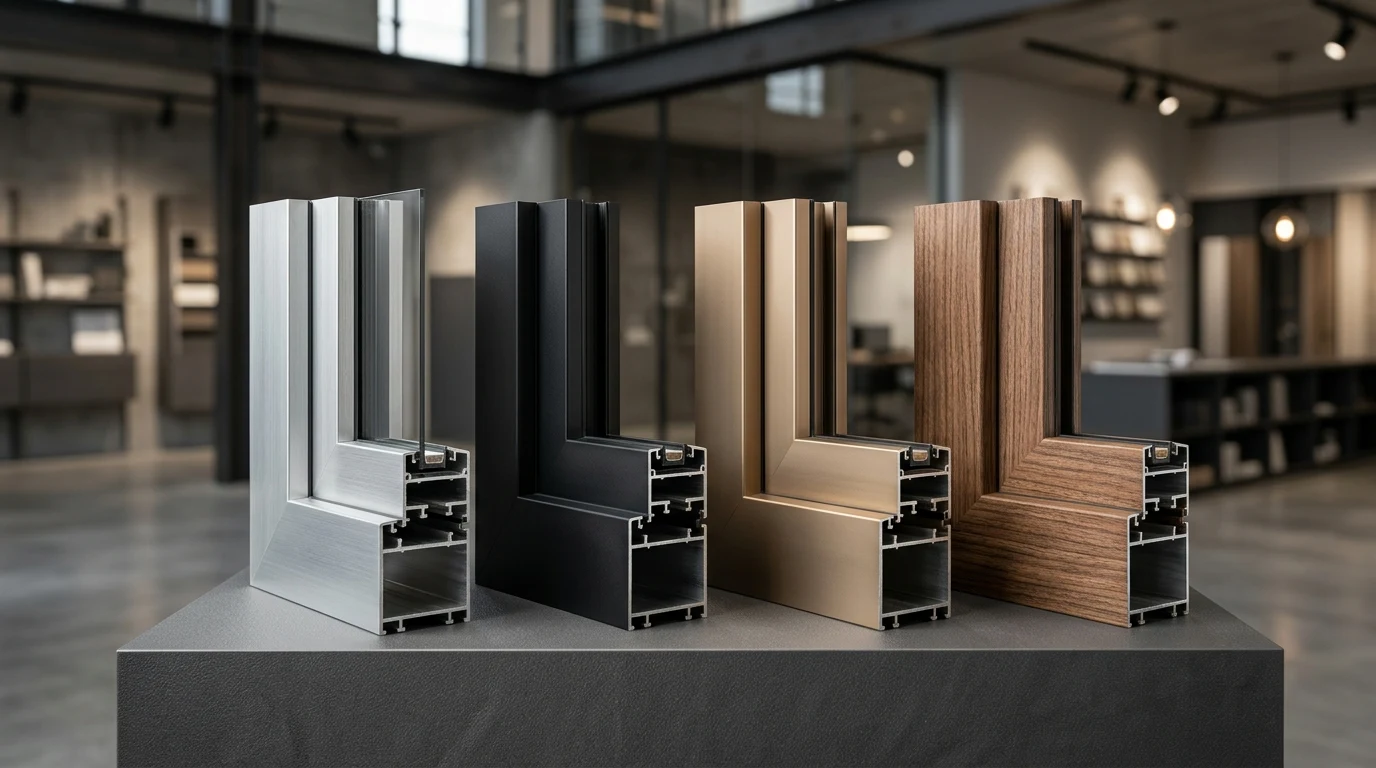
Raw extruded aluminium (mill finish) possesses exceptional natural strength and corrosion resistance thanks to a micro-thin, spontaneous aluminium oxide passivation film. However, in modern architectural facades, high-traffic commercial interiors, and luxury residential fenestration, raw mill finish aluminium is rarely deployed in visible installations. Unprotected mill finish is prone to atmospheric water spotting, handling fingerprint stains, alkaline cement splatters during masonry work, and surface oxidation.
To impart striking visual elegance, scratch resistance, UV color fastness, and 30+ year environmental durability, extruded aluminium undergoes advanced industrial surface finishing. Today, four dominant finishing technologies dominate the Indian architectural and industrial market:
- Architectural Anodizing (Electrolytic Oxide Growth)
- Electrostatic Powder Coating (Thermoset Polymer Deposition)
- PVDF / Fluoropolymer Liquid Coating (Kynar 500 / Hylar 5000)
- Sublimation Wood-Grain Finish (Vacuum Heat Transfer Timber Effect)
Selecting the wrong surface finish can result in catastrophic aesthetic failure—such as peeling coatings on coastal facades, premature color chalking under harsh UV rays, or surface corrosion from industrial pollution.
Curated by the surface finishing engineering team at Premier Aluminium Traders (authorized distributor of Jindal Aluminium Limited in Paharganj, New Delhi since 1978), this comprehensive engineering manual breaks down the chemical processes, durability metrics, performance benchmarks, and cost-per-kilogram economics of all four finishing treatments.
1. Architectural Anodizing: Electro-Chemical Molecular Integration
Unlike paint or powder coatings that sit as a separate layer on top of the metal, anodizing is an electrochemical conversion process that transforms the actual surface of the aluminium into an ultra-hard, porous aluminium oxide ($Al_2O_3$) ceramic matrix.
       [ Cathode (-) ]                 [ Anode (+) : Aluminium Extrusion ]
              |                                        |
              +--------> [ Dilute H2SO4 Bath ] <-------+
                                   |
                  Electrochemical Oxidation of Aluminium:
                     2Al + 3O^2-  ====>  Al2O3 + 6e-
The Process:
- Pre-Treatment: Caustic soda etch cleans and removes mechanical die lines, producing a uniform matte satin base.
- Electrolytic Bath: Extrusions are immersed in a temperature-controlled sulfuric acid ($H_2SO_4$) bath. An electric DC current drives oxygen ions into the metal, growing an organized honeycomb cellular oxide layer.
- Electrolytic Coloration: Metal salts (tin, cobalt, or copper) are electro-deposited into the porous honeycomb cells to produce light-fast architectural shades: Natural Silver, Champagne, Bronze, and Deep Black.
- Hydration Sealing: Submersion in boiling deionized water with nickel salts hydrates the oxide into boehmite, permanently sealing the pores against dirt and moisture.
Architectural Micron Thickness Grades (IS 1868 / AAMA 611):
- Grade AA 10 (10 – 14 microns): Interior partitions, modular kitchen profiles, indoor furniture.
- Grade AA 15 (15 – 19 microns): Standard exterior architectural windows, shopfronts, low-rise facades.
- Grade AA 25 (25+ microns): High-rise coastal elevations, industrial zones, extreme pollution environments.
Key Advantage: Will never peel, flake, chip, or blister because it is molecularly part of the aluminium substrate.
2. Electrostatic Powder Coating: Infinite Colors & Impact Toughness
Powder coating is a dry finishing process where finely ground particles of pigment and thermosetting polymer resins are electrostatically sprayed onto the aluminium section and cured in a high-temperature baking oven.
  [ Grounded Aluminium Profile ] <====== [ Negatively Charged Powder Spray (60-80 kV) ]
                |
                v
  [ Convection Curing Oven @ 180°C - 200°C for 15-20 mins ]
                |
                v
  [ Fully Cross-Linked, Homogeneous Polymer Film (60 - 80 µm DFT) ]
Polymer Chemistry Tiers:
- Standard Architectural Polyester (Qualicoat Class 1): Delivers 1 year South Florida UV weatherability. Ideal for interior partitions and standard residential windows.
- Super-Durable Polyester (Qualicoat Class 2): Engineered with advanced isophthalic resins delivering 3 years South Florida UV retention (~15-20 years in Indian conditions). Resists color fading and gloss loss under intense sunlight.
- Polyurethane Powders: Outstanding surface hardness, chemical resistance, and fine textured/hammered finishes.
Key Advantage: Infinite color versatility. Fabricators can select any shade from the international RAL Classic Color Chart in glossy, satin, matte, metallic, or micro-textured finishes.
3. PVDF Liquid Coating: The Undisputed Facade Heavyweight
PVDF (Polyvinylidene Fluoride), commonly marketed under brand names like Kynar 500® or Hylar 5000®, is a premium fluoropolymer resin liquid coating applied via automated multi-stage spray booths and baked at temperatures exceeding 240°C.
Carbon-Fluorine ($C-F$) Bond Strength:
The carbon-fluorine bond is one of the strongest single chemical bonds known to organic chemistry. This atomic bond requires colossal energy to break, making PVDF almost completely impervious to:
- High solar ultraviolet (UV) radiation
- Severe acid rain, sulfur dioxide ($SO_2$), and smog
- Marine salt spray and chloride corrosion
- Thermal degradation from continuous cyclic heat exposure
Coating Systems:
- 2-Coat PVDF (Primer + Topcoat, ~30 µm DFT): Standard high-rise architectural specification.
- 3-Coat / 4-Coat PVDF (Primer + Barrier Coat + Color Coat + Clear Fluoropolymer Barrier, ~45 µm DFT): Specified for monumental curtain walls, international airports, coastal skyscrapers, and corporate headquarters.
Key Advantage: Unrivaled color retention and chalk resistance warranted for 20 to 30+ years in the harshest outdoor conditions.
4. Sublimation Wood-Grain Finish: Nature's Warmth with Aluminium's Rigidity
Homeowners and architects frequently crave the warm, organic aesthetic of natural hardwood (Burma Teak, Walnut, European Oak) but reject wood’s vulnerability to termites, moisture warping, rotting, and constant polishing.
Wood-grain sublimation on aluminium extrusions solves this challenge permanently.
  [ Step 1: Base Powder Coat (Specially Formulated Polyurethane) ]
                      |
                      v
  [ Step 2: Vacuum Bagging with High-Definition Wood Pattern Film ]
                      |
                      v
  [ Step 3: Heat Sublimation Oven @ 200°C ]
    (Inks vaporize and molecularly penetrate the powder base matrix)
                      |
                      v
  [ Step 4: Film Stripped Off, Leaving Permanent 3D Textured Grain ]
The Sublimation Process:
- The aluminium extrusion is first coated with a specialized polyurethane base powder matching the timber undertone (golden brown, reddish mahogany, dark walnut).
- The section is wrapped in a thermo-transfer cellulose plastic film printed with high-resolution photographic wood grain patterns.
- Air is evacuated via a vacuum pump, forcing the film tightly against every intricate contour, groove, and corner of the profile.
- The assembly enters a curing oven at 200°C. Inks undergo sublimation—transitioning directly from solid to gas and penetrating deeply into the molten powder matrix.
- Once cooled, the film is peeled away, leaving a hyper-realistic, scratch-resistant, and tactile wood grain texture permanently baked into the profile.
5. Engineering Comparison Matrix: Durability, Performance & Costs
The table below provides an authoritative side-by-side technical comparison of all four architectural finishing methods:
| Performance Parameter | Architectural Anodizing (AA 20) | Powder Coating (Qualicoat Class 2) | PVDF Coating (3-Coat Kynar 500) | Wood Finish (Sublimation) |
|---|---|---|---|---|
| Coating Type | Integral $Al_2O_3$ Ceramic | Thermoset Polymer Film | Fluoropolymer Liquid Resin | Polyurethane Base + Sublimated Inks |
| Standard Film Thickness | 15 – 25 microns ($\mu m$) | 60 – 80 microns ($\mu m$) | 35 – 45 microns ($\mu m$) | 65 – 85 microns ($\mu m$) |
| Surface Hardness | 8 – 9 Mohs (Extremely Hard) | 2H – 3H Pencil Hardness | 2H – 3H Pencil Hardness | 2H – 3H Pencil Hardness |
| Scratch & Abrasion Resistance | Superior (Best in class) | Good | Moderate | Good |
| UV Resistance & Color Life | Excellent (Inorganic salts) | Very Good (Class 2 Super-durable) | Exceptional (30+ Years) | High (Class 2 grade base) |
| Corrosion / Salt Spray Life | 1,000 – 3,000 hrs (ASTM B117) | 1,000 – 2,000 hrs | 3,000 – 5,000+ hrs | 1,000 – 2,000 hrs |
| Aesthetic Palette | Metallic (Silver, Bronze, Black) | Infinite Solid & Metallic RAL Shades | Solid, Metallic & Pearlescent Shades | Authentic Hardwood Textures |
| Will It Ever Peel or Flake? | Never (Integral to metal) | Only if pre-treatment fails | Rare if applied correctly | Rare if applied correctly |
| Indicative Surface Jobwork Cost | ₹45 – ₹70 / kg | ₹40 – ₹65 / kg | ₹110 – ₹180 / kg | ₹90 – ₹140 / kg |
6. Sourcing Finished Jindal Profiles in Delhi NCR: The Premier Advantage
The ultimate durability of any surface finish is determined 80% by the pre-treatment quality (degreasing, deoxidation, chromatizing/nano-passivation) and the purity of the underlying aluminium billet. Applying powder coating or anodizing over cheap scrap re-melted extrusions causes blistering, poor film adhesion, and rapid filiform corrosion.
At Premier Aluminium Traders, we guarantee:
- 100% Jindal Genuine Primary Billets: Extrusions feature uniform grain structure and minimal iron impurities, ensuring crystal-clear anodizing and flawless coating adhesion.
- Qualicoat-Compliant Multi-Stage Pre-Treatment: High-tech automated dip/spray tunnels utilizing nano-zirconium or chrome-free passivation for unmatched salt-spray resistance.
- Certified Dry Film Thickness (DFT): Every batch is verified using magnetic/eddy-current thickness gauges, cross-hatch adhesion tape testing (ASTM D3359), and impact resistance testing.
- Extensive Color Inventory: Immediate availability of Natural Anodized Silver, Matte Black, Champagne Bronze, and popular architectural RAL shades (RAL 7016 Anthracite Grey, RAL 9010 Pure White, RAL 9005 Jet Black) in our central Paharganj facility.
7. Frequently Asked Questions (FAQs)
1. Which finish lasts longer outdoors: Anodizing or Powder Coating?
In harsh sunlight and high abrasion environments, high-grade architectural anodizing (20 to 25 microns) lasts exceptionally well because the ceramic oxide layer is chemically integrated with the aluminium and cannot peel. However, for sheer color diversity, deep matte aesthetics, and protection against alkaline concrete splashes during building construction, modern Super-Durable powder coatings (Qualicoat Class 2) offer comparable longevity (15 to 25 years).
2. Does wood-finish aluminium fade in direct sunlight?
High-quality wood finish profiles produced via vacuum sublimation with UV-stabilized exterior inks and super-durable polyurethane base powders resist fading for 10 to 15+ years in Indian sunlight. Inferior wood grain transfers using cheap interior dyes will fade or yellow within 2 to 3 years.
3. Why is PVDF coating more expensive than standard powder coating?
PVDF resins utilize fluoropolymer compounds (Kynar 500) that require expensive raw chemical synthesis, multi-coat automated liquid spraying (primer + color + clear coat), and very high oven baking temperatures (240°C+). However, for commercial high-rise curtain walls, PVDF’s 30-year maintenance-free lifespan makes it far cheaper over the building lifecycle.
4. What is the minimum recommended anodizing thickness for windows in Delhi NCR?
For Delhi NCR’s urban-industrial environment with high particulate matter and seasonal temperature swings, a minimum of 15 microns (Grade AA 15) is recommended. For prominent street-facing elevations or industrial zones, 20 to 25 microns (Grade AA 20 / AA 25) provides superior scratch and pollutant resistance.
5. How do I clean and maintain finished aluminium extrusions?
Clean anodized and powder-coated sections using a soft micro-fiber cloth with lukewarm water and a neutral pH detergent (e.g., mild dishwashing soap). Never use abrasive scouring pads, strong acid wash, caustic alkaline agents, or hydrocarbon solvents, as these can strip or etch the protective finish.
8. Surface Consultation & B2B Procurement Desk
Unsure which surface finish matches your architectural specifications, environmental exposure, or project budget? Consult with the metal finishing specialists at Premier Aluminium Traders before issuing your tender BOQ.
Why Choose Premier Aluminium Traders?
- Authorized Jindal Aluminium Stockist Since 1978: Guaranteed primary metal quality and die precision.
- Full Spectrum Finishing Solutions: Mill finish, architectural anodizing, Qualicoat powder coating, PVDF, and wood-finish sublimation.
- Rigorous Quality Testing: Adhesion, thickness, and hardness verification on every batch.
- Fast Regional Supply Chain: Serving architects, fabricators, and contractors across Delhi NCR, Haryana, Rajasthan, Uttar Pradesh, and all India.
Contact Our Surface Engineering Team Today:
- Showroom & Central Warehouse: Premier Aluminium Traders, 3/8, D.B. Gupta Road, Paharganj, New Delhi - 110055
- Phone / WhatsApp: +91-9891097111 / 011-41657680
- Email: premieraluminiumtraders@gmail.com
- Explore Extrusion Offerings: Jindal Aluminium Extrusions
- Submit Your Finish Specifications: Get an Instant B2B Surface Quotation