Blog
Aluminium Solar Mounting Structures: Extrusion Profiles, Wind-Load Standards & 6063-T6 Sourcing Guide
India is currently witnessing an unprecedented revolution in renewable energy. Driven by aggressive national targets, expanding industrial captive power adoption, and marquee government schemes such as the PM Surya Ghar: Muft Bijli Yojana, millions of residential rooftops and commercial industrial sheds are being transformed into clean power plants.
However, behind every high-efficiency photovoltaic (PV) module lies a silent, foundational engineering asset: the solar mounting structure (SMS). While solar panels are warranted for 25 to 30 years of continuous outdoor exposure, the entire capital asset is only as dependable as the racking system anchoring it against torrential monsoon rains, cyclonic wind gusts, and corrosive atmospheric pollution.
Across India's solar engineering sector, extruded aluminium profiles (Alloy 6063-T6 / 6005-T5) manufactured by Jindal Aluminium Limited have decisively overtaken conventional Hot-Dip Galvanized (HDG) steel as the gold standard for rooftop and commercial solar installations.
Curated by the structural materials division at Premier Aluminium Traders (authorized distributor of Jindal Aluminium Limited in Paharganj, New Delhi since 1978), this technical engineering manual provides solar EPCs and installers with a comprehensive guide to solar extrusion profiles, wind-load compliance (IS 875 Part 3), galvanic isolation, anodizing standards, and wholesale procurement in North India.
1. Why Extruded Aluminium Outperforms Galvanized Steel for Solar Racking
Historically, ground-mounted and utility-scale solar farms relied heavily on hot-dip galvanized (HDG) mild steel or pre-galvanized cold-formed C/Z channels due to initial raw material cost per metric ton. However, for rooftop solar—especially on RCC roofs, tin sheds, and industrial standing seam metal roofs—extruded aluminium is mathematically and economically superior.
| Engineering Factor | Extruded Aluminium (6063-T6 / 6005-T5) | Hot-Dip Galvanized Mild Steel (HDG) |
|---|---|---|
| Material Density | $\approx 2.70\text{ }g/cm^3$ (Ultra-lightweight) | $\approx 7.85\text{ }g/cm^3$ (2.9x heavier) |
| Structural Dead Load on Roof | Minimal ($4 - 7\text{ }kg/m^2$ overall array weight) | High ($12 - 18\text{ }kg/m^2$, risks roof slab fatigue) |
| Corrosion Resistance | Self-healing oxide film + 15µ architectural anodizing | Zinc sacrificial barrier; rusts once zinc wears out |
| Installation Speed & On-site Work | Pre-slotted snap-in channels; Zero site welding/drilling | Heavy, requires on-site drilling/welding (damages zinc) |
| Lifecycle Durability | 30+ years maintenance-free | 8 – 15 years in polluted urban/coastal air |
| End-of-Life Residual Value | High scrap value (~80–85% of primary metal) | Low scrap value (~15–20% of original cost) |
| Dimensional Tolerance | Extruded to $\pm 0.15\text{ }mm$ precision | Roll-formed with higher geometric variations |
The Rooftop Dead-Load Advantage:
On older commercial buildings and industrial pre-engineered buildings (PEBs), roof structural load reserves are stringently limited. Imposing heavy galvanized steel trusses can violate municipal structural safety norms or cause metal roof sheet sagging. Extruded aluminium structures reduce structural dead load by over 60%, preserving the building's structural integrity while making rooftop material hoisting fast, safe, and manual-crane-free.
2. Anatomical Breakdown of Extruded Aluminium Solar Components
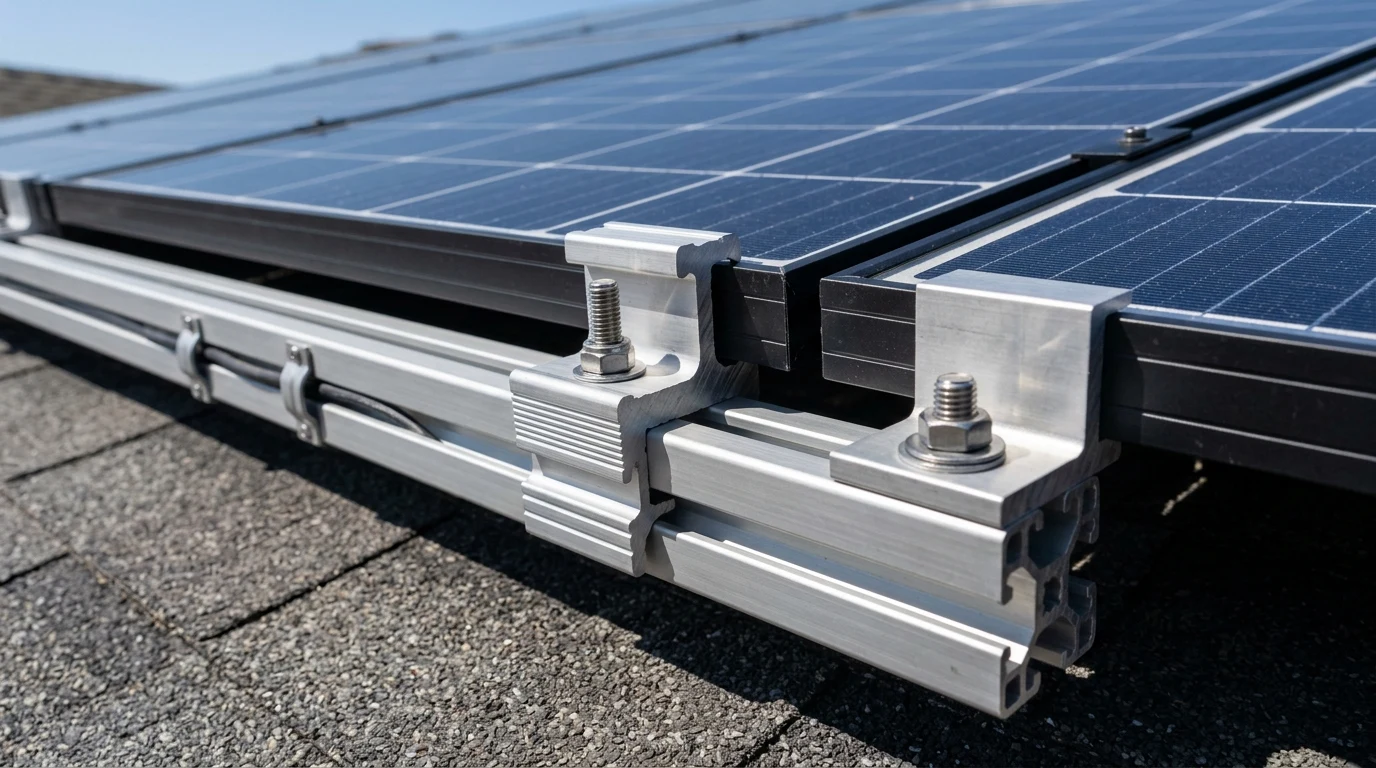
A robust aluminium solar mounting structure is an engineered ecosystem of specialized extruded profiles and precision fasteners:
          [ Solar PV Module (550W+ Bifacial) ]
             |                             |
      [ End Clamp ]                  [ Mid Clamp ]
             |                             |
     +---------------------------------------------+
     |   Universal Aluminium Base Rail (Guide Bar) |
     +---------------------------------------------+
             |                             |
     [ Rail Splice ]                [ L-Feet Bracket ]
                                           |
                                [ EPDM Waterproof Pad ]
                                           |
                                [ Roof Purlin / Fastener ]
1. Solar Mounting Base Rails (Guide Channels)
The primary load-bearing horizontal members running beneath the panels. Jindal manufactures specialized solar rails featuring:
- Top T-Slot Channels: Engineered to capture spring-loaded roll-in nuts or quick-turn hammer nuts for securing clamps without dropping loose hardware.
- Side Mounting Slots: Allows horizontal attachment to L-feet, tile hooks, or triangle tilt legs at variable heights.
- Internal Splice Cavities: Enables seamless joining of rail lengths using internal slide-in splice connectors with self-tapping hex screws, maintaining structural inertia across multi-module strings.
2. Solar Mid Clamps (Inter-Module Clamps)
Extruded aluminium U/T-profile sections placed between adjacent solar modules. Mid clamps maintain a uniform 15mm to 20mm thermal expansion gap between panels and distribute clamping pressure evenly across anodized module frames without cracking the photovoltaic glass laminate.
3. Solar End Clamps (Terminal Clamps)
Extruded Z-profile sections that grip the outer terminal edges of the first and last solar modules in a string. Designed to match standard module frame heights (30mm, 35mm, and 40mm).
4. L-Feet Brackets & Standing Seam Clamps
Engineered heavy-duty right-angle extrusions (typically 6mm to 8mm base thickness) with slotted vertical holes for height adjustment. Paired with UV-resistant EPDM rubber pads to guarantee 100% watertight roof screw penetrations. For industrial trapezoidal or standing seam sheet roofs, specialized non-penetrating seam clamps (Kliplok profiles) preserve factory warranties by eliminating drilling entirely.
5. Walkway & Maintenance Profiles
Non-slip extruded aluminium grating profiles installed alongside rooftop solar arrays to allow safe O&M (operation and maintenance) washing crews to traverse the array without stepping on delicate solar glass cells.
3. Structural Wind-Load Compliance per IS 875 (Part 3)
India encompasses diverse wind zones, ranging from Zone II ($33\text{ }m/s$ or $118\text{ }km/h$) in Central India to Zone IV ($47\text{ }m/s$ or $170\text{ }km/h$) and Zone VI ($55\text{ }m/s$ or $200\text{ }km/h$) across coastal Odisha, Gujarat, and high-altitude areas.
Under IS 875 (Part 3: Wind Loads on Buildings and Structures), rooftop solar structures act as low-profile aerodynamic canopies subject to severe aerodynamic uplift forces caused by wind suction over building parapets:
$$\text{Design Wind Pressure: } P_d = 0.6 \times V_z^2$$
Where $V_z$ is the design wind velocity modified by risk coefficients ($k_1$), terrain roughness ($k_2$), and topography ($k_3$).
Engineering Safeguards in Jindal Solar Rails:
- Section Modulus ($Z_x, Z_y$): Jindal solar rails are engineered with optimized material distribution in the upper and lower flanges, maximizing the section modulus while keeping weight between $0.75 - 1.25\text{ }kg/m$.
- Deflection Limits: Under peak gust loads, structural deflection is strictly capped at $L/180$ to prevent micro-cracks in fragile silicon solar wafers.
- High-Tensile Alloy Temper: Utilizing genuine T6 temper ensures a minimum 0.2% Proof Stress of 170 MPa, preventing permanent plastic deformation under hurricane-force uplift.
4. Metallurgical Specifications: Why Alloy 6063-T6 & 6005-T5 Are Mandatory
Using uncertified commercial aluminium or local scrap extrusions for solar racking is a catastrophic liability. Inferior alloys lack adequate magnesium-silicide hardening, leading to stripped fastener threads, rail sagging, and clamp shear failure.
| Metallurgical Property | Architectural Grade 6063-T6 | Structural Grade 6005-T5 / 6082-T6 | Sub-Standard Commercial Scrap |
|---|---|---|---|
| Indian Standard | IS: 733 / IS: 1285 | IS: 733 | No Certification |
| Ultimate Tensile Strength (UTS) | $\ge 205\text{ }MPa$ | $\ge 260\text{ }MPa$ | Irregular ($120 - 150\text{ }MPa$) |
| 0.2% Proof Stress (Yield) | $\ge 170\text{ }MPa$ | $\ge 240\text{ }MPa$ | $< 90\text{ }MPa$ (Soft) |
| Elongation at Break ($A_{50mm}$) | $\ge 8%$ | $\ge 8%$ | Brittle ($< 3%$) |
| Webster Hardness | 12 – 14 HW | 15 – 17 HW | $< 8\text{ }HW$ (Easily deformed) |
| Primary Billet Purity | $\ge 99.7%$ Primary Ingot | $\ge 99.5%$ Primary Ingot | High Iron/Zinc Contamination |
At Premier Aluminium Traders, all solar extrusion inventory is sourced directly from Jindal Aluminium Limited, cast strictly from genuine primary electrolytic bauxite billets with zero post-consumer scrap contamination.
5. Anodizing Standards for 25-Year Outdoor Solar Lifespan
Solar arrays endure 8,000+ hours of annual outdoor exposure under blazing solar UV, cyclic monsoon acid rain, and urban smog (elevated $SO_x$ and $NO_x$).
Mandatory Anodizing Benchmark:
- Minimum 15 Microns ($\mu m$) Clear Anodizing: Natural silver anodized finish per IS 1868 / AAMA 611 Class II standards.
- Electrolytic Acid Bath Sealing: Hot demineralized water nickel fluoride sealing ensures complete closure of porous aluminium oxide honeycomb cells, passing the Acid Dissolution Test (ISO 3210).
- Galvanic Corrosion Prevention: When securing aluminium rails to steel purlins or using Stainless Steel (SS 304 / SS 316) bolts, the 15µ non-conductive anodic oxide layer acts as a dielectric barrier, preventing catastrophic galvanic corrosion between dissimilar metals.
6. Sourcing Genuine Jindal Solar Profiles at Premier Aluminium Traders
As North India’s premier authorized dealer of Jindal Aluminium Limited, Premier Aluminium Traders maintains a dedicated renewable energy inventory desk:
- Massive Ready Inventory in Delhi: Thousands of meters of standard solar rails (short rails, standard 3.2m, 4.2m, and 6.4m lengths), universal mid-clamps, end-clamps, and triangle tilt angles ready for immediate dispatch.
- Custom Extrusion Tooling: Access to over 8,000+ Jindal extrusion dies. For multi-megawatt EPC tenders requiring proprietary rail profiles or integrated cable-management channels, we facilitate fast-track custom die development and bulk delivery.
- In-House Cut-to-Length & CNC Punching: Pre-cut, pre-drilled, and slotted kits delivered directly to solar job sites across Haryana, Rajasthan, Uttar Pradesh, and Delhi NCR, saving valuable on-site labor hours.
- Mill Test Certificate (MTC) Guarantee: Authenticated batch test reports supplied with every dispatch, satisfying stringent quality audit protocols for bankable solar project financing.
7. Frequently Asked Questions (FAQs)
1. Why is aluminium preferred over galvanized steel for rooftop solar?
Aluminium is nearly three times lighter than steel, drastically reducing roof dead load. Furthermore, aluminium naturally generates a protective oxide layer and is anodized to 15 microns, ensuring 25+ years of rust-free operation without needing maintenance painting.
2. Which alloy is recommended for solar mounting rails: 6063-T6 or 6082-T6?
Alloy 6063-T6 is the industry standard for rooftop solar rails, providing the perfect balance of yield strength (170 MPa), corrosion resistance, and extrusion precision. For large-span ground mount solar structures or heavy industrial purlins spanning over 2.5 meters between supports, high-strength 6082-T6 or 6005-T5 is specified for its higher proof stress (240 MPa).
3. How do I prevent galvanic corrosion between SS 304 fasteners and aluminium rails?
Galvanic reaction is prevented by specifying 15-micron anodized aluminium rails, which provide an electrically insulating barrier. In critical heavy-saline environments, non-conductive EPDM or nylon isolation washers can be paired with the stainless steel hardware.
4. What is the standard weight of an aluminium solar rail profile?
Standard rooftop solar rail weights typically range from 0.78 kg to 1.15 kg per running meter, depending on the profile height (typically 40mm to 55mm) and internal web thickness (1.2mm to 1.8mm).
5. Can Premier Aluminium Traders supply solar profiles for large-format 550W–650W bifacial modules?
Yes. We supply heavy-duty reinforced rail profiles and extra-wide mid/end clamps engineered specifically to accommodate the larger spans, heavier glass weights (dual-glass bifacial), and higher wind load pressures of modern 550W+ Tier-1 solar modules.
8. Solar Structural Procurement & Engineering Desk
Are you an EPC contractor, solar installer, or industrial developer bidding on a rooftop or commercial solar plant? Ensure your mounting systems withstand 25 years of outdoor exposure with genuine Jindal Aluminium extrusions.
Partner with Premier Aluminium Traders:
- Direct Authorized Stockist: Direct supply chain from Jindal Aluminium Limited since 1978.
- Complete Mounting System Kits: Ready stock of rails, clamps, L-feet, splices, and hardware.
- Factory Pricing: Competitive B2B pricing linked to primary aluminium market benchmarks.
- Rapid Site Delivery: Same-day loading for Delhi NCR and expedited logistics across North India.
Contact Our Renewable Energy Sourcing Desk Today:
- Central Warehouse: Premier Aluminium Traders, 3/8, D.B. Gupta Road, Paharganj, New Delhi - 110055
- Phone / WhatsApp: +91-9891097111 / 011-41657680
- Email: premieraluminiumtraders@gmail.com
- Product Information: View Jindal Solar Extrusions
- Submit Your Solar BOQ: Request an Instant Wholesale Quotation